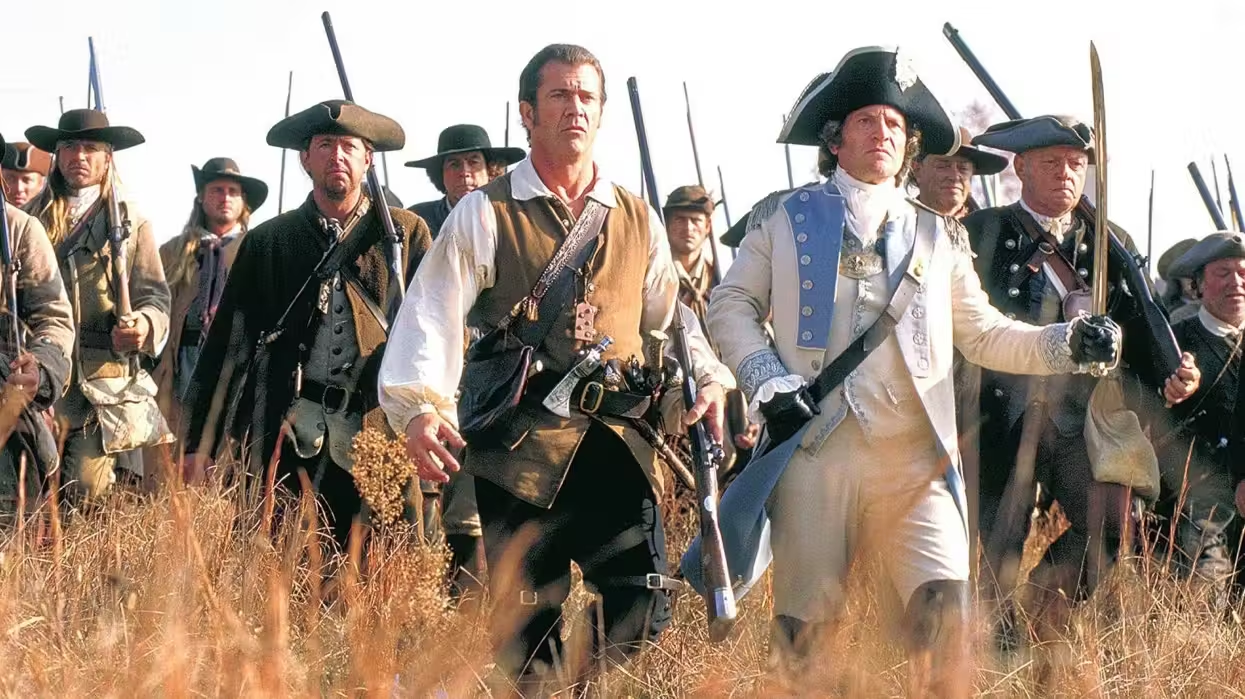
When I was a baby history nerd, I had a pretty big obsession with The Patriot. It’s a violent war epic I was somehow allowed to watch, probably because it was so inspiring. Plus, it has one of the best John Williams scores, a fact I think a lot of people forget.
Roland Emmerich's 2000 Revolutionary War film was written by Robert Rodat. It follows Benjamin Martin (Mel Gibson) as he goes from reluctant farmer to militia leader after his family is torn apart by the British.
This year, the line that stuck with me doesn’t belong to Gibson or even Heath Ledger, who played his son Gabriel. It belongs to a small-town preacher nobody in the pews saw as a fighter.
"A shepherd must tend his flock. And at times... fight off the wolves."
Let’s dive in.
- YouTubewww.youtube.com
The Scene
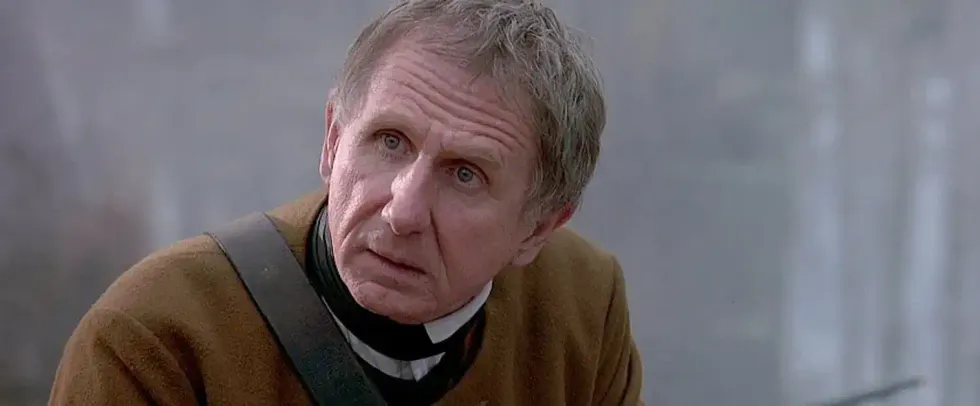
Gabriel has just visited a small town, where a congregation is already suffering. They have had members of their community recently hanged by the British. Gabriel enters the church and asks for any able-bodied man to join their militia. Reverend Oliver, played by René Auberjonois, is resistant to even letting Gabriel speak, insisting that this is not the right time or the right cause.
But Gabriel’s beau, Anne Howard (Lisa Brenner), gives an impassioned speech that spurs the men to action.
Shortly after, outside, the men join Gabriel and bid their families farewell. Suddenly, Reverend Oliver walks by with his musket to join them, too. Anne’s father calls out to him.
The reverend turns, pulls off his powdered wig, swaps it for a plain black hat, and tells them why he's leaving to fight.
"A shepherd must tend his flock. And at times... fight off the wolves."
The people watching him have spent years hearing him preach. A few scenes earlier, he was the one clutching his pearls. Watching him choose a gun instead of the pulpit tells the audience what this war is about to cost these characters.
A Reluctant Fighter
Auberjonois plays Oliver as soft for most of the film's first act. He’s a little fussy, easily rattled, more comic relief than combatant. Nothing really sets him up as a fighter.
The other militiamen even tease him, at one point joking that they’ll eat the Great Danes they’ve plundered from the British. The reverend is appropriately shocked. (Of course they don’t eat the dogs.)
The point is, he’s the guy you wouldn’t pick as a fighter. So when he tells his flock that protecting them was never a separate job from caring for them, it doesn't play like a line. It plays like a man saying out loud what he already knows he has to do.
It’s a pretty good reminder on a weekend built around fireworks and cookouts, because the holiday can flatten freedom as an idea if we let it.
It’s Anne who calls for the men to be patriots. Reverend Oliver steps up, but he doesn't mention liberty. He talks about duty and about the people counting on him. Responsibility drives him as a motivation.
He remains a spiritual guide for the men as well as a militiaman, offering them comfort and leadership at difficult moments, including when they’re later captured and nearly hanged.
- YouTubewww.youtube.com
The Musket Toss
Reverend Oliver’s line pays off later, when Oliver is shot by Colonel Tavington (Jason Isaacs) during a raid on the British officer’s camp.
Gabriel, with some of the men, fights Tavington in a surprise attack. The men have just learned that Tavington has killed many of their families by locking them in their church and setting it on fire. Anne is one of the victims.
So it makes sense that the reverend, despite his quiet nature, joins Gabriel in this attack. In the violence, he stands off against Tavington, both racing to load their guns. But then the reverend notices that Gabriel is in trouble and rushes to help him. The moment allows Tavington time to finish loading and shoot the reverend.
In his last seconds, Oliver throws his loaded musket up to Gabriel so someone can keep fighting.
Oliver tended his flock until the bloody end.
 The Patriot Credit: Columbia Pictures
Screenwriting Research
Rodat studied history at Colgate University before earning an MBA at Harvard and an MFA in film at USC. That academic streak carried into his process.
A profile from Screenwriting from Iowa notes that Rodat's research for historical scripts runs to roughly 30 books, along with journals and letters, before he starts writing. He told the New York Post (via Screenwriting from Iowa):
“What interests me right now is big-canvas stories told from an intimate perspective. I like to find one small story within the larger picture and use that—not as a microcosm, but as an illustration. I don’t claim that Benjamin Martin, my main character in The Patriot, says everything there is to say about the American Revolution. But the goal is to have one small, emotional, and dramatic story about a complex character—with a matrix of people around him [who can transport] the audience to a different world and time.”
You can feel that groundwork in how Reverend Oliver is built. He isn't dropped in to deliver moral commentary from the sidelines. He's written as an ordinary Colonial townsperson, educated (a little more uptight), but no more protected from the war than anyone else in his parish, which is why his arc feels earned.
Plant the Belief, Then Pay It Off Physically
If you’re a writer, there’s something to take from Oliver if you're building a character of your own. You can have them state what they believe early, before the story has tested it. Then, at the hardest moment, give them a physical action that proves it.
We looked at this same structure in Kirk's line about death in Star Trek II, and in the callback that closes out Top Gun. Oliver tells his congregation that he'll fight off wolves when he has to. Later, in his dying moments, he throws the gun.
Earning a theme means you plant it, then pay it off through action instead of dialogue. It's why Oliver's death lands harder than most secondary characters get to here.
Auberjonois died in 2019. Reverend Oliver is still one of the quieter, sharper performances in a film mostly remembered for its bigger set-pieces. If The Patriot is playing in the background this weekend, watch for the moment his wig comes off. It’s a turning point for that character and a touching, inspiring beat.