The ‘Schindler’s List’ Line That Captured The Struggle For Survival
Fear of death lingers beneath this quiet Schindler’s List line.
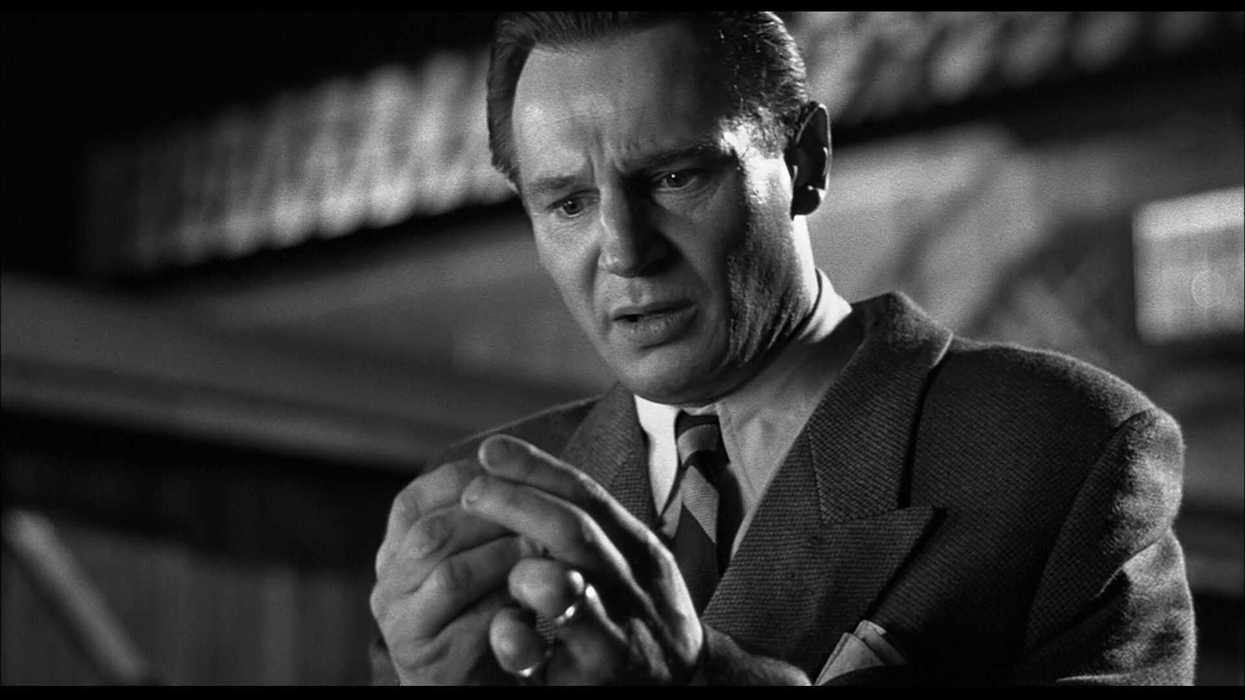
'Schindler's List' (1993)
In Steven Spielberg’s Schindler’s List (1993), which takes place in the traumatizing shadows of the Holocaust, death lingers in every corner, and one fleeting line perfectly crystallizes the desperation to survive.
“They say that no one dies here,” is one of the most painful moments from the film, which isn’t short of them. A Jewish woman’s agonizing request to save her elderly parents from mass killings tells us everything we need to know about the fragility of hope and the shocking arbitrariness behind ending a human life.
What makes this line so powerful? And what can we learn from it?
Let’s jump right in.
Context Of The Scene
Before we get into the specifics of the line itself and why it works so well, let’s remind ourselves of the context of the scene. By the time this scene takes place, Jewish families are being displaced in large numbers, and they are reassigned through violent and often random Nazi decision-making.
Oskar Schindler (Liam Neeson) is still regarded as a businessman by the people around him. He uses inexpensive Jewish labor to keep his factory profitable and himself safe. However, because he employed Jewish people, his factory is beginning to be known as a haven, a place where Jews are less likely to disappear or die.
The woman, Regina Perlman, who approaches Schindler, uses the name Elsa Krause and dresses elegantly to gain access to his office. She is desperate to rescue her elderly parents from the Płaszów concentration camp, which is under the extremely dangerous Amon Göth (Ralph Fiennes). At the Płaszów camp, elderly Jews are being recklessly killed and buried in forests. Regina pleads with Schindler to employ her parents in his factory and save them from being murdered by Göth and his people. Schindler initially rebuffs her request and insists that he only hires people based on their skills. He even threatens to have her arrested if she doesn’t stop persisting.
For Schindler, his factory is a regular profit-making business, essential for maintaining good relations with his superiors. For Regina, the factory is probably the only way to save her parents from being murdered needlessly. Her request isn’t an ordinary one; it is the only lifeline she sees for her parents.
When Survival Clings Hangs On A Rumor
The brilliance of this scene lies in the fact that the very idea of survival hinges on hearsay, and not certainty. Regina Perlman’s desperation to save her parents makes her find hope in a rumor. We also have to consider the fact that Regina risks her life even by visiting Schindler’s office.
In the darkness of the Holocaust, even the slightest act of humanity can bear tremendous meaning. Perhaps that is precisely why Regina has faith in the rumor. While Amon Göth continually kills men and women based on a whim, the stories of Oskar Schindler’s factory and his employment of Jewish labor travel through whispers.
At this point, the purpose behind Schindler’s factory is still business-related, at least for the most part. But Regina sees hope in that, simply because of how distinct his employment strategy is.
“They say that no one dies here” - encapsulates the sheer desperation for survival, a time when those fighting for their lives would cling to virtually any glimmer of hope, even if it were a mere rumor. It’s important to understand that this line is not meant to flatter. It is more of a plea than a statement made to polish Schindler’s ego. After saying these words, Regina does not continue praising the businessman; she quickly gets to the point by mentioning her real name and telling him what she is actually in his office for.
When Regina talks about the factory being a haven, Schindler is forced to confront the fact that his opportunism might actually be an accidental sanctuary of survival. He does not immediately pivot to this viewpoint, but his discussion with Itzhak Stern (Ben Kingsley) shortly after this speaks of a rising internal conflict.
When a rumor can be the difference between life and death, the value in its exploration cannot be overstated, and this line proves precisely that.
3 Lessons From This Line
Here are three lessons to take away from the line, “They say that no one dies here.”
Belief Matters More Than A Rumor
The strength of Regina Perlman’s belief in Oskar Schindler’s factory being a haven makes this scene more about faith than about the rumor. Hypothetically, if the movie did not progress towards Schindler’s rescue attempts, the scene would still hold significance because Regina relentlessly believed in something that could have been far from certain and could also risk her life.
Fear In The Literal
Regina does not have to announce her fear at any point in this scene. The deepest, most agonizing sense of fear hangs beneath her sheer realism behind her words. By stating facts about the killings of the elderly, for example, Regina makes us experience terror and fear without actually describing her own or her parents’ state of mind.
Subtext Over The Explicit:
Regina’s dialogue focuses on the terror Jewish people face as a whole. She does not make it just about herself or her parents. She exercises restraint by invoking a collective plea for safety. This forces the audience to confront the overwhelming horror that isn’t specific to any wrongdoing or crime. The implication of what’s left unsaid makes the scene deeper and more painful.
Final Thoughts
In the darkness of the Holocaust, as depicted in Steven Spielberg’s Schindler’s List, Regina Perlman’s trembling line - “They say that no one dies here,” serves as a painful reminder of the struggle for survival. It is a testament to human perseverance, endurance, and the power of faith.
Which, according to you, is the strongest scene in Schindler’s List? Tell us in the comments.