The VHS Movies Millennials Grew Up Wearing Out
Take a trip down memory lane and get inspired by these classics.
'Who Framed Roger Rabbit'
If you grew up in the late '80s or early '90s, you know the feeling of looking through your movie collection, picking up one of those clunky cases or slipcovers, and shoving a tape into a player. And the tracking issues. Or the wait for the rewind.
But there was something magical about the whole process, then sitting down to enjoy your favorites at home. You know the movies that did that to you and are now lodged somewhere permanent. What's easy to miss now, behind all the nostalgia, is how hard their filmmakers were fighting for them. We want to reflect on a few.
Other films belong on any honest version of this list—Rock-A-Doodle, Hocus Pocus, The Sandlot. And obviously, a lot of millennials were Disney kids, but we can't put every movie from the Disney Renaissance on here. We know that The Little Mermaid and Beauty and the Beast and Aladdin are masterpieces. Consider these five a starting point.
Let's dive in. And don't forget to be kind, rewind.
- YouTube www.youtube.com
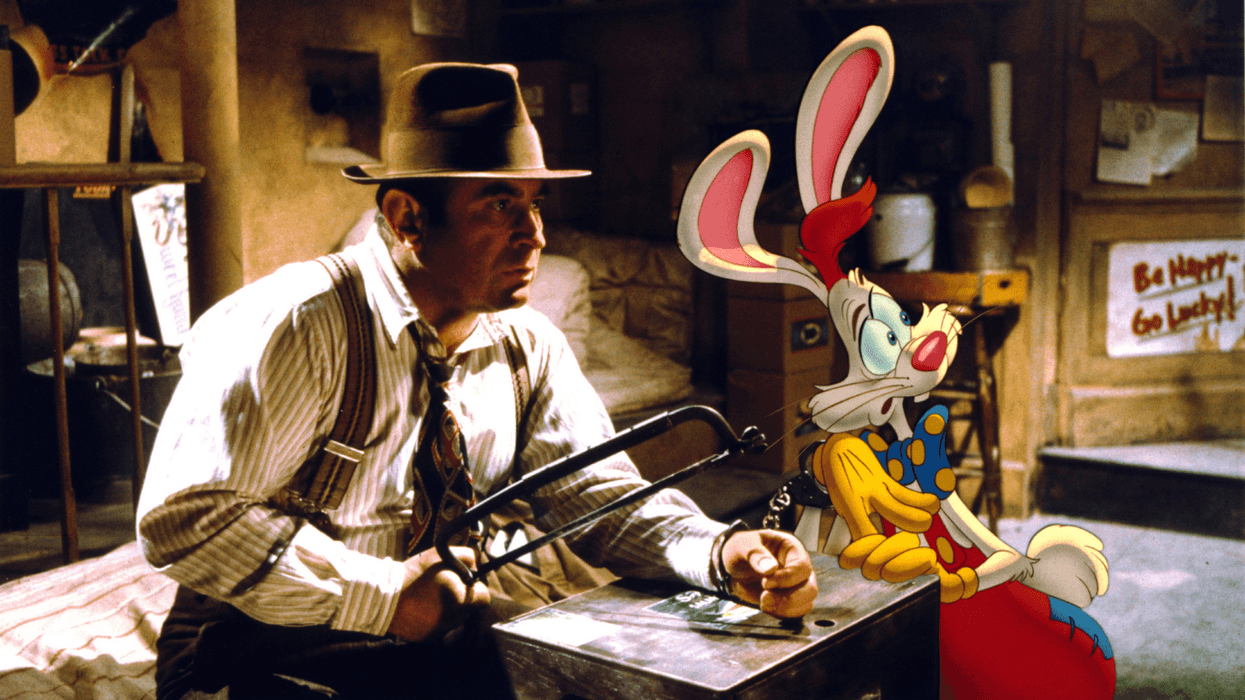
Who Framed Roger Rabbit
This is a miracle of a movie, and probably one that a lot of little kids technically shouldn't have been watching yet. But it's fine, we all turned out okay.
Robert Zemeckis' hybrid live-action/animation film remains one of the most technically audacious movies ever made, and we've previously covered how the crew pulled off its physical comedy through puppetry and engineering.
What drove the whole effort was Zemeckis' conviction that he was making a film for adults, not children. He said as much on the Happy Sad Confused podcast (via The Hollywood Reporter).
“Then, I kept saying, and I sincerely say this, and I do believe this, and I say, ‘I’m making Roger Rabbit the way I believe Walt Disney would have made it.' And the reason I say that is because Walt Disney never made any of his movies for children. He always made them for adults. And that’s what I decided to do with Roger Rabbit.”
That intention is all over the film. It's a noir dressed up in visual gags, a Toontown parable about segregation and corporate greed as well as inside Hollywood bits that kids didn't have to understand to enjoy, because Roger and the toons were so dang funny.
Zemeckis has since said the current Disney would never greenlight it today. Companies are much too precious with their IP to allow any of their characters to have the amount of fun they did in this wild, wacky noir.
- YouTube www.youtube.com
The Land Before Time
This is the one that broke every child's heart. Don Bluth's dinosaur migration story came out the same year as Roger Rabbit, and the two films couldn't occupy more different emotional territory. Where Zemeckis was working in neo-noir, Bluth was making something closer to Bambi.
As we've covered before, the film's making was a constant tug-of-war over just how dark it could go. The central fight was over the T. rex attack sequences. Bluth told Animation World Network, "When I showed Steven Spielberg a completed version of The Land Before Time, he told me, 'The T. rex is too scary. I don't want to see mothers in the lobby with crying children.' So, we cut some of it out. But I think it weakened it. A story is only as strong as your villain, and I still believe in telling children that life is going to be a struggle and it will be hard, but something good will always come to rescue you."
The film still works despite the cuts. What Bluth understood was that emotional stakes have to be real rather than implied.
- YouTube www.youtube.com
Homeward Bound: The Incredible Journey
What was it with all these dramas traumatizing young audiences?
Duwayne Dunham had edited Return of the Jedi and Blue Velvet before Disney handed him his feature directorial debut, a remake of the 1963 film The Incredible Journey, about two dogs and a cat crossing the Sierra Nevada to find their family.
The animals were shot largely separately for safety reasons. Dunham's editing background was what allowed him to build convincing interactions in post. The voice cast included Michael J. Fox, Sally Field, and Don Ameche.
Dunham told Eye For Film about one of the film's biggest challenges.
"Outside of just getting the movie made, the biggest challenge was probably the music—it was the question of what is the right music? It has got to be playful, and yet it goes deadly serious at times. It was important that we create a sense of place, and music was part of that place."
Dunham also fought the studio to keep a scene where a 13-year-old boy cries to his mother. The studio's position, as actor Benj Thall later recalled, was that a boy wouldn't do that. Dunham's position was that a human being would. He won.
- YouTube www.youtube.com
Free Willy
If there's anything millennials love, it's a movie about a friendly animal.
Simon Wincer came on board Free Willy as a replacement director after the original filmmaker couldn't get the script to hold together. His first move was practical. Fix the script, then get to Mexico to meet the whale.
That whale was Keiko, a 12-year-old killer whale living in a tank at Reino Aventura amusement park in Mexico City. Wincer told Slash Film:
"So I got back with the writers and we sort of managed to, you know, pull the thing into shape. And then I flew down to Mexico, where they had this whale in a tank, Keiko, and they were building the set at this theme park (which was closed at the time). Then we flew up to the Pacific Northwest; did a week in scouting, found the major locations and then I had to go home to Australia because I hadn't seen my kids for a long time. So I took off for about five days, then came back and we cast the rest of the film."
The film's success sparked a real-world campaign to free Keiko—a $20 million effort that ended badly for the whale, who had been in captivity so long he couldn't integrate with wild orcas and died in 2003.
A Michael Jackson song over the end credits didn't hurt the tears-per-minute ratio.
- YouTube www.youtube.com
The Lion King
We know we already mentioned the Disney Renaissance, but The Lion King is in a class of its own. It's now part of the conversation about the greatest animated films ever made, but at Disney in the early '90s, almost nobody wanted to make it.
The studio was splitting attention between two simultaneous productions, and all the prestige animators chose Pocahontas instead. Co-director Rob Minkoff said in The Lion King: A Memoir that Jeffrey Katzenberg identified that film as the favorite.
“Pocahontas is a home run,” Katzenberg said (via IGN). “It’s West Side Story, it’s Romeo and Juliet with [American] Indians, it’s a hit! The Lion King, on the other hand, is kind of an experiment, and we don’t really know if anyone is really going to want to see it.”
The animation team that came together was, by several accounts, more motivated than a conventional all-star crew might have been. The film's combination of Shakespearean structure, lush hand-drawn animation, and Hans Zimmer's score produced something that still holds up in ways that reveal a lot about what separates lasting animation from the rest.
- Gen Z Is Officially Driving the Box Office: Here’s What Every Filmmaker Needs to Know ›
- You Could Write the Next "Parental Apology Fantasy"—Why They're Popular and Effective ›
- This Infographic Reveals the Truth About Millennial Moviegoing ›
- As Millennials Move Up in Hollywood, Video Games Take On a Larger Role ›
- The Movies Someone's Older Brother Made You Watch | No Film School ›