The Savage War Room Humor That Made ‘Dr. Strangelove’ Timeless
The article unpacks how “Gentlemen, you can’t fight in here; this is the war room!” captures the film’s entire worldview with wicked precision.
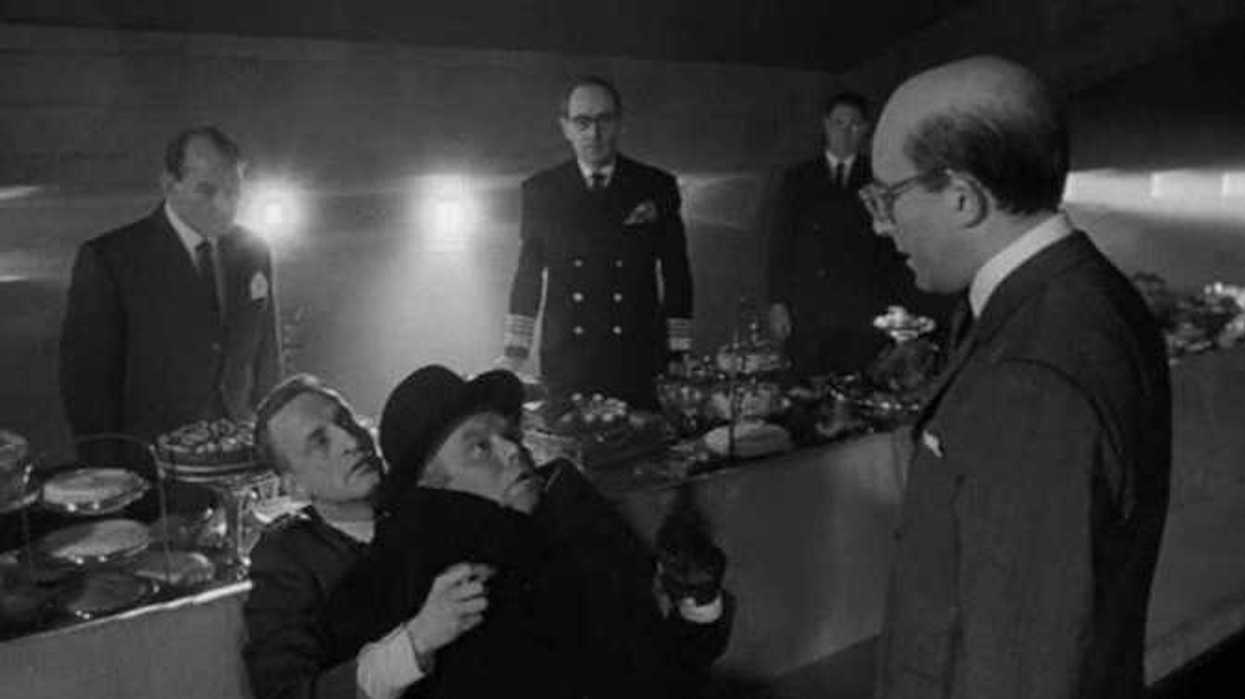
Dr. Strangelove (1964)
The scene is set in the war room. (I mean, duh!) People are important and powerful, and the atmosphere is serious; people are ready to take charge. Everything about the situation should scream “control.”
But it doesn’t. That’s missing from this “war room.” And that exactly is the great joke of Dr. Strangelove (1964). The war is brewing, yet the people inside keep proving that genuine control is what none of them has. They aren’t capable of stopping the war.
In the midst of this chaos comes President Muffley’s (Peter Sellers) famous plea, “Gentlemen, you can’t fight in here; this is the war room.” Aside from bearing the frantic urgency of the moment, the line doesn’t sound particularly chagrined. And that’s how it shows the irony that fills the world and how surreal the moment is.
Dr. Strangelove is a satire, so the line obviously has situational and verbal irony, but it also reflects the movie’s entire outlook on leadership and crisis. It shows how the film handles powerful situations, stubborn egos, and weak communication.
The Line and Its Immediate Function
The Context
The paranoid U.S. General Jack Ripper (Sterling Hayden), thinking the Soviets are fluoridating American water to corrupt their precious “body fluids,” starts a nuclear crisis between the rival countries. Muffley calls a crisis meeting to telephone the Soviet Premier and inform him about the “accident.”
Before the call, General Turgidson (George C. Scott) suggests they should double down on Ripper’s rogue attack and initiate a preemptive strike to weaken the imminent Soviet retaliation. The Soviet Ambassador, Alexie Sadeski (Peter Bull), wants to avoid a full-scale war and nuclear holocaust. The animosity between Turgidson and Sadeski is on full display. It escalates into a physical altercation where Turgidson accuses Sadeski of secretly taking photographs of the war room. Sadeski claims Turgidson was trying to plant the camera on him.
Dumbstruck by their behavior, Muffley admonishes them, saying, “Gentlemen, you can’t fight in here; this is the war room.”
The Comic Contradiction at the Heart of the Scene
The funny part of the line is that it’s logical, but its logic is wackadoo. The room is meant to be used to plan wars, so asking someone not to fight inside feels ridiculous. It’s the same as “you can’t scream here; this is the loudspeaker testing room.”
And that’s how Kubrick underscores the complete disengagement between political language and real behavior. It also points to the classic political paradox: saying a valid thing, but doing the exact opposite.
The War Room Paradox
A White Hot Center of Cold War Clichés
A war room is ideally meant to be a place where the responsible military generals and strategists engage in rational and tactical planning. In Dr. Strangelove’s war room, however, it becomes a playground for unchecked egos and territorial disputes. While President Muffley expects a measured counsel on an ultra-sensitive subject, his counsels engage in primary school-level squabbles.
This is a symbolic commentary on the Cold War narrative. It implies that it may not be malice that would cause global annihilation; it may be the utterly ridiculous human failure to control impulses.
The Set Design
Stanley Kubrick cleverly uses Sir Ken Adams’ brilliant, triangular set design—in addition to using it as a character in itself—to underscore the tomfoolery of the situation. Its imposing, severe aesthetic, centered on a massive illuminated map, gives us the grim military architecture that we expect. And its high ceilings and stark lighting amplify the feeble, low-grade political drama that takes place underneath. This pure theatricality turns this “war room” into a rec room.
Mutually Assured Destruction to Mutually Assured Distraction
The Cold War was defined by the terrifying prospect of Mutually Assured Destruction (MAD). Kubrick puts a spin on it and makes it Mutually Assured Distraction, just as MAD. Even today, we see personal grudges and political baggage veer powerful people away from their supposed objective of the larger good. This scene is indicative of the grim future (may it not fall upon us), where the world will end, not because of a calculated strategy, but because of absurd misunderstandings and procedural errors.
Muffley’s line does its job to point out this disastrous turnaround in priorities, where maintaining decorum takes precedence over maintaining global peace.
You can also take the quote as a reminder that “people in the war room” are ultimately people, just like you and me. They are not above petty differences and clashes, and errors of judgment. If (or when) the world ends, it won’t be because of the bomb; it will be because of the stupid ego.
Conclusion
The line is not only funny but also relatable because it exposes the gap between how leaders talk and how they behave when the pressure mounts. It also signals the reality of infantilism and uncertainty that festers behind the confident, arrogant voices once the doors of powerful rooms close.
Ultimately, the line shows us that those entrusted with preventing global catastrophe are (and quite terrifyingly so) just people.
- This New Book on 'The Shining' is Blowing My Mind | No Film School ›
- Get Inspired By Stanley Kubrick's Rare 'Notes on Filmmaking' | No ... ›
- What Does Stanley Kubrick's Average Shot Length Say About His ... ›
- What Were Stanley Kubrick's Thoughts on Stephen King's Writing ... ›
- What Happened to Spoof and Parody Films? | No Film School ›
- 3 Types of Satire Every Filmmaker Should Know | No Film School ›
- Listen to a 76-Minute Interview with Stanley Kubrick, Legendary ... ›
- 'It Was Nerve-Destroying': Legendary Set Designer Ken Adam ... ›
- RIP Ken Adam, Oscar-Winning Production Designer for 'Dr ... ›
- What's It Like to Work With Stanley Kubrick? Sterling Hayden Tells ... ›