The Risky Camera Move in 'The Bourne Supremacy' That Redefined Action
Why a controversial filming style and breakneck editing changed action cinema forever.
'The Bourne Supremacy'
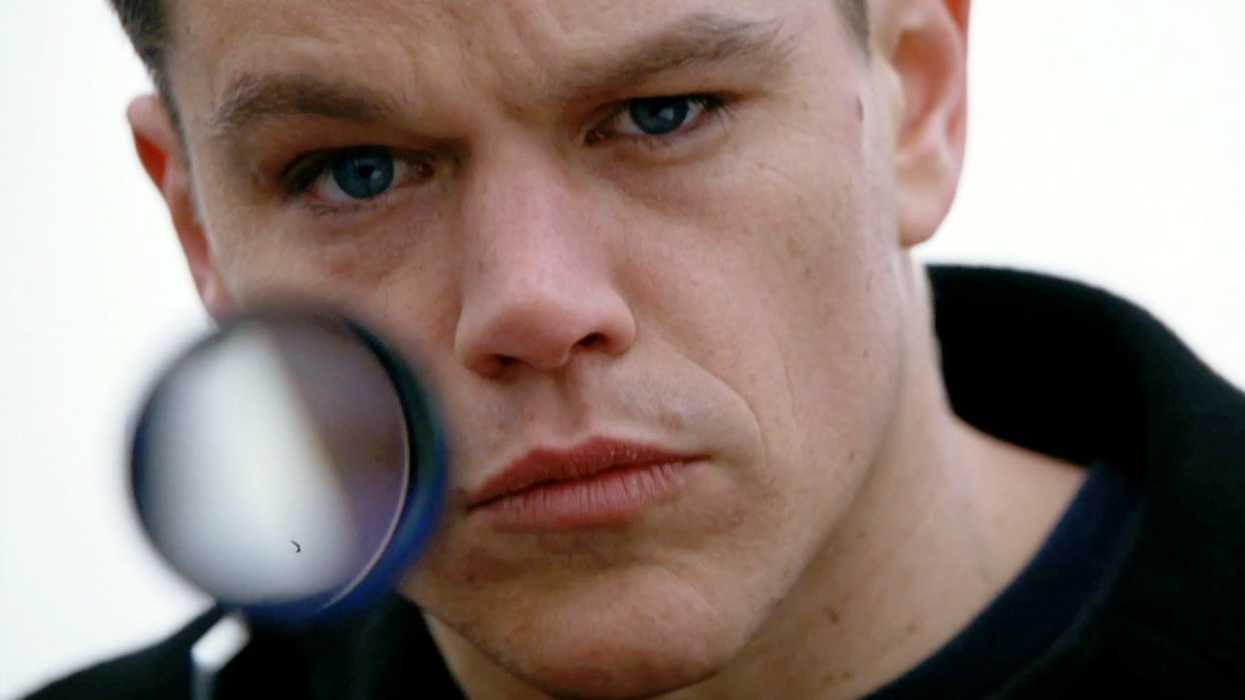
Bloodied and desperate, Jason Bourne (Matt Damon) smashes a stolen taxi through traffic as Russian police chase him.
That’s The Bourne Supremacy’s (2004) now-famous chaotic car chase in Moscow we are talking about. It’s quite hard to forget, really.
And one of the reasons why is that its famously unsteady camera makes you dizzy. It shakes, veers, and shivers as if it’s desperately trying to hold on to the backseat. And since you are trapped inside the storm, instead of observing from a safe and expansive vantage point, every crash, swerve, and metal slam feels magnified.
This sequence immediately sparked a debate that has persisted for years: was this a brilliant or a disastrous use of style?
The unsteady camera and frantic editing gave some people an adrenaline rush that no other movie could match. Others found it nauseating—a challenge to spatial awareness. In either case, viewers were shaken when they left theatres.
And that’s what truly matters. Whether the style was a hit or a dud, The Bourne Supremacy changed the way action movies were filmed and edited for the next twenty years. Action movies began to resemble lived-in chaos at this point, rather than neatly choreographed scenes.
The Hollywood Action Scene Before Bourne
The Age of Clarity
Hollywood action had a completely different grammar before 2004. For instance, in Mission: Impossible II (2000), director John Woo used operatic slow-motion to stage balletic gunfights. Wachowskis choreographed every kick and bullet-time dodge in The Matrix (1999) with impeccable wide-lens precision. The edits were fluid, and the camera was steady. The audience was fully aware of everyone’s location and activities.
That clarity was deliberate. Since the stunt work was presented as a dance that viewers were expected to follow step-by-step, action directors wanted viewers to be awed by the choreography. Yes, it was thrilling, but it was also well-executed nd isolated from the chaos of the real world.
The TV Influence
On TV, there were signs of something messier. For dialogue scenes, shows like NYPD Blue and Homicide: Life on the Street had already adopted handheld camerawork, giving viewers the impression that they were watching uncut documentary footage.
However, these were still not full-fledged action set pieces; they were limited to police precinct drama. The majority of Hollywood action’s borrowings from television were in narrative beats rather than visual style.
And this is why The Bourne Supremacy was so shocking—it took a TV-born style and exploded it inside a high-budget spy thriller.
The Architects of Chaos
Direction Paul Greengrass
When Universal awarded Paul Greengrass The Bourne Supremacy, he was not an insider in Hollywood. He came from political docudramas based on journalistic grit and handheld realism, such as Bloody Sunday (2002).
His camera stumbled like a witness rather than hovering like a storyteller. It was definitely a risk to bring that background into a $75 million action sequel, but still, a clean spectacle didn’t appeal to him. So he leaned into his experience.
A Narrative Tool, Not a Gimmick
The decision to use a handheld camera was not an easy way out; it was planned. At this stage of the narrative, Jason Bourne is broken—haunted by lapses in memory, pursued from every direction, paranoid, and worn out.
Greengrass wanted that instability to be felt by the audience. The camerawork’s confusion reflected Bourne’s own fractured mental state. Viewers were compelled to process information in splintered fragments while inside Bourne’s headspace rather than as detached spectators.
Editor Christopher Rouse
None of this would have landed without editor Christopher Rouse. Keeping in line with the action movie rulebook, he obviously maintained a fast pace for the chaos, but he also gave it rhythm. Even if a shot was only a fraction of a second long, it always captured something crucial, such as Bourne’s flinching eyes or the turn of a car’s wheel. An operative would naturally rely on this fragmented perception under duress.
Rouse and Greengrass obstructed scenes by stacking impressions rather than using broad establishing shots. It wasn’t a prim and proper effect—because it wasn’t intended to be. It was a mess that was actually a psychological immersion.
Deconstructing the Style: More Than Just a Shaky Picture
The “Shaky Cam” Myth
It would be an understatement to say that Greengrass’ strategy was “shaky cam.” This wasn’t your usual random camera jiggling moment. There were guidelines for the technique: handheld rigs, yes, but always with the scene in mind. The camera frequently remained focused on faces or other specifics, responding nearly like a second party to the altercation. The camera “flinched” when Bourne punched. It dipped when he did. The shake told a story through movement, not chaos for the sake of chaos.
The Rhythm of the Cut
This style was further refined through editing. The movie used inserts to construct geography rather than lengthy masters — knife in a hand, eyes darting to a doorway, across the room, glimpse of a gun. Even though these shots lacked conventional spatial clarity, Rouse stacked them into sequences that intuitively made sense. Even though you weren’t always aware of Bourne’s location, you were able to carry the scene by knowing how he felt.
Case Study: The Berlin Fight Scene
Consider the altercation between Bourne and Jarda (Marton Csokas) in their Berlin apartment. It’s a savage fight in which commonplace items are turned into weapons rather than a fancy martial arts duel. They are thrashed by the camera, giving the impression that the room is too small to accommodate this violence. By the end, the furniture is broken, both men are gasping, and the audience is just as exhausted as the fighters. The point was tiredness, not elegance. More effectively than any wide shot, the style conveyed the toll of combat.
The Immediate Aftermath
Praise, Pan, and Polarization
Critics didn’t know how to respond to this. Some praised it as revolutionary, and some complained that they were unable to discern what was going on.
For instance, Entertainment Weekly said, “Paul Greengrass employs handheld cameras and shoots everything that happens—from a dozen angles at once, arranging the images into what looks like a chain reaction of jump cuts.”
On the flip side, one of the viewers’ feedback on Ebert’s website reads, “Somewhere in that movie were some great action scenes, but one could barely make out what was going on. You should warn your viewers about movies like this. They should be rated MS, for motion sickness.”
Immersive grit or nauseating blur, then. There was a genuine divide based on whether you believed the style enhanced or detracted from the action experience.
Audience Reception
Be that as it may, the audience loved it. People were drawn to the film’s rawness, as evidenced by its global gross of over $311 million. Bourne limped, bled, struggled with memory, and fought for his life—compared to the extravagant and pretentious spy fantasies of the past, this game felt more realistic.
Fans returned for more in The Bourne Ultimatum (2007) because the question of the unsteady camera was already answered—it was accepted and became a part of the brand.
How Bourne Remade Hollywood
The Spy Genre Reinvented
James Bond was the first to feel the effects. Casino Royale (2006), which rebooted 007 two years after The Bourne Supremacy, abandoned glitz and technology for brutal realism. Handheld cameras, quick edits, and a feeling of vulnerability in Madagascar’s opening scene—these are all hallmarks of Bourne’s work. In part because of Greengrass’ example, Bond was no longer impervious; he was human.
The Action Genre Blueprint
The “Bourne method” quickly became the go-to option. The style was incorporated to varying degrees in films such as Christopher Nolan’s The Dark Knight (2008) and Pierre Morel’s Taken (2008). Even superhero movies adopted a Bourne-like gritty aesthetic, abandoning glitzy visuals for something more unpolished. Even though they weren’t always aware of the craft involved, studios desired the “you are there” effect.
The Legacy of Bad Imitation
For every gold standard, there is a knockoff; something proved right even in this case. Many imitations of this style sprang up, but failed to capture its spirit. They used shaky cam as a cover for hasty choreography or careless stuntwork.
Quantum of Solace (2008) doubled down on the handheld frenzy, but in a way that left the viewers perplexed. The 2010 remake of Clash of the Titans was criticized for its overreliance on shaky camera to “energize” its battles. The Hunger Games (2012) used it to tone down the violence, but ended up distracting the audience as they couldn’t see Katniss or the action clearly. Taken 3 (2014) is perhaps the most infamous offender, which turned the Bourne-style camerawork into a parody of itself—in one fence-jump scene, it reportedly cut 14 times in six seconds only to disguise sloppy staging and aging stunt doubles.
People got tired of feeling seasick in theatres. A return to clarity was demanded by both critics and viewers by the 2010s, which explains the popularity of the John Wick franchise, where long takes and crisp choreography felt anew.
The Definitive Verdict: Revolution or Gimmick
Weighing the Arguments
So what is it, an accident or an art?
Perhaps the middle is where the truth is. Whereas the absence of spatial geography remains a deal-breaker for some people, the immersive disorientation is enlightening for others. Calling it a gimmick, however, ignores the craft and intent. Because Rouse and Greengrass knew exactly what they were doing—rewriting the rules, not breaking them out of laziness.
The influence is indisputable. Hollywood had to reconsider action as a result of The Bourne Supremacy. It demonstrated that style could be substance—that a fight’s cinematography could reveal just as much about a character’s psychology as their backstory or dialogue could.
So, the next time you watch a car chase or a fist fight, observe whether the camera trembles or if the cuts pass by like fleeting thoughts. That is Bourne’s DNA. What started out as a headache has evolved into the blueprint. And maybe that’s the most apt legacy of all: Bourne not only outlived his assailants, he altered our perception of the chase.
- Here's Why You Need to Revisit 'Interstellar' in 70mm IMAX | No Film ... ›
- Watch Ben Affleck, Matt Damon, and Nicole Holofcener Break Down ... ›
- Jason Bourne Will Stay at NBCUniversal... Forever | No Film School ›
- Ben Affleck and Matt Damon Launch New Production Company ... ›
- 5 Screenwriting Lessons From the 'Good Will Hunting' Script | No ... ›
- How 'The Martian' Cleverly Drops Multiple F-Bombs & Still Gets a PG ... ›
- “How Drunk is Drunk Enough?”—‘The Legend of Bagger Vance’ ›
- Paul Greengrass' 5 Best Movies, Ranked | No Film School ›
- Why Chaotic Filmmaking Works in 'The Bourne Ultimatum' and Fails in 'Taken 3' | No Film School ›