The Meaning Behind the Ending of 'Soylent Green' and Why It's So Scarring Even Today
A reflection on Soylent Green’s (1973) explosive final dialogue, “Soylent Green is people!” that gave the movie a horrifying aftertaste.
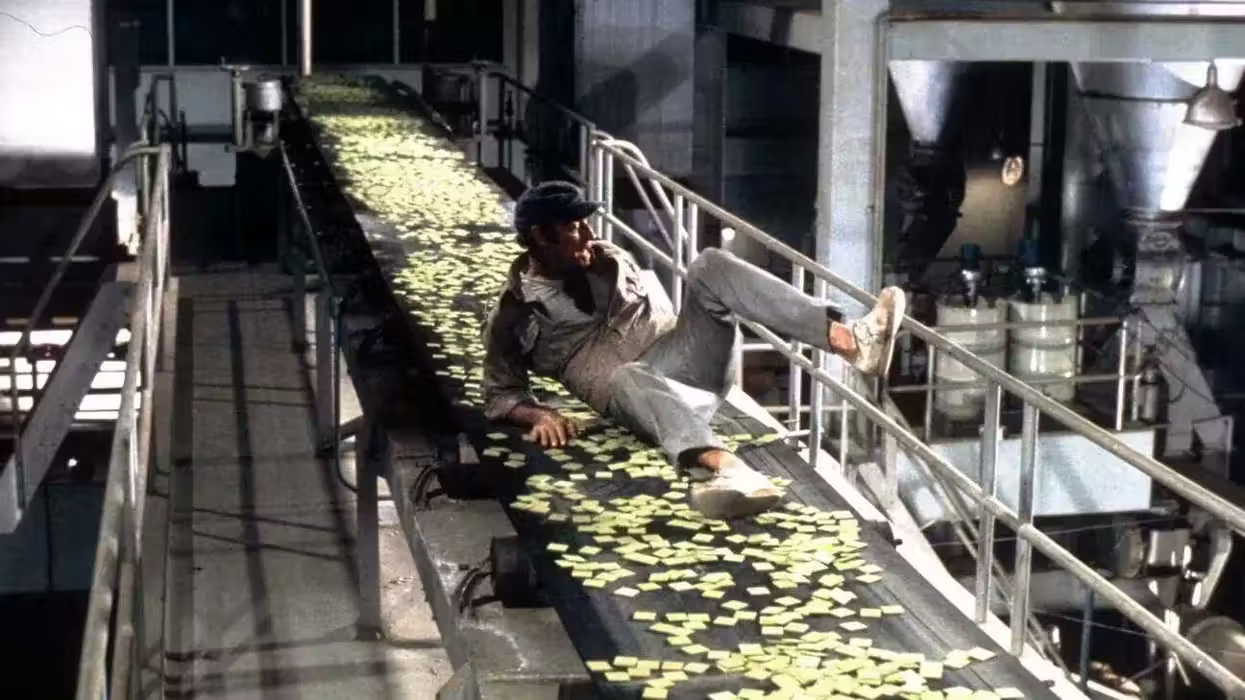
Soylent Green (1973)
I can imagine, in the early '70s, i.e., after the release of Soylent Green (1973), people finding its climax to be what we now call creepypasta. Why only then? It’s quite possible even today. Realizing that your mass-produced staple food is made of human flesh sounds a bit overstretched.
And yet, you cannot disagree that somewhere inside that reasoned, skeptical reaction, you actually feel unnerved. Perhaps, even more so today than back then. Why do you think that is?
The scene, in its narrative context, gives us a plot twist, but more essentially, turns a mirror to a dying society, with all its morals, standards, and humanity dying with it. A grim preview of what’s to come. And regardless of the viability and ludicrousness of its likelihood, even the hypothetical consideration of that situation feels discomforting.
It’s been fifty years since the movie was released, and not only has that discomforting feeling not faded, but it has actually begun to sound more relatable. The look and feel of the movie might appear dated now, but the anxiety it carries underneath is fresh and uncomfortably modern.
The movie shows us the dystopian world of growing heat, widespread hunger, and constant lies. Sounds familiar? That’s because the future, as shown in the movie, no longer feels fictional.
The Context Behind the Climactic Meltdown
In 2022 (i.e., 50 years into the future), the world is a dystopian society, which is polluted, overpopulated, and immensely imbalanced between the few rich and the rest of the poor. While the elite have access to good living conditions, clean water, and natural food, the poor literally live in the grime, drink contaminated tapwater, and eat mass-produced and highly processed food wafers manufactured by the Soylent Corporation. Aside from their base offerings of the “Red” and “Yellow” variants, Soylent has recently introduced a new, allegedly healthier, tastier, and more wholesome “Green” variant, which they claim is made from plankton.
NYPD detective Robert Thorn (Charlton Heston), one of the poor people, takes on a murder case of a wealthy board member of Soylent Corporation, William Simonson (Joseph Cotten). His danger-fraught investigation ultimately leads him to uncover a huge conspiracy: the oceans are dying and cannot produce plankton, and Soylent Green is actually made of human remains—flesh, bones, and organs.
He is injured during his final fight with the authorities, who want to silence him. While he is taken away by the paramedics, the distraught and utterly helpless Thorn, in an attempt to urge his commanding officers to spread the truth, screams out loud, “Listen to me, Hatcher, you gotta tell them… Soylent Green is people!”
Setting the Stage for the Shock
The Future That Looks Uncomfortably Real
The movie is set in New York. Even though it is set 50 years into the future, the “futuristic” elements aren’t swoonworthy—no flying cars, no shiny robots. On the contrary, this futuristic world is where the resources have run out (for the poor), and the society has learned to accept less. The heat is growing, fresh water is a luxury, real vegetables have become museum pieces, and overall, the amount of food has decreased in stark contrast to the rising number of people. Most people survive on bland “chips” made by God-knows-what.
This high-and-dry approach creates the foundation for the climax, where Thorn’s desperate cry for help feels less like fantasy and more like a grim possibility.
The Twist That Recontextualizes Everything
As the audience moves with Thorn’s investigation, it doesn’t take much for them to suspect that there is foul play. And yet, when the moment comes, it still hits like a meteor. The truth is much darker. Who would have guessed forced cannibalism, rationed by the government and made possible by massive corporations?
We know cannibalism, we have heard stories, we have seen elements of it in movies; even the idea of “evil corporations” is anything but new.
But corporations breeding people like cattle for food?
When did the idea “of the people, by the people, for the people” change its context from democracy to food? How ghastly is that!
And when this realization dawns upon the audience, the film shifts from a police procedural into a horrifying commentary on the ultimate exploitation of the working class.
Why the Soylent Scare Still Trends
Climate Anxiety and Resource Scarcity
Soylent Green’s future is today’s reality. We may not be at the doorstep of cannibalism yet, but other things—global warming, rising sea levels, ocean acidification, food scarcity, battle for fresh water in overpopulated cities—all this is real today.
The film’s doomed future was set in the year 2022. It has already passed, and we are still pretty much in an upright state (in comparison to the film’s prediction, at least), but the film’s warning still stands valid. Perhaps, not as a dated prediction, but surely an imminent headline.
The Real-Life Soylent and Modern Food Fear
Today, we live in a world dominated by processed food and other “allegedly” organic substitutes with questionable nutrition. I mean, we have an actual, real-life brand called “Soylent” that sells meal replacement powders and shakes. It claims to contain healthy nutrients necessary for good living, but there are reports of people falling sick.
Most of today’s mass-produced food products contain high-fructose corn syrup, pink slime, and various chemical binders.
There has been a push for eating insect-based proteins as a sustainable solution to resource scarcity. Its feasibility is still being discussed, and while some think that it’s a genuine alternative to regular meat, it is also known to come with some potential health risks, such as allergies and pathogen contamination. If “mass-produced” by for-profit companies, who’s to say what pros and cons it will bring?
All things considered, the movie stands as a reminder to carefully examine (if not outright oppose) this opaque system that puts mass-produced items on our dinner tables.
Conclusion
The movie, and this scene in particular, rests in the center of what we call our survival instincts. It asks what we are willing to bet and sacrifice to survive. And the climax is a symbolic stain on the idea (more like an illusion) of progress that we let big, multinational corporations lead and direct.
Finally, the “people” twist might seem over-the-top (which is perhaps why the quote is so legendary), but I think the true horror of this line is not in its narrative or the plot itself; it’s in the fact that how easy it is to believe it.
- The 14 Greatest Movie Endings Ever Filmed ›
- What is Anticlimax? The Art of ‘Much Ado About Nothing’ ›
- What Is Denouement? Definition & Film Examples ›
- 11 Orson Welles Great Films, Ranked for Cinephiles ›
- The 10 Best Knight Movies For Every Medieval Fan | No Film School ›
- Before Street Racing, ‘Ben-Hur’ Defined Cinematic Speed ›
- What is External Conflict? (With Examples) | No Film School ›