11 Orson Welles Great Films, Ranked for Cinephiles
Every Film, From Studio Triumphs to Guerrilla Experiments.
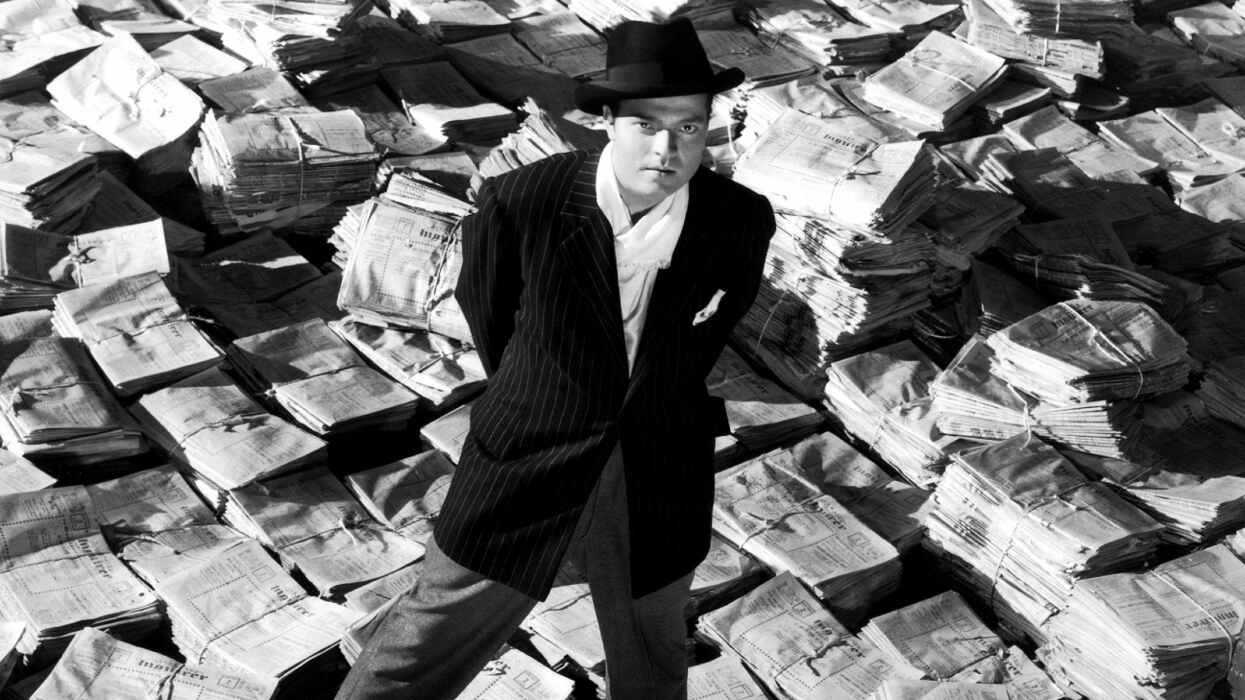
Citizen Kane (1941)
Orson Welles once said he “began at the top and has been working my way down ever since,” and honestly, he wasn’t kidding.
At just 26, he directed Citizen Kane, a film so groundbreaking it practically re-wrote the rules of cinema, only to spend the rest of his life chasing that high, often while battling studio executives, budget woes, and the occasional back-of-a-van editing session.
Legend has it that after its first screening, Hollywood mogul Louis B. Mayer offered to buy the film and burn every negative because he was afraid that William Randolph Hearst (the powerful media mogul the movie was based on) would be offended and severely damage the whole film industry with his influence.
Such was the influence of Citizen Kane, and such was the glorious career and creative peak Welles achieved at an age when most of us are still figuring out how to do laundry.
Welles’ career was as chaotic as it was brilliant. His filmography is riddled with unfinished projects, but his influence on cinema is immeasurable. From pioneering deep focus to reshaping narrative structure, he was a magician with a camera. Whether turning Shakespeare into a war epic or crafting a noir on a shoestring budget, he never stopped pushing boundaries.
So, how do you rank the films of a man defined by both genius and disaster? With difficulty, humor, and respect.
We are tackling the 11 feature films he directed (no documentaries, sorry F For Fake fans, and we are excluding Don Quixote as it was never properly completed), from masterpieces to magnificent messes.
11 Films by Orson Welles: Ranked
11. The Immortal Story (1968)
Set in 19th-century Macao, The Immortal Story follows Mr. Clay (Welles), a wealthy merchant obsessed with turning an old sailor’s legend—a rich man paying a young sailor to impregnate his wife—into reality. Clay manipulates a woman (Jeanne Moreau) and a naive sailor to fulfill his twisted vision.
Despite its artistry, the film ranks among Welles’ lesser works. It feels more like an exquisite short story than a full-fledged feature. While it boasts beautiful visuals, haunting performances, and Welles’ first use of color, it lacks the narrative depth and innovation of his other masterpieces.
10. Mr. Arkadin (1955)
The movie follows Guy Van Stratten (Robert Arden), a small-time smuggler hired by the enigmatic Gregory Arkadin (Welles) to uncover Arkadin’s mysterious past. What begins as a globe-trotting adventure filled with eccentric characters and hidden truths soon spirals into a web of deceit, murder, and betrayal.
Despite flashes of brilliance, Mr. Arkadin is one of Welles’ messier efforts. Plagued by multiple conflicting edits and the project being snatched away from Welles during the post-production, it suffers from uneven pacing and narrative confusion.
Even so, scenes like the haunting masquerade ball show Welles’ visual genius. Despite lacking emotional depth, the movie remains a fascinating, if flawed, experiment that hints at the bold innovation of his later work.
9. Macbeth (1948)
The movie reimagines one of Shakespeare’s masterpieces as a shadowy, expressionistic nightmare. Shot in 23 days on a shoestring budget, it tells the story of an ambitious Scottish general (Welles) whose descent into murder and madness is mirrored by its fog-drenched sets, eerie landscapes, and theatrical performances. Long takes and deep focus create a claustrophobic intensity that captures the story’s psychological horror and moral decay.
Ranked lower due to technical flaws and uneven execution, Macbeth struggles with pacing, unconvincing costumes, and the infamous Scottish accents, which were later dubbed. And yet, it is a bold and inventive adaptation, showing Welles’ ability to turn limited resources into grand cinematic visions.
8. The Other Side of the Wind (2018)
Filmed between 1970 and 1976 but finished in 2018, 33 years after Welles’ death, the movie is his most self-reflective work. It follows Jake Hannaford (John Huston), a fading director, unveiling his experimental comeback film at a chaotic Hollywood party.
The movie-within-a-movie mirrors Welles’ own industry struggles, blending black-and-white documentary-style party scenes with vibrant, psychedelic sequences. This cinematic exploration critiques masculinity, creativity, and the shifting tides of 1970s Hollywood.
Ranked lower due to its fragmented nature and Welles’ inability to finalize it, the film’s jagged editing and rapid dialogue make the viewing experience slightly overwhelming. Yet, it’s a bold, visionary farewell, featuring moments of brilliance, like the stunning car sequence, anchored by Huston’s magnetic performance.
While its fragmented style keeps us wondering about Welles’ true vision, the movie still remains an enduring legacy as a cinematic trailblazer.
7. The Stranger (1946)
A rare foray into traditional filmmaking, The Stranger is a noir thriller about Franz Kindler (Welles), a Nazi war criminal hiding in a quiet Connecticut town under the alias Charles Rankin. A relentless investigator gets on his trail, sparking a tense game of cat-and-mouse as Kindler’s past threatens to unravel his new life.
While more restrained than Welles’ other works, the film is expertly crafted, with striking cinematography and suspenseful editing, evident in iconic scenes, like the clock-tower sequence.
More of a middle-ground film, The Stranger proves Welles could deliver commercial success under studio constraints. Though it lacks the boldness and personal touch of his masterpieces, it’s a gripping, well-executed thriller with thematic depth. It exposes how fascism can lurk beneath small-town American values. While not groundbreaking, it remains a compelling genre piece highlighting Welles’ versatility.
6. Othello (1951)
Welles’ Othello is a visually stunning, dreamlike adaptation of Shakespeare’s tragedy, shot over three years in Morocco and Italy amid financial chaos. Its fragmented production adds to its ethereal quality, with Welles’ inventive use of shadow, architecture, and perspective turning limitations into triumphs, like the iconic steam bath murder.
Ranked sixth, the film’s technical flaws, such as uneven audio, hold the narrative back, but its striking black-and-white visuals, expressionist style, and Welles’ commanding performance as the titular character make it a haunting, emotionally powerful work.
5. The Trial (1962)
The Trial plunges into Kafkaesque nightmarish bureaucracy, following Joseph K. (Anthony Perkins), a man accused of an unknown crime by a dispassionate system.
Shot in haunting locations, the film’s stark black-and-white visuals, disorienting sets, and labyrinthine storytelling create a surreal, oppressive world, mirroring Joseph K.’s psychological collapse. Welles’ use of wide-angle lenses and claustrophobic spaces amplifies the story’s existential dread, making it a visually and thematically bold work.
Ranked fifth, this is one of Welles’ most ambitious films, blending Kafka’s absurdity with his expressionist style. While its cold tone and frustrating narrative may alienate some, it’s a chilling exploration of powerlessness against faceless authority.
Perkins’ frantic performance and Welles’ haunting cameo as the advocate elevate the film, cementing it as a profound critique of dehumanization.
4. Chimes at Midnight (1965)
Orson Welles made this movie as a personal adaptation of Shakespeare’s Henry IV plays, centering on Sir John Falstaff (Welles). The film traces the bittersweet friendship between Falstaff and Prince Hal (Keith Baxter), from raucous tavern escapades to crushing betrayal as Hal ascends the throne. It blends bawdy humor against medieval England’s political backdrop with profound themes of loyalty, honor, and lost innocence.
Ranked fourth, Chimes at Midnight is celebrated as one of the finest Shakespeare films, thanks to its emotional depth, Welles’ towering performance, and the revolutionary battle of Shrewsbury—a gritty, visceral depiction of medieval combat.
Despite budget constraints and sound issues, its visual beauty makes it a timeless, deeply moving masterpiece. It’s Welles at his most vulnerable, a testament to his genius and love for Shakespeare.
3. The Magnificent Ambersons (1942)
The film is a masterpiece marred by tragedy—the studio cut over 40 minutes and added a happy ending, leaving Welles’ vision incomplete. Yet, its stunning sequences, like the seamless Christmas ball and single-take kitchen scene, and Welles’ poignant narration make it emotionally resonant.
2. Touch of Evil (1958)
The movie is set in a seedy border town, where a corrupt cop, Hank Quinlan (Welles), manipulates evidence and abuses power.
The film opens with one of cinema’s most iconic tracking shots, a three-minute take following a car with a ticking bomb, setting the tone for its themes of corruption and moral ambiguity. As a Mexican agent, Mike Vargas (Charlton Heston), uncovers Quinlan’s crimes, the story becomes a dark, morally complex tale of justice and revenge.
Touch of Evil is ranked highly because it’s a technical and atmospheric triumph. Though Universal Studios re-cut it, Welles’ 58-page memo led to a restored 1998 version, now seen as his most complete work.
From its legendary opening to its grotesque characters, the film blends artistic innovation with noir conventions. Quinlan is one of cinema’s greatest villains, thanks to Welles’ ability to portray him with amazing depth. A dark, subversive gem, this movie cements Welles’ legacy as a cinematic trailblazer.
1. Citizen Kane (1941)
Citizen Kane traces the rise and fall of Charles Foster Kane, a newspaper tycoon whose life embodies the complexities of power, ambition, and the search for truth. The film begins with his mysterious final word—Rosebud—and unfolds through a non-linear narrative as a reporter pieces together conflicting accounts of Kane’s life.
Citizen Kane is Welles’ crowning achievement and one of cinema’s most influential works. At just 26, Welles redefined cinema with overlapping dialogue, non-linear storytelling, and deep-focus shots that capture action across multiple planes. Beyond its technical brilliance, it’s a deeply American tragedy that explores the emptiness of material success and the impossibility of truly knowing another person.
Despite a rocky release due to William Randolph Hearst’s opposition, Citizen Kane became a timeless masterpiece, a testament to Welles’ genius, and a film that continues to reveal new depths with every viewing.
Conclusion
From the groundbreaking Citizen Kane to the experimental The Immortal Story, Welles’ films showcase unmatched ambition and innovation. Despite studio interference, budget woes, and exile, his 11 features reveal a visionary who redefined cinema. Even his so-called “failures” sparkle with moments of genius, inspiring filmmakers to this day. Trying to rank his works is our way of celebrating the bold and obsessive artistry of American cinema’s most daring auteur.
- Watch: How Orson Welles Hid a 12-Minute Single Take in Plain Sight ›
- Block or Die: Lessons from Orson Welles ›
- What Did Orson Welles Learn from Ernest Hemingway? ›
- Orson Welles on Acting - 'Take Away from Yourself to Reveal the Truth of What You're Doing' ›
- Orson Welles' Warning to Filmmakers: Don't Watch Too Many Movies ›
- 7 Reasons Why Orson Welles Was Such a Boss at Cinematic Composition ›
- Decoding “Rosebud”: Orson Welles’ Greatest Narrative Trick | No Film School ›
- 10 Things Directors Wish They Never Did in Their Own Movies ›
- How Orson Welles Turned a "Routine" Script into a Masterpiece ›