On today's movie sets, there are a lot of tools flying around that help each department do its job. I'm just you know about the camera and lights, but what about C-47s and XLR cables?
I decided to create a glossary of tools that you can find pretty much on every set in film and television. If you want to work in the industry, you need to know about these things and what they do.
Let's dive in.
What Tools Are On a Movie Set?
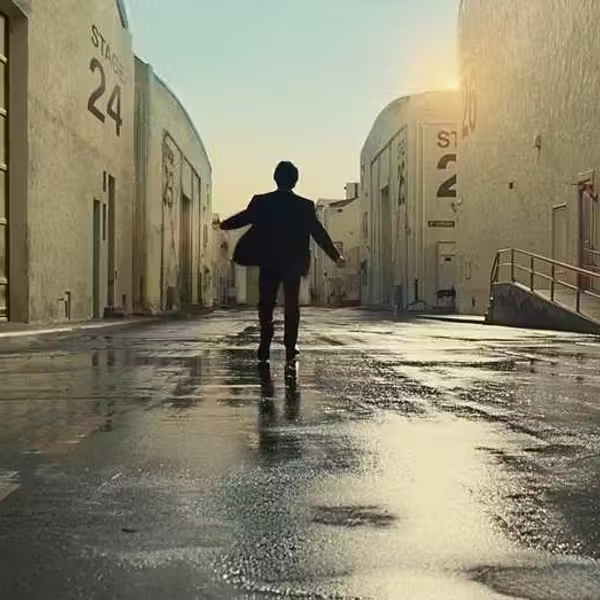
 'Babylon'CREDIT: Paramount Pictures
General Production Tools
These are common items you'll see used by many departments, especially cinematographers, the Assistant Directors (ADs), and Production Assistants (PAs).
- Clapperboard (or Slate): A board with a hinged "clapper" on top. It's filmed at the beginning of each take to mark the scene, shot, and take number. The "clapping" sound provides a clear audio-visual reference point for synchronizing sound and picture in editing.
- Walkie-Talkie (or "Walkie"): The primary communication device for the crew. Different departments are assigned different channels to coordinate.
G&E (Grip & Electric) Department
This is where you'll find the most "slang" and specialized gear. Grips are responsible for rigging, camera support, and shaping light. Electrics (led by the Gaffer) are responsible for setting up and powering the lights.
Grip Tools (Shaping Light & Camera Support)
- C-Stand (or Century Stand): The most essential and versatile stand on set. Used to hold flags, silks, nets, and small lights. It consists of a collapsible base, a two-stage riser, and a "gobo arm" with a "gobo head" (or grip head).
- Apple Box: A simple wooden box used for countless purposes: to prop up equipment, to level dolly track, or to give an actor a slight height boost (a "man-maker"). They come in standard sizes: full, half, quarter, and pancake.
- Dolly: A wheeled platform that the camera and camera operator ride on to create smooth, moving shots.
- Dolly Track: The "railroad tracks" laid on the ground for the dolly to move on, ensuring a perfectly smooth path.
- Flag (or Cutter): A solid black, rectangular frame (usually cloth) used to "cut" light and create shadows. A "floppy" is a flag with an extra flap of cloth that can be unvelcroed to double its size.
- Gaffer Tape (or "Gaff Tape"): A heavy-duty, cloth-backed tape with a strong adhesive that (crucially) removes without leaving a sticky residue. Used for everything from taping down cables to securing gels. This is not the same as duct tape.
- Sandbag (or "Bag"): A heavy bag of sand or lead shot used to weigh down and stabilize C-stands, light stands, and dolly track.
- Mafer Clamp, Cardellini Clamp, & C-Clamp: Various types of heavy-duty clamps used to mount lights and grip gear in unusual places, like on pipes, beams, or set walls.
- Safety Chain (or Safety Cable): A mandatory steel cable used to secure any light or piece of equipment rigged overhead. If the primary clamp fails, the safety chain prevents the (often very heavy) gear from falling.
- C-47: The set-specific name for a wooden clothespin. Used to clip gels and diffusion onto hot lights (the wood doesn't transfer heat like plastic would).
Electric Tools (Creating Light)
- Lamp (or "Light" / "Head"): The actual lighting fixture itself. Crew members almost always refer to it as a "lamp," not a "light."
- Barndoors: The four hinged, black metal flaps on the front of a lamp. They are used to roughly shape the light beam and prevent it from spilling into unwanted areas.
- Gel: A colored, transparent plastic sheet placed in front of a lamp to change the color of the light.
- CTB (Color Temperature Blue): A blue gel that makes a warm (orange) tungsten light look like cool (blue) daylight.
- CTO (Color Temperature Orange): An orange gel that makes a cool (blue) daylight source look like a warm (orange) indoor light.
- Diffusion (or "Diff"): A white, semi-transparent material (like a frost or a "silk") placed in front of a lamp to soften the quality of the light, reducing harsh shadows.
- Gobo (or "Pattern" / "Cookie"): A thin metal or glass stencil placed inside a lamp to project a pattern, such as the shadow of a window frame or tree branches.
- Black Wrap: A heavy-duty, matte black aluminum foil. It's heat-resistant and moldable, used to precisely "cut" light, mask light leaks, or create custom barndoors.
- Stinger: The on-set term for a heavy-duty extension cord.
- Cube Tap: A small box that plugs into a single outlet and provides three or more additional outlets, splitting the power.
Camera Department
- Follow Focus: A mechanism that attaches to the camera's lens, allowing the 1st Assistant Camera (1st AC or "Focus Puller") to precisely adjust the focus using a knob.
- Gimbal (or "Stabilizer"): A device that uses motors and gyroscopes to stabilize a camera, allowing for smooth, floating handheld shots.
- Matte Box: A hood that mounts to the front of the lens. It has two functions: it blocks stray light from hitting the lens (preventing "lens flare") and it holds "filters" (such as ND filters or polarizers).
- Tripod (or "Sticks"): The three-legged stand used to keep the camera steady.
- Fluid Head: The "head" that mounts on top of the tripod and allows the camera operator to pan and tilt the camera smoothly.
Sound Department
- Microphone (or "Mic"):
- Shotgun Mic: A highly directional microphone, usually mounted on a boom pole, that captures sound from a very specific direction.
- Lavalier Mic (or "Lav"): A small microphone clipped to an actor's clothing, often hidden, which transmits its signal to a wireless pack.
- Boom Pole: The long, extendable pole that a "boom operator" uses to hold the shotgun mic as close to the actors as possible without it being seen in the shot.
- Dead Cat (or "Blimp" / "Zeppelin"): The large, furry windscreen that covers a shotgun mic. The blimp is the hard, cage-like structure, and the "dead cat" is the furry cover that goes over it to diffuse wind and prevent "whooshing" sounds.
- XLR Cable: The professional, three-pin cable used to connect microphones to audio recorders.
Summing It All Up
These are some of the common tools you'd find on set, so if you're going to be exploring any sound stages anytime soon, keep your eyes peeled. If you want to become a production assistant or work as a grip or any other job, you need to know what these are, so familiarize yourself before applying to gigs.
Let me know what to add in the comments.
- A Glossary of Filmmaking Terms Every Production Assistant Must Know ›
- A Glossary of Terms Cinematographers Must Know ›
- 8 Iconic Movie Sets That Shaped Cinema ›
- Grip Gear Guide: From Indie Shoots to Full Crews ›
- Ready to Add One of These On-Sale Tilta Matte Boxes to Your Camera Setups? | No Film School ›
- Curious About Becoming a Grip? Here’s Everything You Need to Know About the Equipment | No Film School ›