The $2 William Shatner Mask That Made ‘Halloween’ Legendary
Michael Myers' mask wasn’t so much a meticulous production design as it was a last-minute thrift store improvisation.
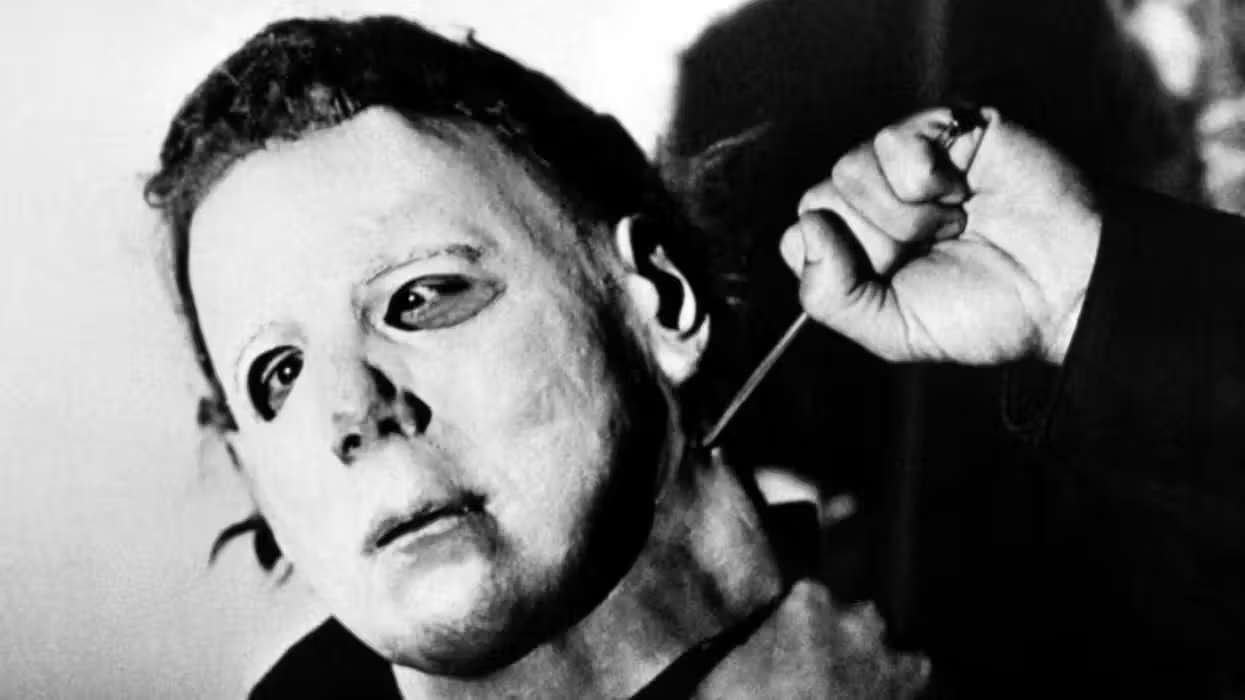
Halloween (1978)
If you have watched Halloween (1978), or haven’t and just seen the trailer or the poster, you know things don’t get more bizarre than Michael Myers’s face. Imagine that pale, leathery face looking at you through those vacant, barren eyes in the dead of the night; you would know what I mean.
Unlike most masks, cinematic or otherwise, this one’s power lies in its emptiness. It’s unimaginably scary, not because it looks that way, but because it offers zero cues. Yes, there is not a trace of humanity in it, but it’s not even your regular evil face. Is it a person underneath? You wouldn’t know. It’s just a shape, and it’s just there.
And that’s why it’s quite unbelievable when someone tells you that no serious creative process or brainstorming sessions went into the creation of this mask. On top of that, it was a cheap, mass-produced mask of a well-known sci-fi hero that anyone could buy from a novelty store.
The Michael Myers mask is a story of last-minute improvisation and creativity born out of necessity. And it’s quite an interesting one.
Halloween: The Production
Halloween was a low-budget independent project. The producers knew from the beginning they would have to be close-fisted about spending the money. And that’s why being innovative and resourceful was at the core of the production.
The Shoestring Budget
Small-time indie filmmakers Irwin Yablans and Moustapha Akkad approached director John Carpenter, then a young filmmaker who had only two films to his credit. The production budget that was finalized was a meager $325,000. That meant every item to be used in the film had to be sourced cheaply and cleverly. It also meant there was no possibility of a dedicated special effects team, let alone a studio. Their only options were to make something as inexpensively as possible or find something that already existed and tweak it as per their needs.
The Search for Michael Myers’s Face
To understand the gravity of the money crunch the makers were facing, let’s put it in perspective. Michael Myers is not only the main villain or the central fear point around which Halloween’s narrative is built, but he is literally the movie’s face and identity. Michael Myers is Halloween. And they didn’t have any budget for his face.
But as they say, creativity blooms in tight corners. In the script, Michael Myers’ character is described only as “The Shape.” It was clear from the beginning that ambiguity would contribute to his fear factor, and so his face would always remain hidden. And how else would you hide a face but with a mask? It couldn’t be just any mask. It was a low-budget movie, but it wasn’t a street play put together by children. It had to stand out from the crowd, especially from the rest of the characters in Halloween masks. But more importantly, it would have to look like an unstoppable, indecipherable force of terror.
A Chance Meeting With a Starfleet Captain
Now it was clear what they wanted; the question was, how? The money was still a problem, and Michael Myers still needed a creepy face. Tommy Lee Wallace, the movie’s editor-cum-production designer, was tasked with finding a solution, with a simple instruction: find something creepy but blank. And he did, in a generic costume shop on Hollywood Boulevard.
But it wasn’t love at first sight. It wasn’t even “just one” love at first sight; it was two, an Emmet Kelly Sad Clown and Captain Kirk. They obviously didn’t know it back then, but this was the moment upon which the future of a possible, and very successful, movie franchise depended. Their choice was going to shape the future of the horror genre.
Director John Carpenter liked both, but his final assessment was that while the Emmet Kelly clown was creepy, Captain Kirk’s mask had a very disturbing neutrality—a quality that creeps you out but you don’t know why. Just like that, there was a winner, and all it needed was a bill of two dollars.
The Making of “The Shape”, a.k.a Michael Myers
The choice was made, but it was still Captain Kirk, and he belonged in Star Trek. Whatever grim appeal this mask had, it still had a lot of humanity under its skin. It needed to be Halloweenized, and not just in a Halloween way, but in a truly unsettling way that would knock someone’s light out.
Peeling the Hero Off
The makeover process was very crude, quick, and quite minimal. Wallace simply cut the eyeholes a bit wider, which suddenly replaced Captain Kirk’s benevolent look with something dark and empty. He shaved off the sideburns and eyebrows, which took away any sign of individuality. Then he spray-painted the whole mask a ghostly white. To add some muted menace, he ruffled up the hair, giving the mask an unkempt, rustic appearance. All it took was a few minutes to reduce Captain Kirk to “The Shape.”
The Ominous Emptiness
While the Emmet Kelly clown would have made a truly creepy Michael Myers, it wouldn’t have been unique. It wouldn’t have scared you, but it wouldn’t have caused you to skip a heartbeat. Because you would have known what to expect.
That wasn’t the option with what was created. It was truly just a shape. It looked soulless. It looked human-like but still inhuman. This shape was created not to show emotions, but to absorb your deepest fears and anxieties.
The Shape’s Legacy
You cannot overstate the impact this simple tweak to a simple mask had on pop culture. The mask defined a sinister character and, while doing so, set a definitive standard for the future horror and slasher films that followed, as well as their subgenres.
Setting the Horror Standard
The idea this mask left behind was of an inscrutable face behind something truly threatening. And we can see this formula being implemented in many movies that came after. Jason Voorhees’s hockey mask in Friday the 13th and the Ghostface mask in Scream exploited this idea efficiently and capitalized on its fearsome power.
William Shatner’s Accidental Horror Legacy
William Shatner, being unaware for years that he was somehow behind the creepy face of an iconic movie, was shocked when he found out. One can only imagine how amusing it must be for him to know this very strange and personal connection with Halloween.
Conclusion
The story of this Halloween mask proves one saying: necessity is the mother of invention. Had it not been for the lack of money, we may never have had The Shape, the utter blank face of an evil that has haunted us for years. It’s also worth noticing that one of the most enduring images of horror cinema was not a result of expensive special effects. It didn’t even need to be created from the ground up. All it needed was a trip to a roadside thrift shop and two dollars.
Just like the ultimate evil was hidden behind a plain face, the ultimate filmmaking was hidden behind this simple act.
- The Lighting in 'Halloween' Is a Masterclass in Creating the Classic Horror Look ›
- The Evolution Of Slasher Movies | No Film School ›
- How 'Halloween' Became a Horror Classic | No Film School ›
- 10 John Carpenter Moments That Still Haunt Us | No Film School ›
- What is the Scariest Movie Ever? No Film School Round Table | No ... ›
- Every Scary Movie on HBO You Should Watch This Halloween | No ... ›
- Watch: John Carpenter Shows How to Master Point of View | No Film ... ›