‘Jaws’: Why Quint Will “Never Put On a Lifejacket Again”
“I’ll never put on a lifejacket again” isn’t fear alone; it’s a survivor’s logic shaped by a wartime tragedy, and echoes the film’s brutal view of the ocean.
‘Jaws’ (1975)
The ocean is like a massive, nonchalant void; a canvas that serves as a blue background. But only until something with way too many teeth shows up. After that, it doesn’t remain in the background. It becomes a red painting of terror.
In Jaws (1975), that terror oozes out like drops of blood from an old injury. And this is the moment when the movie shifts its energy. We pivot from looking for a sea monster and start seeing the big blue canvas from the eyes of a man who has already been eaten alive, emotionally.
The “USS Indianapolis” is not just a wartime anecdote; it’s a very personal brand of fatalism. On the outside, the line “I’ll never put on a lifejacket again” serves as a logical end to a story about being left at the mercy of the ocean. In essence, however, it pretty much encapsulates the spirit of setting a boundary with fate.
The “USS Indianapolis” Monologue
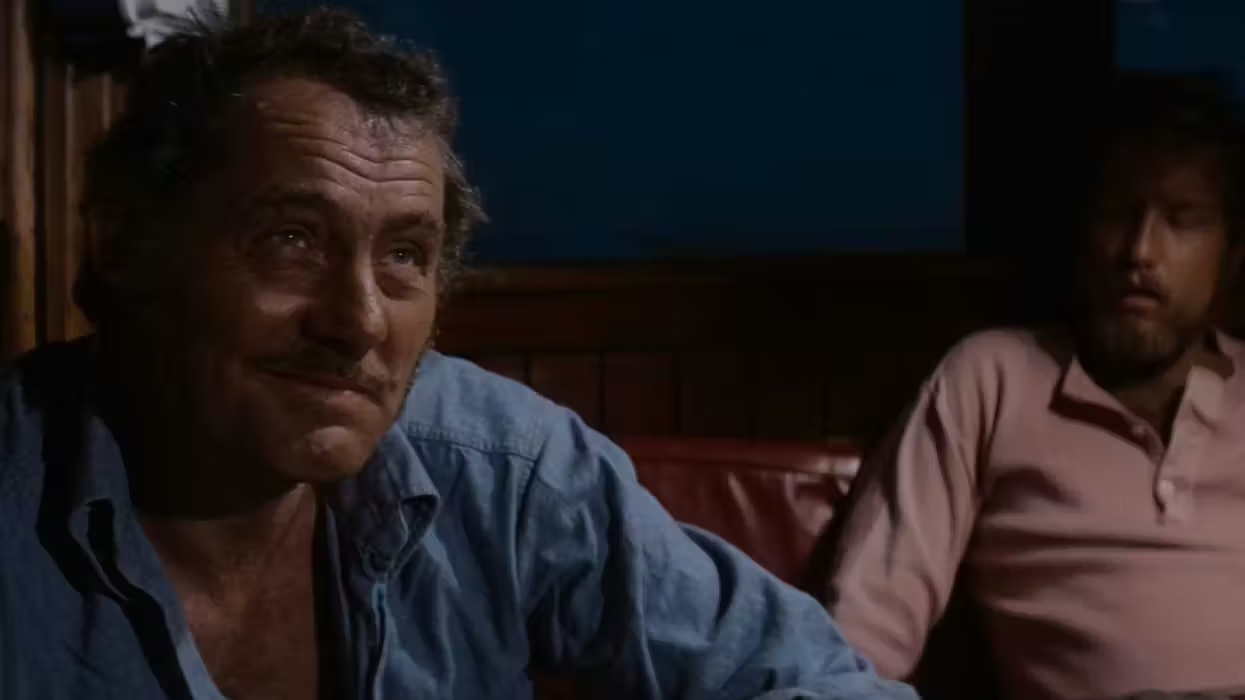
After the 4th of July horror at the beach, Chief Brody (Roy Scheider), Quint (Robert Shaw), and Hooper (Richard Dreyfuss) go on a shark-hunting mission on Quint’s boat, the Orca. They have a brief stint with a massive shark, but it vanishes underwater.
Later that night, Quint and Hooper drunkenly exchange stories about their various body scars. After Brody asks about one of Quint’s scars, he says it’s from a tattoo removal. The tattoo used to be “USS Indianapolis.” This immediately dampens the lighthearted mood on the boat.
Quint narrates the story. The USS Indianapolis was a World War II cruiser tasked with a top-secret mission of delivering the essential components for “Little Boy,” the atomic bomb that was dropped on Hiroshima a week later. While returning after delivering the components to the Tinian Naval Base, the cruiser was torpedoed by the Imperial Japanese Navy. It sank in the sea in 12 minutes and took 300 sailors with it. The remaining 890 were left floating in the middle of the ocean for four days, dealing with dehydration, hunger, saltwater poisoning, and most of all, sharks.
Because it was a top-secret mission, it took four days for the Navy to learn about the disaster. During these four days, the sharks attacked and feasted on the sailors. Being eaten alive by sharks is perhaps the worst possible death for anyone. Ironically, the lifejackets that were meant to be a safety measure turned out to be the death sentence. It kept the sailors from drowning, only to expose them to even more horrifying death. Quint concludes his story by saying, “I’ll never put on a lifejacket again.”
The Line That Sounds Wrong, But Isn’t
Why a Lifejacket Becomes a Target
Lifejackets are meant to protect life, and in usual circumstances, they do. But in the USS Indianapolis disaster, their task turned upside down. The sailors were left alive and floating, but also visible and immobilized. That’s pretty much the same as serving them on a platter for the sharks. They hunted from below, and the surface became a feeding ground. The life-saving device became a marker. Quint’s line carries that brutal shift in logic.
Why the Lifejacket is a False Promise
Quint’s line might sound dramatic and absurd to someone who doesn’t know the whole story. But Quint has witnessed how lifejackets turned from the devices of safety to the ones that only prolong the inevitable. What Quint is saying here is that if the ocean wants you, it will take you. It will turn your life-saving measure into a trap and will consume you anyway.
Even after the “big fat PBY” (PBY Catalina, the amphibious aircraft) came to rescue them, the sharks were still hunting. They were faster than the rescuers. Quint says, “That was the time I was most frightened. Waiting for my turn.” In that last moment, depending on the “dangerously unreliable promise” of a lifejacket, he was perhaps the most miserable he ever was in his life. Meeting violent death when life is just an inch away.
One Line, One Theme: The Ocean Doesn’t Care
Safety is an Illusion in Open Water
If you notice, the film continuously keeps stripping away the certainty of safety. Boats fail, plans fall apart, and tools lose meaning. The lifejacket bit fits perfectly in this thematic mold. Safety on the land? Yes. That’s the humans’ domain. Go nuts while being alive. But water is a different story. Quint’s line highlights that gap. The human rules of the land don’t apply in the ocean. It doesn’t follow human logic. What works there becomes a death trap in the other.
The Paradox of the Hunter and the Hunted
It sounds strange, doesn’t it? A professional shark hunter refuses the most basic safety tool. Be that as it may, it shows one thing about Quint. He is not even trying to survive the shark; he is simply looking for the final, inevitable confrontation. He believes he has been living on borrowed time since 1945. For him, a lifejacket is a symbol of the hopeful, naive world he left behind.
Quint vs. Brody: Two Ways of Facing Fear
Brody has a fear of water. That’s because he doesn’t understand it. Quint fears water because he doesn't understand it. The bottom line remains the same in either of their cases: the ocean is unforgiving.
Brody deals with his fear by relying on systems and preparation. Quint knows better. He relies solely on his experience. For him, the “systems” broke apart decades ago. They have two different approaches to the danger and fear that the ocean presents; Brody’s approach is cautiousness, and Quint’s approach is hardened acceptance of the inevitable.
Conclusion
Quint’s line reminds me of that one scene from Titanic (1997). The Titanic is sinking, and Mr. Guggenheim (Michael Ensign), an elderly gentleman from the upper deck (of the rich), refuses to wear a lifejacket. He says, “No, thank you. We’re dressed in our best and are prepared to go down as gentlemen.” Here, a rich and sophisticated Guggenheim mirrors rough and rugged Quint’s philosophy: “Don’t fight the force you cannot possibly win against.”
Ultimately, this logic is just as cold and dark as the water itself. These men would rather be consumed by the water and sharks than expect a miracle that may never come. It may sound dramatic, but, in my opinion, these are the most honest moments built on terror.
- Jaws’ Most Famous Line Was Actually an Inside Joke on Set | No Film School ›
- Watch: How 'Jaws' Can Help Us Redeem the Summer Movie ›
- Bet You Didn’t Notice 'Jaws' Has Almost No Shark in the First Half — And That’s Genius Writing ›
- The Iconic 'Jaws' Theme Almost Didn’t Make It Into the Movie — Here’s Why ›
- The Best Shark Movie Since ‘Jaws’ Turns 10 Years Old This Month ›
- 'Open Water' at 22: The $500K Shark Thriller Based on Truth ›