The Story Behind the Infamous “Biggus Dickus” Moment in 'Monty Python’s Life of Brian'
Director Terry Jones used a clever casting bait-and-switch to ensure the Roman soldiers’ struggle for composure was 100% real.
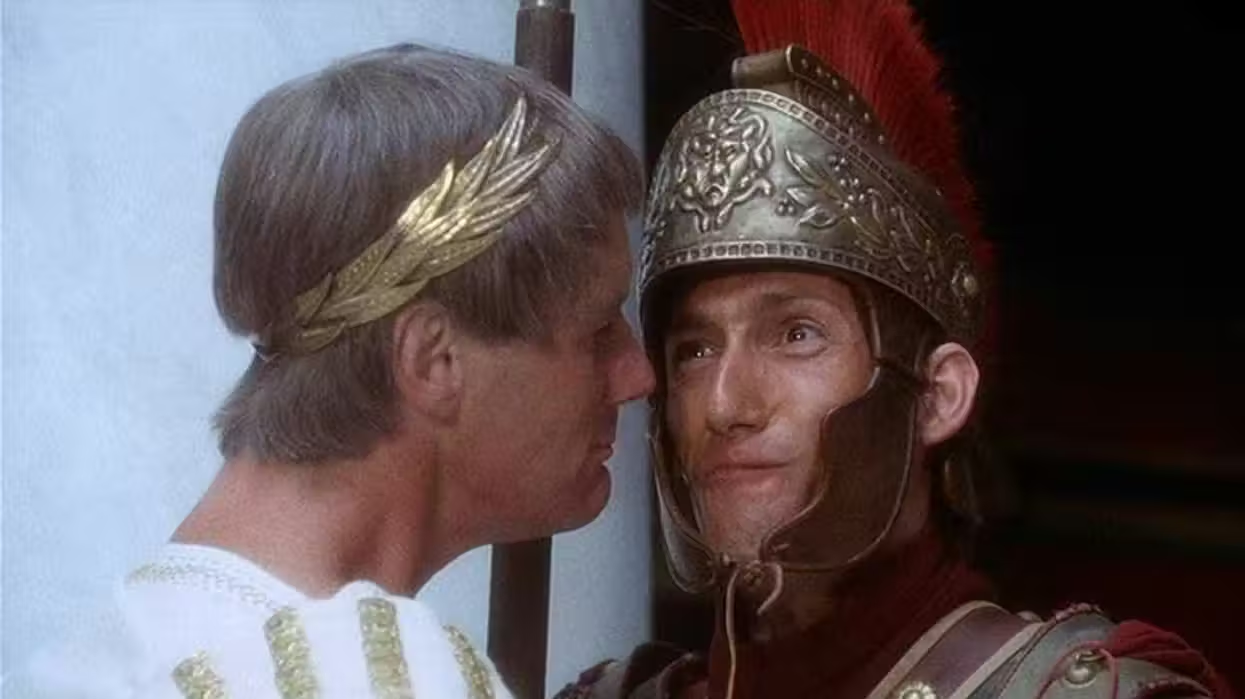
'Monty Python’s Life of Brian' (1979)
In domains such as art, branding, marketing, collectibles, and luxury goods, we often see words like “original” and “authentic” being thrown around like confetti. When it comes to food and farming, the word is “organic.” The idea is the same, though: to claim legitimacy and purity.
The same logic applies to human behavior. Fake behavior is “plastic,” while natural behavior is “genuine.” In television, our partiality toward genuineness results in the success of programs, such as Just for Laughs: Gags and Impractical Jokers. Why go all the way to sophisticated TV programming? Even goofy family videos or people trying to mess with the King’s Guard outside Buckingham Palace are pure comedy gold.
What strikes a chord with us in all these reality-centric videos is the bona fide and honest manifestation of emotion. That’s a real goof, real laughter. In this Kardashian-esque world, increasingly toxic and plastic, these few real moments give us a breath of fresh air.
Movies are intrinsically the kind of projects that are meticulously and cautiously planned, and well in advance, too. Yes, of course, there are improvised moments every now and then, but to make someone improvise with a gun to his head? Innovative. Isn’t it?
Well, that’s what Terry Jones did in Monty Python’s Life of Brian (1979). In a film series that thrives on ridiculous humor, “enacted” comedy from a non-actor wouldn’t have given the best results. Jones knew if the Roman soldiers (played by non-professional actors) were in on the joke, the magic would vanish. Asking for or expecting natural acting from them was pointless. So Jones did the next best thing—held their paychecks hostage. You laugh, you lose.
The result was comedy gold.
The “Biggus Dickus” Scene
Brian Cohen (Graham Chapman) was born in a house that was next to Jesus’s, and was initially mistaken for Jesus himself by the three wise men. He later grows up to resent the Roman occupation of Judea and joins (one of the many) revolutionary movements called “People’s Front of Judea” (PFJ). Sadly, all these peevish, wayward revolutionary movements spend more time fighting each other than the actual Romans.
After PFJ fails to garner enough public support, they plan to kidnap Pontius Pilate’s (Michael Palin) wife. Once they reach inside Pilate’s palace, they come across another revolutionary group, called the “Campaign for a Free Galilee,” who are there with exactly the same objective. As expected, these two factions start fighting over who came up with the plan first. The chaos attracts the attention of the palace guards, who arrive there, but not before everyone has knocked each other out—except Brian.
The Centurion of the Yard (John Cleese) arrests Brian and produces him in front of Pilate. When, during questioning, Brian mentions his father’s name as “Naughtius Maximus,” the Centurion claims that it’s a made-up joke name, just like “Biggus Dickus.” As it turns out, Pilate actually has a friend, named Biggus Dickus. Every time the name is mentioned, the palace guards standing around burst out giggling. Pilate takes offense to this and promises severe consequences if they laugh, but at the same time, he goads them into laughing by repeatedly saying “Biggus Dickus” aloud. After trying hard for some time, the guards finally give up and end up rolling on the floor, laughing uncontrollably.
Engineering the Reaction
A Tactical Bait and Switch
Aside from Terry Jones, it was only the principal cast, i.e., Chapman, Palin, and Cleese, who knew the script. While they rehearsed the scene, even the actors playing the palace guards knew the lines. However, on the day of the actual shoot, Jones replaced the secondary cast with new ones. The new actors were given only one simple instruction: “Don’t laugh under any circumstances, or you won’t be paid.” The warning created a little tension but more curiosity. We tend to be more curious about things we are asked to stay away from. Right? (Usually that applies to kinds, but when do we really grow up?)
The High Stakes for the Background Cast
The threat worked. The cast stood in their designated spots, not knowing what was going to happen. All they knew was that their job was to stand still and “not laugh.” The specificity of the instruction caused the anticipation (of the crazy) to bubble up in their heads. Jones had put them in just the right mental state he wanted. Now everything depended on the principal cast. It was their job to make the guards laugh, while Jones’ instruction would forbid them from doing it. Perfect Catch-22.
Palin’s Escalation Tactics
“He Has a Wife, You Know…”
In order to capitalize on the desired reaction from the stirred-up guards (actors), Palin intensified his “baked” delivery by adding another name: Incontinentia Buttucks. And while pronouncing this name, he stretched the syllables just enough to destabilize the room. Before filming the scene, Palin had spent some time coming up with ridiculous names, always thinking, “What would make these actors go crazy?” As it turns out, it was “Biggus Dickus” and “Incontinentia Buttucks.” This whole thing indeed rendered the actors unable to stifle their laughter, and they dived into a laughing fit. What’s a little loss of money against a wholehearted laugh, right?
Two Takes, Maximum Damage
Multiple takes weren’t an option and would have essentially killed the purpose. Jones and the principal cast managed to “extract” the desired outcome in just two takes. During editing, the genuine and fresh laughing fits were seamlessly merged with usable composure. As it turned out, a couple of these extras, such as Chris Langham and Charles McKeown, were comedy performers themselves. Yet, it couldn’t stop them from cracking up.
Conclusion
Even today, if you Google “the funniest scenes in Life of Brian,” there is a high chance “Biggus Dickus” will be topping the list. There is a reason why. It captures a rarity: authenticity. A truly human moment of suppressed glee. And this little anecdote shows that sometimes directorial vision should be more than artistic; it should also be cunning. I mean, weaponizing these poor actors’ professionalism against their own funny bones? Stroke of genius!
- Watch: How Monty Python Created Modern Comedy | No Film School ›
- The Story Behind the Black Knight’s Famous Line in 'Monty Python and the Holy Grail' | No Film School ›
- The 14 Funniest Parody Movies of All Time ›
- Mastering the Comedy Genre in Movies and TV | No Film School ›
- Was 1996 the Best Year for Comedy Movies? | No Film School ›
- What Are The Best Comedy Movies of All Time? | No Film School ›
- What is Your Favorite Color?: The Hilarious “Bridge of Death” Scene in Monty Python’ ›
- Film Quote of the Day: The 1988 Comedy That Delivered One of Cinema's Funniest Intellectual Put-Downs | No Film School ›