How 'The Lord of the Rings' Used Forced Perspective to Create Movie Magic
A clear look at how The Lord of the Rings trilogy used camera tricks instead of CGI to reshape Middle-earth’s character sizes.
The Lord of the Rings: The Fellowship of the Ring (2001)
“Forced perspective” may sound like a technical niche; in reality, however, it’s nothing but an optical illusion. You can say it works better because of its old-fashioned charm, but also because it saves a lot of moolah.
That’s pretty much the idea that Peter Jackson applied during the making of The Lord of the Rings trilogy (2001-03). CGI was obviously used, and quite extensively so, but when it came to showing different sizes of the Middle-earth creatures, the makers chose to depend on camera placements and handmade props to create optical illusions rather than creating computer-generated imagery.
The motive was obviously cost-cutting, but also because it didn’t compromise the quality. The trick works because our eyes believe what a camera shows us. We accept a visual as we see it, and it doesn’t matter if it’s a carefully arranged (manipulated) illusion. It eventually turned out to be one of the trilogy’s defining aspects.
Here, we are going to break down the technicality, functionality, and sheer simplicity of this approach, and find out how it achieves the sense of physical reality through an optical illusion.
What is Forced Perspective?
Definition
Forced perspective is a practical cinematic technique that alters how the audience perceives sizes and distances within a shot.
The key to achieving this effect is simple: visual cues, strategic camera placements regarding distance and angle, and controlled spacing. The end result is an object or a character appearing smaller, bigger, shorter, or taller than they actually are. In other words, this is an optical illusion built inside the frame (at the time of actual filming) rather than something added later during post-production. This physical quality of the illusion is why it feels so natural on screen—because it is natural.
How It Works
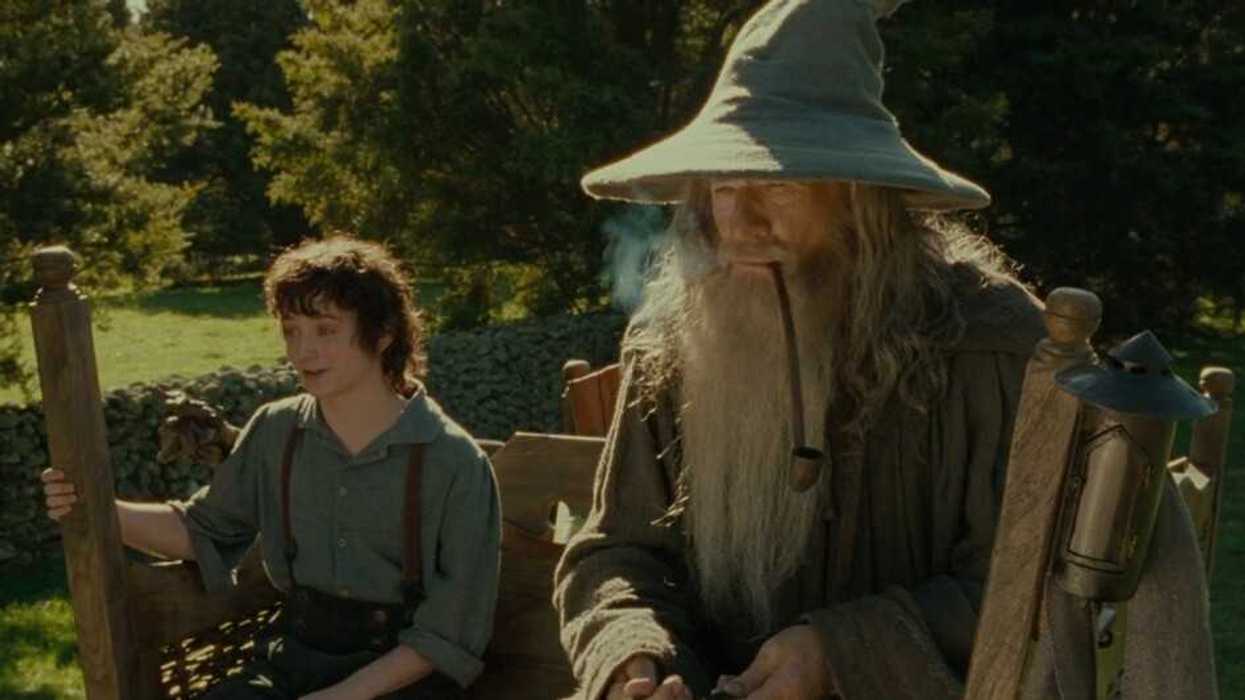
The technique works on the corresponding relationship between the camera, the lens, and the objects (or characters) placed in front of them. The concept is simple: what’s close to the lens will look bigger, what’s farther away from it will look smaller. So, for example, when Gandalf (Ian McKellen) stands at a close distance from the camera, and Frodo (Elijah Wood) stands away from it, the camera will understand Gandalf as bigger and Frodo as smaller, and that’s what it will show us.
But still, we can perceive the spatial plane between them and can figure out that there is quite a distance between them. This is where the filmmaking trickery comes into play. The idea is to remove the sense of depth, which normally reveals the physical distance. So, a filmmaker will angle the camera and arrange the actors in such a way that the lens will see them in a straight-looking formation. As a result, our eyes will read their positions as next to each other.
How the Trilogy Applied Forced Perspective on Set
Camera Placement and Lens Choices
What gives the finishing touches to this technique is the selection of camera lenses, in conjunction with camera heights. Wide-angle lenses are known to exaggerate depth, making the distance between objects appear longer. But Jackson didn’t use this exaggerated depth to show the distance; he instead used it to manipulate the depth of field without making it obvious. It was made possible because the wide-angle lens kept more of the scene in focus and gave him tighter control over depth. The team often aligned the actors diagonally instead of side-by-side to maintain the illusion while keeping their faces visible.
This process took a lot of meticulous in-advance planning, because if an angle shifted even slightly, it could give away the whole trick. Filming scenes this way took a significant amount of time, but it offered Jackson total control over how big or small he wanted the characters to appear.
Adjustable Sets, Moving Tables, and Performance Blocking
The LOTR films also famously used “split-scale-sets,” where set pieces, such as tables, chairs, doors, and even some other props, were built in multiple sizes; some oversized, some smaller than normal.
Also, motorized tables allowed actors to move while maintaining the illusion, at the same time, keeping their distance relationship consistent.
The sets were also marked precisely, and the actors were instructed to hit those in a particular way to match each other’s eye lines. This process was also time-consuming, in addition to being complicated, but, in the end, it created far more grounded and realistic cinematic effects.
Famous Scenes That Showcase This Illusion
Gandalf Arrives at the Shire on a Carriage and Meets Frodo
This scene utilizes a clever version of forced perspective, where it moves along with the camera. In the shot, Gandalf sits closer to the lens, and Frodo is positioned farther back on the same wagon. This makes Frodo appear significantly smaller than Gandalf, even though both characters are on the same prop. Later, when the carriage rolls forward, the framing stays locked, and the optical illusion stays intact from every angle.
Gandalf Visits Bilbo at his Hobbit-Hole (Smial)
Once in Bag End, Gandalf visits Bilbo Baggins (Ian Holm) at his Hobbit-hole, where they seem to share one table. For this scene, the room was built as two separate, differently scaled halves. Also, two different tables were built: a large, oversized one for Bilbo to make him look smaller, and a smaller, undersized one for Gandalf to make him look bigger.
While Ian Holm sat farther away from the camera at his larger table, Ian McKellen sat closer to the camera at the smaller table. They are several feet apart on this split set, but when viewed through the lens, the angles line up, making Gandalf look towering and Bilbo much smaller.
Why It Outshone CGI
Consistency, Real Shadows, and Physical Interaction
In CGI, every effect needs to be created separately and then aligned with every other element to create one coherent visual. But practical effects occupy the same time, space, and light as the actors. So if a ray of light falls or a shadow appears, it remains consistent throughout the visual.
Forced perspective used while shooting the trilogy made sure that whatever every character did, touched props, walked on floors, or reacted to their surroundings, did it in real time. This gave every frame a solid physical grounding (despite the film’s fantastical premise), making all the activity on screen feel lived-in and tangible. CGI, especially from that time, would have struggled to achieve this level of realism.
Viewer Perception and the “It Feels Real” Effect
You may not realize it, but your eyes are trained to spot anything unnatural, anything out of the ordinary. They are quite sharp that way. CGI can achieve realism, but it depends on how qualified, skilled, and experienced the CGI artist is and how perceptive and detail-oriented the end product is. Even when you manage to arrange such an artist, it’s still a very strenuous, time-consuming, and expensive process.
Forced perspective bypassed this problem for The Lord of the Rings films. All the makers had to do was create an optical illusion and record it. Since the technique is built directly into the image, there is nothing irregular about it, and since there is nothing irregular, the audience doesn’t see it.
It’s like, if you are telling the truth, there is no need to be scared. Except, in this case, you are manipulating the truth. But as long as you do it well, all is forgiven. Appreciated even.
Conclusion
The biggest contribution of forced perspective to The Lord of the Rings saga is that every character looks naturally created and shaped by their surroundings, rather than looking like they were copy-pasted. The technique helped blend preparation, craft, and performance into something that was smoothly cohesive and, as a result, looks convincing even today.
The choice to use practical effects, instead of digital subterfuge, gave Middle-earth a texture that the viewers could feel rather than just observe it. It also serves as a lesson that simplicity, if used well, can be its own kind of magic.
- Viggo Mortensen's Hilarious Way He Assesses a Screenplay | No ... ›
- An Epic Battle Between Style & Substance: Why is 'LOTR' Better ... ›
- Elijah Wood Says 'The Lord of the Rings' Wasn't a 'Lucrative ... ›
- You Have To Listen to Tolkien's Advice on Worldbuilding | No Film ... ›
- How to Pull off the Forced Perspective Effect Used in 'The Lord of the ... ›
- How 'The Lord of the Rings' Was Adapted for the Big Screen | No ... ›
- 8 Great Filmmaking Lessons from 'The Lord of the Rings: The ... ›
- Why You Should Watch 'The Lord of the Rings' This Holiday Season ... ›
- What Gandalf Teaches Us About Choice In ‘The Lord Of The Rings’ ›
- The Deeper Meaning Behind Samwise Gamgee's Most Inspiring Line In ‘The Lord Of The Rings’ ›
- The Line from 'LOTR' That Changed How We Think About Grief ›