Storytelling Lessons from Matt Dinniman & Wendy Martin
Two of today's most popular authors take us through some awesome writing strategies.
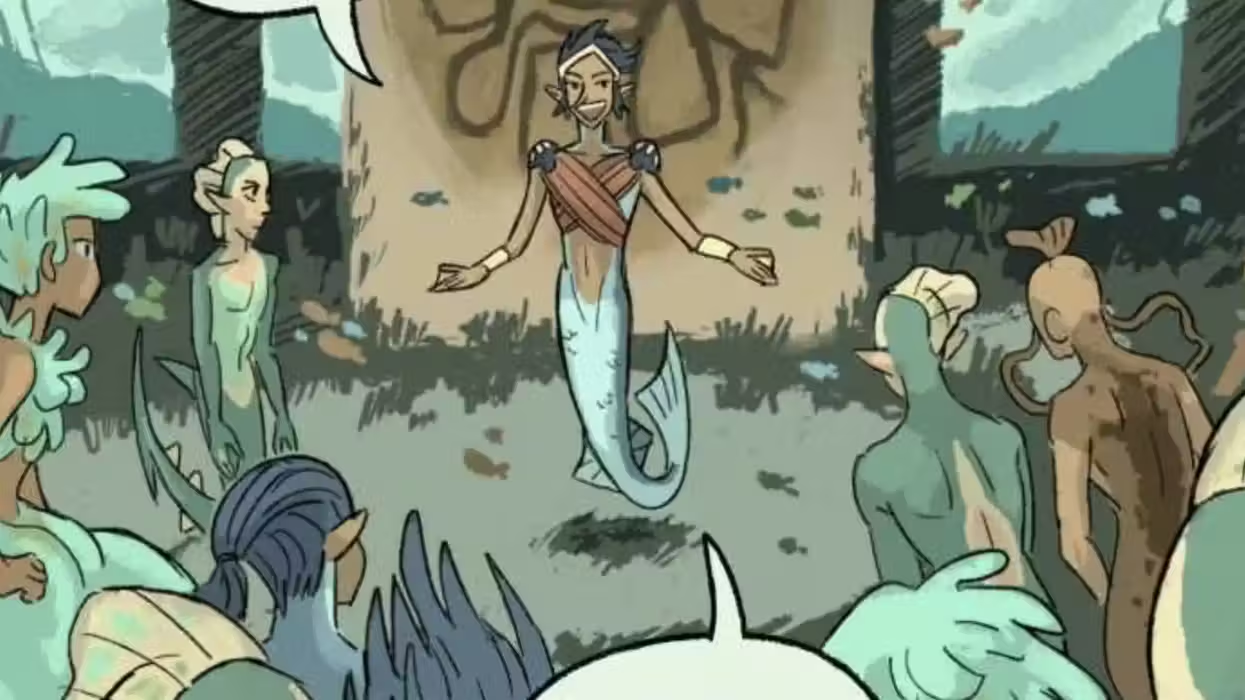
'Castle Swimmer'
I think the best thing screenwriters can do to get better at their craft, aside from writing a lot, is to read a lot.
And that's not just reading screenplays, but reading a variety of mediums to really master storytelling beats and all the little nuances of being an audience and convincing them you have something meaningful to say.
Two of the people I love reading are Matt Dinniman (author of the runaway LitRPG hit, Dungeon Crawler Carl) and Wendy Martin (creator of the viral Webtoon series Castle Swimmer).
So it was cool to see them break down their writing styles and techniques in a video together.
Within this video are creative takeaways that every writer and visual storyteller can learn from, including some stuff on pantsing that really matters!
Let's dive in.
- YouTubewww.youtube.com
1. Start with High Concepts, Let Character Follow
I hope you watched the whole video, because I'm taking out key sections to talk about here, but this is a goldmine for any writer.
One thing I think a lot of people miss out on is worldbuilding; you can't just have a giant concept; you need to create a world and populate it with characters who feel authentic.
Both Dinniman and Martin build their universes by starting with a distinct central concept and asking logical, character-centric questions, then letting things develop naturally from there.
For example, Martin says the idea for Castle Swimmer sparked from playing the Little Mermaid level in Kingdom Hearts and then putting her own personal spin on the situation and the people inside it.
She had questions like, "Do they need doors? They don't need doors; they just swim in," and then built the world from that, knowing her curiosity would mirror what the audience thinks and feels as they dig deeper into the series.
Dinniman’s starting point for Dungeon Crawler Carl is an electrician out in the freezing cold looking for his ex-girlfriend's cat, who suddenly finds himself thrust into an alien reality game show where the losers die.
The comedy and tension come from dropping a grounded character into a hyper-absurd environment, where all the world-building flows naturally from him having to ask questions and participate in a world that is new to both the character and the audience.
2. Embrace "Pantsing"
I told you there would be a pantsing discussion here! And we're not talking about 8th-grade trauma, well, not totally.
Both authors unabashedly self-identify as pantsers. They mean they are writers who discover the story as they write rather than plotting every scene in advance.
You get things through surprise rather than by making a beat sheet.
Dinniman says that plotting out every plot point upfront kills his passion for writing.
In his words, "If I knew exactly how it was going to end, I wouldn't be having as much fun... why would I do it? It's a passion, and that discovery is a huge part of it."
That passion keeps him putting out new pages and also drew him to finish his work, which, as we all know, is how he got a ton of fans.
His ability to keep writing drew people in and led to a hit series.
If he plotted all 10 books out, that may have taken up the time he would have spent writing.
Now, you don't HAVE TO do what they do. I like to prep myself, but know that worldbuilding doesn't have to be pre-planned. And you don't have to stick with what you write down, either.
It can be cataloged after it’s invented.
Once you establish a rule or stat on the page, lock it down in your tracker so future installments stay consistent.
3. Story Always Trumps Visual Polish
I know I want you all to write visually, but the most important thing is getting it out of your brain and onto the page.
I can't emphasize enough that finishing something, or making pages in an ongoing series, is so much more important than ticking every little box.
You can always polish during the rewrite; you need to get your idea onto the page.
As an illustrator and comic artist, Martin emphasizes a rule that applies equally to directors, cinematographers, and even screenwriters: visuals get audiences in the door, but story keeps them there.
The story is what matters most.
She says, "People will forgive bad art in a comic, but they won't forgive a bad story"
Whether you're working with webtoon panels, storyboards, or high-budget visual effects, people want to feel something. They want ot root for the characters on the page and to understand the stakes of the visuals, not just see them.
So tug at their heartstrings with the people, or mermaid, or cats, or whatever—just make sure we care— and then work on the visuals to go along with it all.
That's how you will resonate and get the attention of producers or publishers.
Summing It All Up
The success of both these authors in different mediums proves that building a direct relationship with an audience is one of the most effective ways to prove concept viability to major traditional publishers.
And it kind of proves one thing we talked about before: Hollywood wants creators who make their own IP and who have proven they can get people to show up.
So if you take just one thing away, it's to practice your skills and create things that beckon people to join you, because they'll be strong selling points later.
To do that, you need wonderful characters, creative worldbuilding, and the ability to finish what you start.
Let me know what you think in the comments.