Film Quote of the Day: The 'Once Upon a Time in the West' Line That Made Frank One of Cinema's Greatest Villains
"People scare better when they're dying."
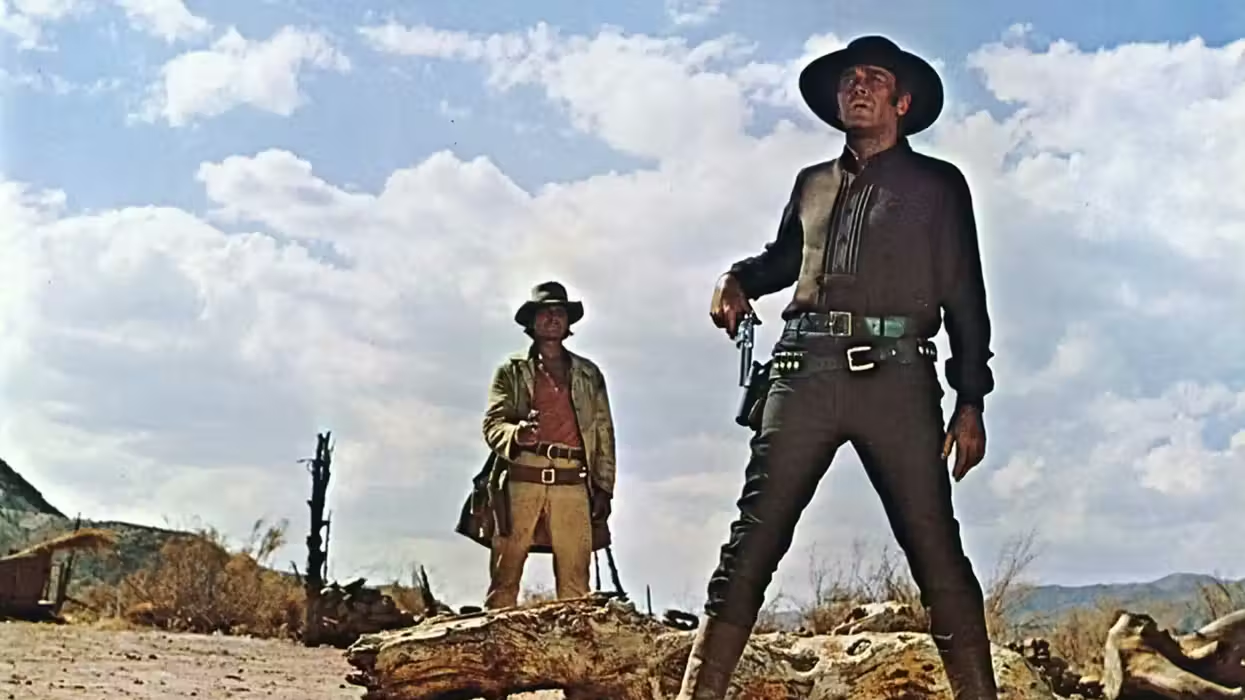
'Once Upon a Time in the West'
I love Sergio Leone, and I feel like he's actually still somehow underrated as a director. The guy knew how to take his time with a story and to shoot a landscape. It seems thosel ong shots also knew how to build character and tension, especially with villains we're waiting to see act.
The guy directed some of the most important Western movies of all time, but today, I was to focus on just one line from one of them.
When Once Upon a Time in the West hit theaters in 1968, audiences were shocked to see Henry Fonda as one of the most evil villains put to screen. He was a hero in so many movies, and in this one, he executes a child in his introductory scene.
But there is one specific line that sneaks past a lot of people but completely encapsulates why Frank is one of cinema's greatest antagonists.
Let's dive in.
- YouTubewww.youtube.com
The Scene In Question
Once Upon a Time in the West is a sprawling Western about the bloody expansion of the railroad. In the movie, there's this one piece of land near Flagstone that this greedy tycoon, Morton (Gabriele Ferzetti), is dying to get his hands on because he knows the new train line has to stop there due ot the availability of water.
Morton thinks he's willing to do whatever it takes to get it, so he sends his main thug, Frank (Henry Fonda), to scare the owner, McBain (Frank Wolff), into selling the land to him.
But Frank goes rogue, kills McBain, and frames an outlaw named Cheyenne (Jason Robards) for the gruesome murder to cover his tracks.
Meanwhile, McBain’s new wife, Jill (Claudia Cardinale), meets up with a gunslinger (Charles Bronson), who both roll into town and get wrapped up in figuring out who killed her family.
In the scene I'm talking about, Frank is sitting inside the luxurious, custom train car of Mr. Morton. These are two evil guys, but Morton was not sure how evil Frank was until he heard about the body count Frank left behind.
This is where Morton realizes he may have hired Frank, but he can't control him.
Morton, horrified not by the morality of killing a man and his entire family, but by the unnecessary mess and complications, confronts his hired gun and tries to reason with him.
Morton: "Tell me, was it necessary that you kill all of them? I only told you to scare them."
Frank: "People scare better when they're dying."
The Contrast of the Myth and the Monster
This is one of the best scenes because it hits the exact intersection of screenwriting subtext, and just like...a little over the top villainy, which has already been backed up by actions.
This is a guy who we saw needlessly slaughter a family. He killed them in cold blood. Now, we're getting to the underlying that he cannot be controlled, and thanks to Morton's evil ways, he's unleashed this guy on the west.
And this evilness will not stop unless someone kills him.
The stakes have been escalated on both sides of the story.
Frank uses fear as an asset, and he understands that a dead human being is more useful to him than one alive. That's something Morton is learning to stomach now.
If you want to win the West, you have to leave a trail of bodies. And if you want to survive the West, you have to be willing to do the same. This is Morton's realization that he's now in bed with pure evil, and that he might be this evil by association as well.
The Takeaway for Screenwriters and Directors
As filmmakers and writers, sometimes we feel the need to make villains chew the scenery, scream their lungs out, or give a massive monologue explaining their evil plans. I love a good monologue and to overexplain things.
But Frank’s line teaches us how a single sentence can do all the heavy lifting for your character development.
We're also seeing how, in this framing, even though Frank is lower and further than Morton, he's in control of the scene. It's a power shift to see how corporate greed meets an unyielding menace and aligns itself with the monster unleashed.
Here are some takeaways:
- Subvert your character archetypes: Fonda carried so much weight as a hero that he blew everyone's minds as the villain in this movie. Try to write and cast against type - it may lead to you getting a better actor, who wants to do something different on screen.
- Keep the delivery casual: The scariest lines get stated as simple, objective facts by evil people who really believe them. This is a whole code and worldview wrapped up into one.
- Let the camera linger: Give your dialogue room to breathe by moving the camera and establishing a point of view for the scene. In here, we see the camera finally rest on Morton's face as he realizes what he's done.
Summing It All Up
There's a reason Once Upon a Time in the West still gets talked about today. I have plans to see it in 70MM this month. If you can, do it. It will blow your mind on the big screen.
Breaking into the film industry and getting your scripts noticed can feel a bit like a standoff in the desert sometimes, but leaning into character-defining dialogue is always the quickest way to draw first.
This movie is a great example of that and of some of the best cinematography of all time.
Let me know in the comments below.
- 15 Western Movie Tropes: The DNA That Defines the Genre ›
- 5 Greatest Charles Bronson Lines of All Time, Ranked ›
- When Silence Speaks Louder Than Bullets: The Genius of Leone’s Opening Sequence ›
- Old Henry Quote ›
- Western Movie Villains Who Stole the Show | No Film School ›
- Film Quote of the Day: One Line From 1968's 'Once Upon a Time in the West' Built the Tension Perfectly | No Film School ›
- Film Quote of the Day: The Oddest Trust Test in 'Once Upon a Time in the West' | No Film School ›
- Film Quote of the Day: Groucho Marx's Best Insult Disguised as a Compliment | No Film School ›