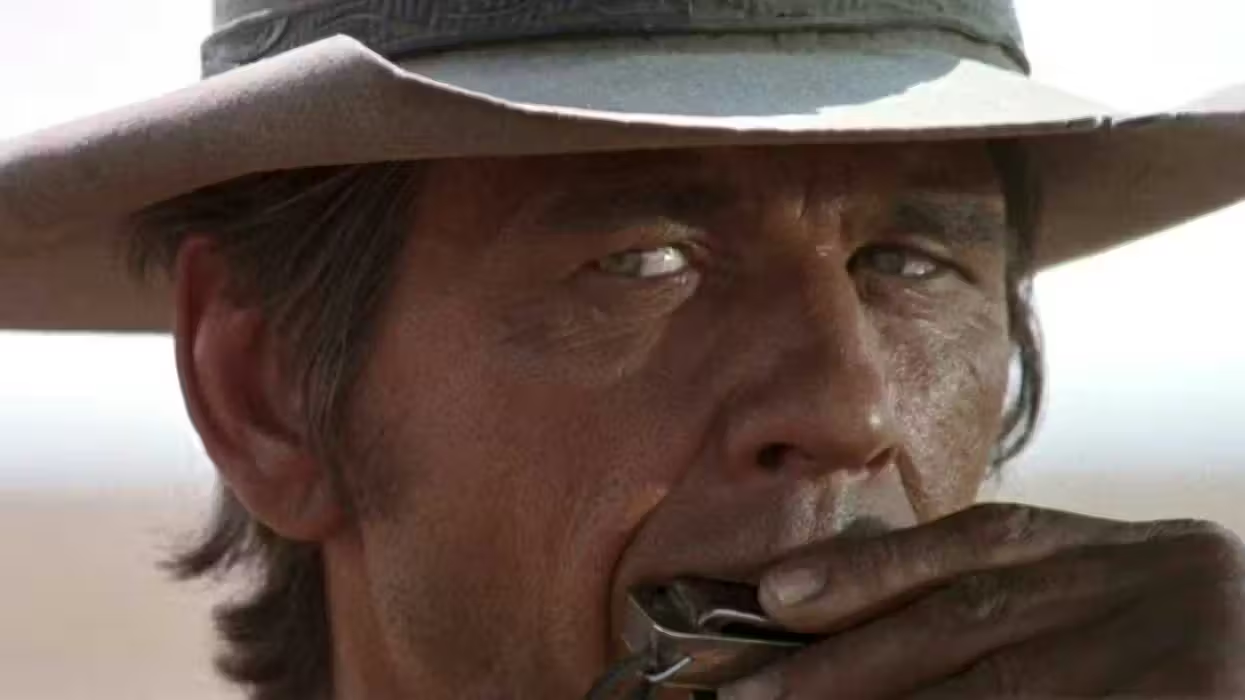
Sergio Leone's Once Upon a Time in the West is a nearly three-hour Western that spends most of its runtime moving very, very deliberately.
Charles Bronson plays a gunfighter known only as Harmonica. Henry Fonda, famously cast against type, plays the killer Frank. Jason Robards is Cheyenne, an outlaw who becomes something close to a friend. Claudia Cardinale plays Jill McBain, the widow at the center of it all.
It's basically a movie that's all about stillness and the danger in that stillness. The climax of the film takes place in the town of Sweetwater, with all the characters coming together as Ennio Morricone's iconic score plays. It's both tense and almost lackadasical, compounded by one of Cheyenne's iconic lines.
Ride along with us as we explore this line of dialogue together.
- YouTube youtu.be
The Scene
We're in Sweetwater, late in the film. Frank is nearing the town for his final reckoning with Harmonica. Harmonica has taken up a position outside near the railroad tracks, back against a fencepost, whittling on a stick with his knife.
Cheyenne rides up. He pauses at Harmonica. They exchange a brief, wordless look, then Cheyenne rides on to meet Jill at her farmhouse. Cheyenne, mortally wounded though he's playing it lightly, has just complimented Jill's coffee.
"My mother used to make coffee this way. Hot, strong, and good."
Jill moves to the window and watches Harmonica out there. She turns to Cheyenne.
"Cheyenne," she says.
"Huh?" he answers, at the water basin.
"What's he waiting for out there? What's he doing?
Cheyenne washes his face. "He's whittlin' on a piece of wood. I've got a feeling when he stops whittlin'... Somethin's gonna happen."
At that moment, Frank rides up to confront Harmonica, while Cheyenne and Jill watch from the farmhouse. Harmonica does stop whittling, then gets down from the fence and puts his knife away.
The line about whittling is often cited by fans as one of their favorites, and at first glance you might wonder why. After all, it feels like a bit of a melodramatic exchange when he's not really saying anything super impactful.
But with this line, the scene lets us all know that there's a countdown running. Harmonica's knife is marking time that only he keeps.
The domestic warmth of the coffee moment right before makes the shift harder. Cheyenne's line is delivered in the same easy register as his crack about Jill's coffee.
The Line as a Ticking Clock
Cheyenne's line is a near-textbook execution of what Hitchcock called the bomb-under-the-table idea. Tension comes from information, not surprise. If the audience doesn't know the bomb is there, an explosion is a shock. If the audience knows, every second of the ordinary conversation happening at that table becomes unbearable.
The bomb in this case is Harmonica himself.
The line itself is on the nose… without being too on the nose. Yes, Harmonica is whittling, and he'll stop to commit necessary violence. But the point of the line is still somewhat abstract. Cheyenne doesn't say, "When he stops, he'll kill Frank." He says, "Somethin's gonna happen."
The audience has to fill in the specifics themselves, which pulls them into the scene as collaborators.
The line also generates a bit of dramatic irony. Jill now knows the same thing Cheyenne knows (that Harmonica is a fuse), but Harmonica himself, whittling with his back to them, is not announcing that he is. We're reading him from outside his skull.
If you're looking for easy ways to up the tension in your own writing, create a ticking clock. This could be a scene-level clock or a clock that governs the whole movie. It's a great way to create direction for both your characters and your audience.
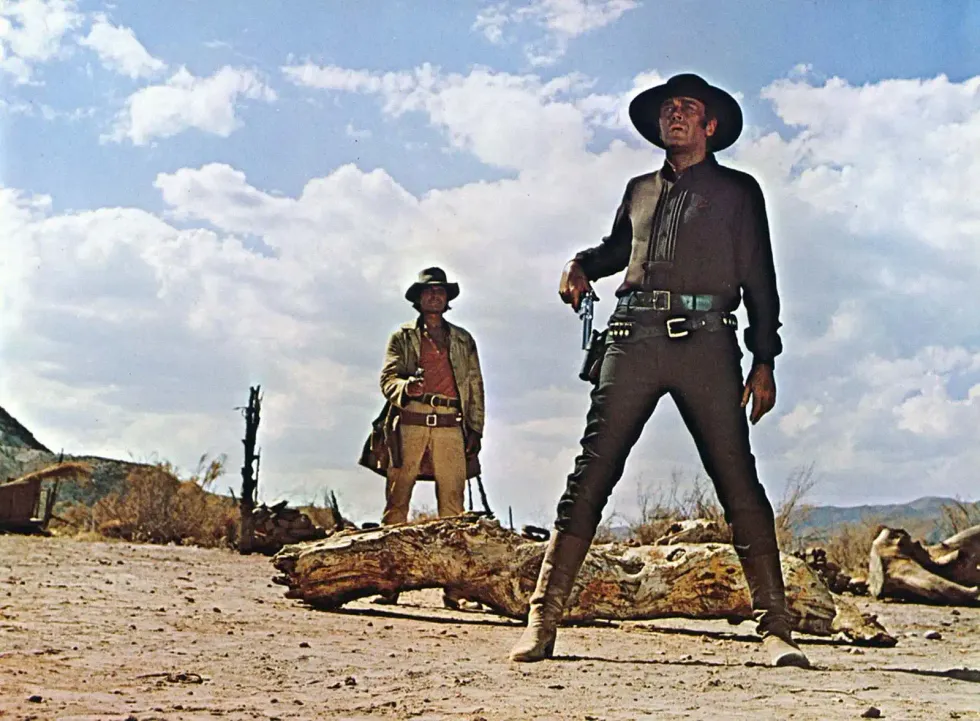 'Once Upon a Time in the West' Credit: Paramount Pictures
Cheyenne Is the Only Character in This Movie Who Talks
No, not literally. But Once Upon a Time in the West features many men who barely speak. Harmonica communicates in stares. Frank does his talking with a gun. Morton, the railroad man, is a tycoon behind a desk. In a Leone Western, most characters don't explain themselves. They just act.
Cheyenne is the exception. He's the philosophizing rogue, which is the same character type Leone gave Tuco in The Good, the Bad and the Ugly. He's the film's moral center, rough around the edges but overall a good guy.
He jokes with Jill. He rambles about his mother. He needles Harmonica about Judas and Jesus. He's the one man in the movie who says what he thinks, which is very necessary among the other characters. Somebody has to speak, or the audience is left staring at three sphinxes for three hours. Not very exciting.
That's why the whittling line is his. Cheyenne isn't a sidekick just delivering exposition, because we would have realized the same thing a few seconds later when Frank arrives. When Cheyenne earlier says of Harmonica, "Instead of talking, he plays. And when he better play, he talks," it's his way of offering insight that might not be necessary but gives us texture.
He speaks Harmonica's silence fluently. "When he stops whittlin'... somethin's gonna happen."
It's worth noting too that he's kind of an oracle by this point. He's dying. Cheyenne has taken a bullet during the fight with Morton that the audience is starting to sense is going to kill him. He walks out of the farmhouse alongside Harmonica after Frank falls and collapses shortly after.
How to Use This in Your Screenplay
If there's anything you can do to increase tension, even for a second, go for it. Give the audience a bomb, a trigger, a Chekhov's gun, something to make them wonder what might happen next, even if you answer their question in the very next scene.
Once the audience knows what to watch for, every ordinary frame becomes a tick of that hidden clock. This is Hitchcock's suspense rule again.
Mix verbal and nonverbal cues. The tension is created by dialogue. The release is created by a physical action. This is one of the most efficient suspense mechanisms in film because the dialogue doesn't have to describe what happens next. It just tells you where to look.
Give meaning to the mundane. Whittling might be the least threatening thing a Western character can do. Leone chose it because, in this case, he knew the calmer the setup, the harder the release.
- 15 Western Movie Tropes: The DNA That Defines the Genre ›
- 5 Greatest Charles Bronson Lines of All Time, Ranked ›
- Film Quote of the Day: The 'Once Upon a Time in the West' Line That Made Frank One of Cinema's Greatest Villains ›
- When Silence Speaks Louder Than Bullets: The Genius of Leone’s Opening Sequence ›
- Film Quote of the Day: The Oddest Trust Test in 'Once Upon a Time in the West' | No Film School ›