A Nice Piece of Hickory: Why ‘Pale Rider’s’ Simplest Fight is Its Best
After dismantling a gang of thugs with an axe handle, the Preacher delivers a line that perfectly blends humor, menace, and Western myth.
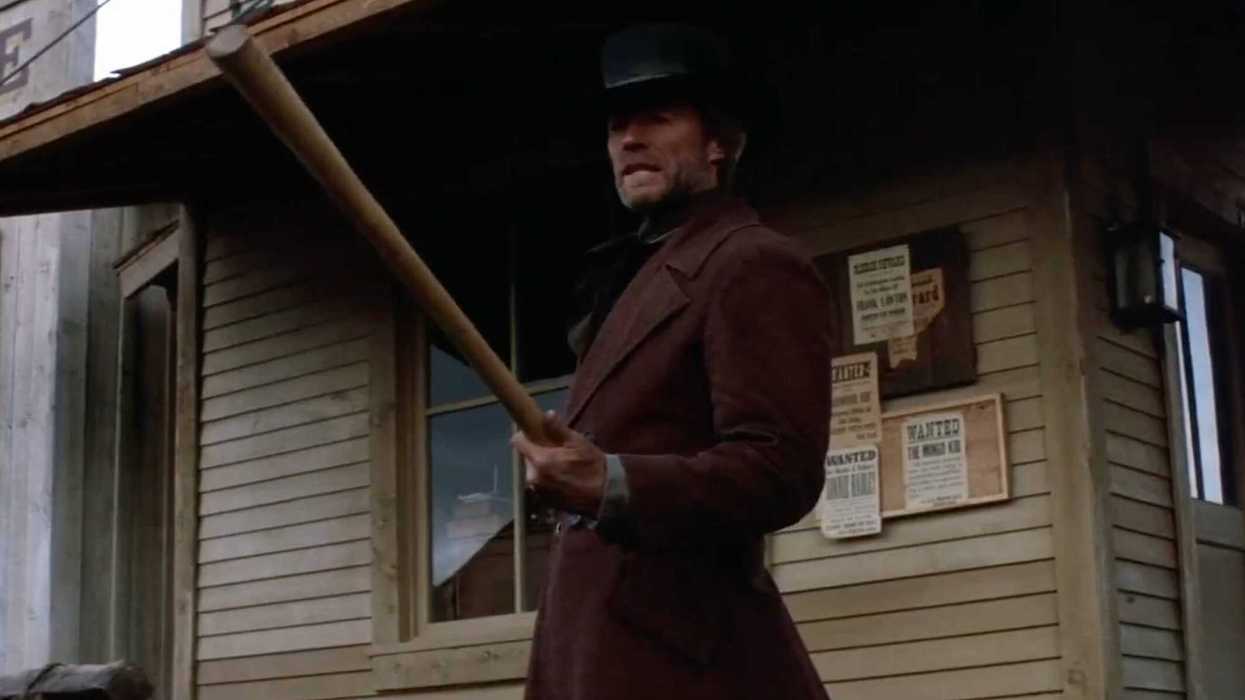
‘Pale Rider’ (1985)
A cowboy is the soul of any Old West tale, and his “Peacemaker,” a.k.a. the Colt .45, is his weapon of choice. So, when this six-shooter is replaced by an axe—I’m sorry, an axe “handle”—you raise an eyebrow and pay attention.
In Pale Rider (1985), Clint Eastwood’s mysterious Preacher, as always, rides into a town to spread his tough but fair magic. The first to face the music is a group of thugs. Except, this time, he makes an entrance with this aforementioned axe handle instead of a gun. It sure makes for a nice Bōjutsu fight, and yet, you can’t help but wonder, “Why the break from the routine?”
But here is the one thing that we got wrong. The weapon that a cowboy depends on is neither his gun nor anything material. His weapon is his confidence. And that confidence peeks through in these words: “There’s nothing like a nice piece of hickory.”
Let’s see what exactly happens and what he means when he says that.
Enter, Pale Rider: The Preacher
In Carbon Canyon, California, a small community of independent prospectors has settled to work their claims. They are being terrorized by a mining baron, Coy LaHood (Richard Dysart), who wants to control all of the canyon’s gold.
Hull Barret (Michael Moriarty) is one such independent prospector. One day, while he is carrying out his daily tasks and picking up supplies, a group of four henchmen employed by LaHood start harassing him and then beat him up. A mysterious stranger, the Preacher (Clint Eastwood), who had recently ridden into the town, suddenly appears and effortlessly beats them into submission using nothing but an axe handle.
After the thugs are beaten and lying on the ground, the Preacher looks at his axe handle and says, “There’s nothing like a nice piece of hickory,” before throwing the handle onto the piled-up thugs.
The “Hickory” Philosophy
This line is both a punchline and a threat. The way he says it, as if he were talking about freshly brewed coffee, makes it a lighthearted wrap-up to a violent encounter. At the same time, it’s also his veiled reminder to the thugs that he is used to this "coffee" and might try it again. Just like a cup of coffee gives you renewed gusto and a fresh start, this “piece of hickory” does something similar to him.
Why the Line Works
Clint Eastwood’s Understated Delivery
Like most of his performances, Eastwood maintains his “downplayed” vibe. His character has delivered heroic justice, and his actions have spoken quite loudly enough. There is no need for him to raise his voice or be dramatic. Being dramatic would indicate that this is a standout moment for the Preacher, which it’s not. By saying this line as a “passing comment,” Eastwood makes it cooler. The calm tone subtly reinforces the impact of his victory and keeps the scene grounded.
Fair and Practical Justice in the Western Tradition
At the start of the scene, you can see each of the four goons picking up an axe handle from a bucket. They improvise their thuggery by picking whatever is nearby. That’s a wildly violent and disturbing attitude. The Preacher, who is shown to be observing from the start, simply repeats their action and turns it against them. He does what they do, and he fights with what they have; nothing more, nothing less. By doing this, he creates a sense of fairness, and that’s why the ultimate justice feels weightier.
Also, Western heroes often rely on skill and practicality. Guns may be an integral part of their lives, but they aren’t fussy about them when they are actually needed. Improvisation is the key here. Both the Preacher and the goons improvise—for different purposes.
Conclusion
The “nice piece of hickory” moment stays with us because it feels like a gritty presence is winking at you. It also shows us a hero who is completely in control of his environment—as Eastwood’s characters usually are. His opting for wood over lead shows that he is fair (for reasons I explained above) and is capable of knowing how much pressure to apply, as well as when, where, and on whom. Small players, small weapons.
Ultimately, this only proves the saying: the best weapon is what’s next to you.