The Line That Marks Butch’s Freedom In 'Pulp Fiction'
Unveiling the hidden meaning behind that sigh of relief.
Pulp Fiction (1994)
Pulp Fiction features some of the most iconic antagonists. Out of them, Zed (Peter Greene) and Maynard (Duane Whitaker) are the ones I fear the most.
So, when Butch Coolidge (Bruce Willis) says, “Zed’s dead, baby. Zed’s dead,” as he comes to pick up Fabienne (Maria de Medeiros) to leave the city forever, the relief in Butch's voice mirrors what audiences feel—and what Marsellus (Ving Rhames) must feel.
In this article, we’re discussing why Butch’s quote is less about sass and wit and more about him reminding himself of his narrow escape from death.
Story and Themes (In the Context of Butch Coolidge)
Quentin Tarantino’s Pulp Fiction follows interconnected storylines of a group of Los Angeles criminals, presented in non-linear timelines that ultimately converge into one.
Butch’s arc in the story is that of survival, honor, and self-determination against the backdrop of the violence of fate. An aging, overlooked boxer, Butch is hired by Marsellus Wallace, the L.A. crime-lord, to lose a fight.
Instead, Butch risks both his safety and his money and double-crosses Marsellus, betting on himself and winning the fight. He lets his disdain for being belittled and underestimated shape his fate, becoming an antihero who chooses pride and honor over money (and life) by shunning submission.
His actions trigger Marsellus’ wrath, which sets off Butch’s desperate flight from Marsellus’ trusted hitmen.
The Scene
We’re at the climax of Pulp Fiction. Butch arrives outside the motel where he kept his girlfriend, Fabienne, hidden away. Fabienne has no clue about the perils in her boyfriend’s life.
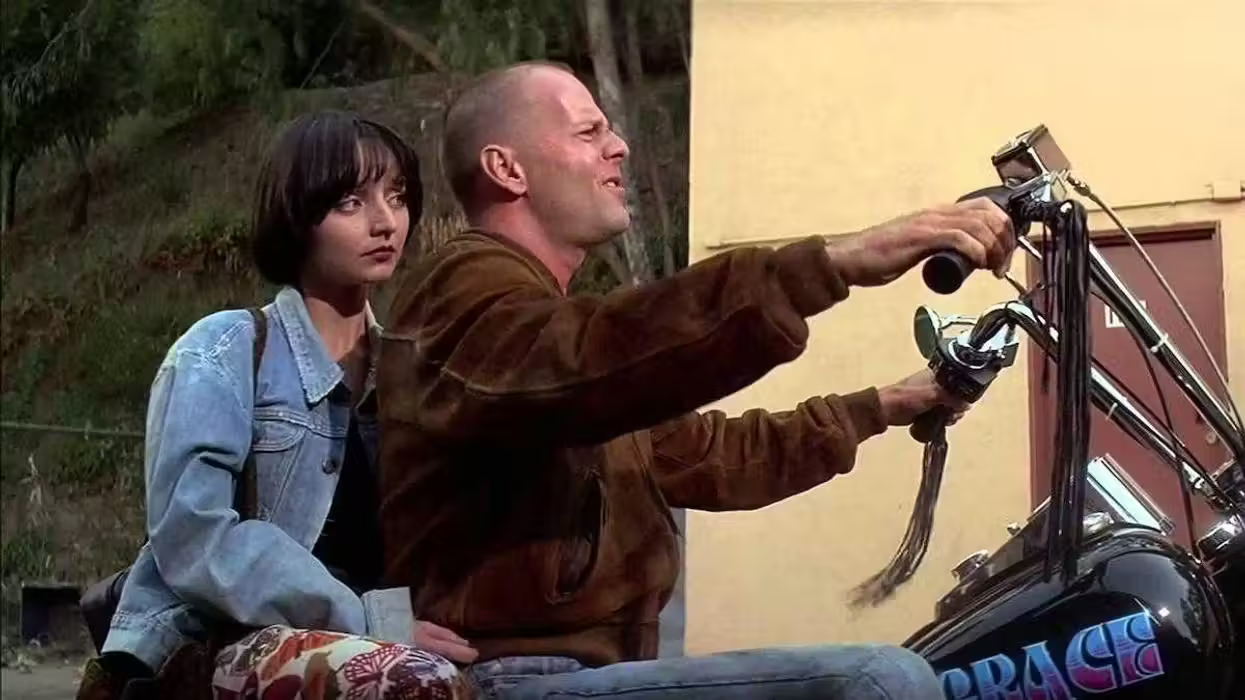
Fabienne rushes outside to the balcony as Butch calls out her name. She sees him on a chopper, which she mistakes for a motorcycle. Worried about Butch, she starts demanding answers. He asks her to hop on the chopper quickly, as they must leave right away. But she is too shaken.
With Butch gone for so long and now returning with a broken nose, she cannot stop asking questions. Butch loses his cool over her for a moment, and the innocent Fabienne breaks down into tears. Butch gives her kisses and apologizes, after which she finally hops on the chopper, still worried about Butch and his injuries.
“Whose motorcycle is this?” she asks again.
“It’s a chopper, baby,” Butch corrects her.
“Whose Chopper is this?” she asks, confused and worried.
“Zed,” Butch replies.
“Who’s Zed?” she asks.
“Zed’s dead, baby. Zed’s dead,” Butch says with a subtle grin, as he revs up the engine and drives away with Fabienne.
Why “Zed’s Dead” Is a Sigh of Relief
Here, “dead” means more than that Zed simply dies. It is a sly comment on how his days are going to be no less than hell, now that Marsellus has him as a hostage.
In this case, Zed is at the mercy of Marsellus, so he’s going to die (a very slow, painful, agonizing death).
1. The End of a Brutal Antagonist
Zed and Maynard represent a different breed of danger than Vincent, Jules, Butch, or Marsellus. Their violence serves no purpose beyond sadistic pleasure, while the others use violence as a means to an end.
Looking back, Zed is a bigger embodiment of evil and brutality. Zed's willingness to hold hostage and sexually assault a powerful crime lord like Marsellus demonstrates his recklessness and depravity.
So, with Zed under Marsellus’ custody, Butch has nothing to worry about.
2. Butch Is Even with Marsellus
Crossing paths with Zed and Maynard was an unfortunate moment for both Marsellus and Butch, considering the former were random predators who attacked the latter when they came into their pawn shop. Although what happened with Marsellus is unfortunate, it opened a door for Butch.
Butch’s humanity doesn’t let him leave Marsellus behind. As he saves him, Marsellus gives him the pass he deserves. In exchange for his silence, Marsellus lets Butch go, calling it even with him.
The encounter with Zed becomes Butch's unexpected path to freedom. The randomness of the situation—Zed choosing Marsellus over Butch, Maynard intervening in their fight—functions as a narrative turning point. Without this intervention, Marsellus likely would have killed Butch.
Knowing Marsellus, he wouldn’t have spared a double-crosser.
3. “Zed’s Dead” Marks a New Life
Butch deliberately keeps Fabienne separate from his violent world. He treats her delicately and keeps her separate from that part of his life. Yes, it’s love, but I think there’s more to it.
Butch falling in love with someone who is nothing like him is not limited to the concept of “opposites attract.” To him, Fabienne is the future he wants for himself someday—innocent, soft, and untainted. So when he tells her, “Zed’s dead,” he subtly underscores the beginning of a new life, his days of violence over now.
Pulp Fiction is a brutal exploration of humanity's darkness through its antiheroes, antagonists, iconic one-liners, and plot twists. It highlights the play of fate in your life and how life is the last thing under your control.
Which is your favorite moment from the movie?
- How Pulp Fiction Hacks the Three-Act Structure ›
- Tarantino Explains Nonlinear Storytelling in this 'Pulp Fiction' Video Essay ›
- Unpacking the Dark Legacy Behind the Gold Watch in 'Pulp Fiction' ›
- 'Pulp Fiction' Gets Deconstructed in This Full-Length Film Analysis ›
- How Pulp Fiction Went from Cannes to $100 Million ›
- The Wolf’s Goodbye in 'Pulp Fiction': One of The Coolest Exits Ever Written ›
- The Grandeur of the 'Pulp Fiction' Dance Scene ›
- Watch: If You Turn the Sound Off, 'Pulp Fiction' is Still Brilliant. Here's Why ›
- How Did Fellini's Influences Directly Inspire Tarantino's 'Pulp Fiction' ›
- 8 Bruce Willis One-Liners That Ruled the ‘90s | No Film School ›