Robert Altman’s 7 Favorite Movies of All Time and What Every Director Can Learn From Them
The blueprints for overlapping dialogue, sprawling ensembles, and beautiful cinematic chaos.
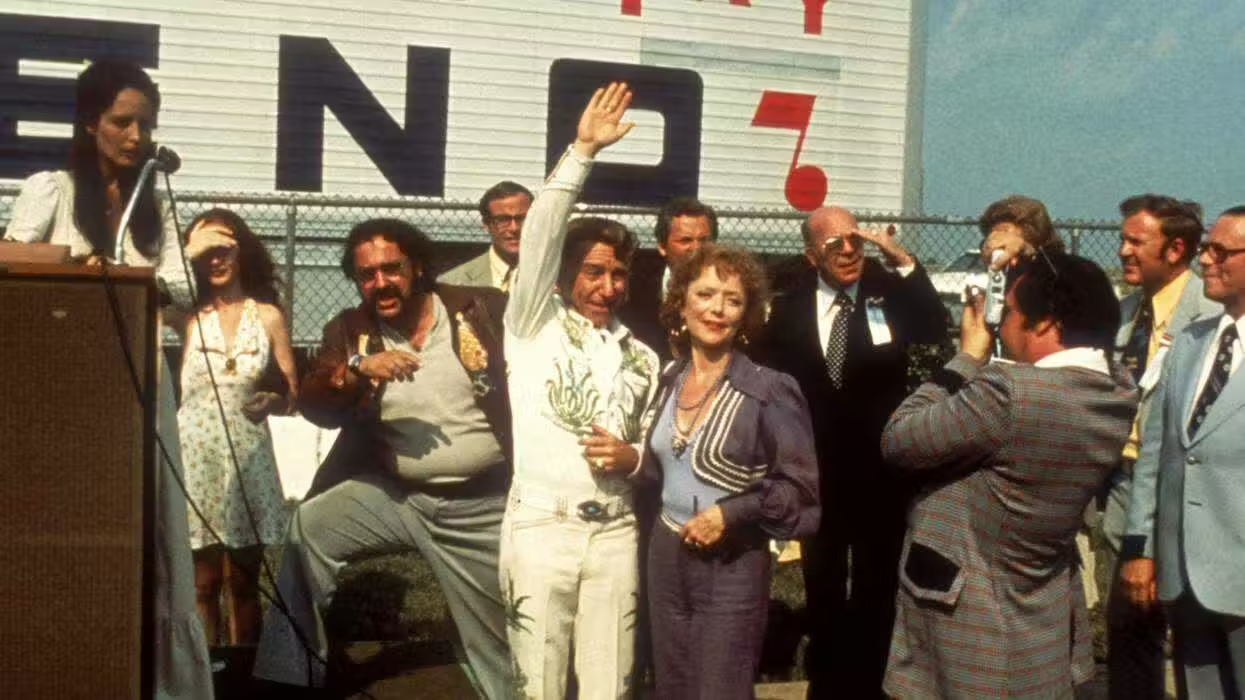
'Nashville'
Robert Altman is one of those directors who created his own rules and visual language, and asked you to come with him on a journey and to embrace them.
When you encounter an auteur like that, it's kind of hard to believe they watched other movies or even took any influence from them. His voice was so singular and unique, but of course, he had to learn everything by watching movies, just like the rest of us.
From MASH and Nashville to The Player and Gosford Park, his filmography captures life as it spills across the frame and is so beautiful to look at.
The films Altman loved and that inspired him reveal the rebel behind the camera, one who was always listening, learning, and changing up until the end.
Here are the seven films Robert Altman counted as his favorites of all time, and the specific lessons filmmakers can take from them when finding their own voice.
Let's dive in.
- YouTube www.youtube.com
1. Rules of the Game (1939) – Dir. Jean Renoir
Jean Renoir’s film follows an assortment of French aristocrats and their servants during a weekend hunting party at a country estate on the eve of World War II.
I mean, if you can't see Gosford Park in that, you gotta be kidding me. But the lessons go beyond one title.
- YouTube www.youtube.com
The Lesson
This was a movie that showed Altman he could track many characters across many scenes, and jam the narrative with a lot of story. It also has a camera that floats in and out of rooms, catching conversations that overlap.
It feels like eavesdropping, and you see the seeds of Altman's signature style.
Without Rules of the Game, we don't get the intersecting characters of Nashville or the overlapping dialogue of lots of his other works.
2. Grand Illusion (1937) – Dir. Jean Renoir
You can see how much of an effect Renoir had on Altman. He has two movies on this list, and this one is set inside a German prisoner-of-war camp during World War I.
Grand Illusion examines the barriers of class and nationality that separate individuals during the war, creating a sort of upstairs/downstairs dynamic in prison.
- YouTube www.youtube.com
The Lesson
I think this is a very empathetic movie, and one where you can see Altman sort of beginning to understand the human heart, and wanting to know characters deeply.
Even the bad guys in this movie are confused men bound by duty and country, stuff they can't turn their backs on.
Altman movies are about observation and watching people step into their own and become who they are. You can see the backstory and understand motivations and goals.
Nothing is on the nose; it's all earned.
3. City Lights (1931) – Dir. Charlie Chaplin
This movie came out after talkies and still didn't care. There was no dialogue, just empathetic moving images that tell the story of a Tramp who falls in love with a blind flower girl.
As you can imagine, Hollywood execs at the time thought it would fail, and it became a masterpiece.
- YouTube www.youtube.com
The Lesson
Altman would not have a career if he left all the decisions up to execs. He waaa. firebrand who didn't follow the rules; he made moving pictures that showcased what he cared about.
He watched City Lights dozens of times and was mesmerized by how Chaplin used faces and bodies moving through space to evoke both comedy and heartbreak.
That duality of things that shouldn't work together but do taught Altman not to pay attention to critics. Be convinced in your style, and the audience will find you.
4. Bicycle Thieves (1948) – Dir. Vittorio De Sica
I actually think this movie sums up all of humanity, and that's why whenever I teach a class or talk to students, I tell them they have to watch it. It's that good, and it's that revealing about process and character.
If you haven't seen it, Vittorio De Sica’s post-war Italian neorealist movie focuses on a desperate father searching the streets of Rome with his young son after the bicycle he needs for his new job is stolen.
- YouTube www.youtube.com
The Lesson
The immense power of simplicity and a clear character motivation. For this movie, De Sica used non-professional actors and shot it entirely on location.
There's a realness here you can't fake. and these people play unvarnished versions of themselves, with wants and desires the audience understands right away.
Altman absorbed this documentary-style observation for films like Thieves Like Us and California Split. He went to places and found real people and obsessed over their lives. He trusted the audience to go along with them and to be enthralled by the world.
5. Citizen Kane (1941) – Dir. Orson Welles
At just 25 years old, Orson Welles rewrote the cinematic rulebook with his debut feature. This movie introduced deep-focus cinematography, non-linear structures, and changed the studio system.
Of course Altman loved it. Everyone loves this movie.
- YouTube www.youtube.com
The Lesson
The structure of Citizen Kane relies on various reporters interviewing different people from Kane's past, with no single, objective truth ever emerging.
Instead, the audience is asked to make their own judgments based on the information they're given, which others cannot put together: rosebud.
Altman took this directly into MASH, using multi-track audio recording to compel viewers to actively choose where to focus their attention in a crowded room.
We're at war and laughing, but there's so much going on we have to track it with our eyes and ears. And he felt free enough to try scenes in a wide range of tones and styles to challenge us, too.
6. Seven Samurai (1954) – Dir. Akira Kurosawa
Akira Kurosawa’s three-hour epic tracks a desperate farming village that hires seven distinct warriors to defend their harvest from a ruthless band of outlaws.
This is another must-see for every filmmaker.
- YouTube www.youtube.com
The Lesson
Even with a lot of characters, you have to make them unique and make them matter. Kurosawa gives all seven samurai individual motivations and plenty of room to exist on screen for us to understand them.
When the final battle arrives, it is a chaotic mess of rain, panic, mud, and ungraceful deaths. But you remember it for all time because of how it scares and moves you.
Altman admired how Kurosawa managed sprawling casts without letting the narrative lose focus and how he separated the characters.
It gave him the confidence to balance the tapestries of Short Cuts and The Player, because he knew audiences could easily track complex ensembles if each character felt fully realized and distinctly human.
7. M (1931) – Dir. Fritz Lang
Fritz Lang’s masterpiece centers on a citywide manhunt for a child murderer in Berlin. We cut between the police force and the criminal underworld, who team up to catch the killer themselves.
- YouTube www.youtube.com
The Lesson
I think Altman gets a lot of credit for many things, but I never quite hear anyone talking about his sound design. Sure, we know the overlapping dialogue bits, but Altman uses sounds to convey emotion, just like this film.
M famously used an off-screen whistle to build an overwhelming sense of dread.
Altman absorbed this technique for The Long Goodbye, where it feels like every meow and footstep off-screen is the world closing in on our detective. And he used it again in Nashville sound design to show the competing acts and differences between bars and environments.
There is also the moral ambiguity of that movie that rubbed off on Altman, who, you can see, refuses to give easy answers to complex human questions.
Summing It All Up
Robert Altman studied these movies to find the courage to be himself. He took lessons from each, but all that became a reason for him to break rules, trust chaos, and build a career entirely on his own terms with his own stories.
Let me know what you think in the comments.