Sometimes you want a film to just do the fundamentals well, and for a movie that gets some of the basic filmmaking things right, maybe without too much flash or flair, you have to go backward. Not every movie needs to be a special effects jamboree shot totally on IMAX—while story and character suffer. Yeah, I said it.
Steven Spielberg's early work is a great example of grounded storytelling that starts with character and builds a universe around them. And Indiana Jones, while an homage to the pulp adventures Spielberg loved, is one such film.
Raiders of the Lost Ark opened in 1981, directed by Steven Spielberg from a Lawrence Kasdan script. It follows a college professor (Harrison Ford) who also happens to be devastatingly handsome and willing to risk his neck to rescue ancient artifacts from no-good black-market dealers who care little for their archaeological value. In Raiders, World War II is in full swing, and the Nazis have set their eyes on the Ark of the Covenant.
Spielberg's work is dense with lessons for anyone learning to direct. We've covered his approach to scene blocking, his long-take philosophy, and his second team method.
Now, follow us as we swerve. You know Steven Soderbergh, who is also a highly revered director? In 2014, the Ocean's Eleven and Magic Mike filmmaker took away color and dialogue from Raiders, swapped in a moody Reznor/Ross score, and posted it to his personal site Extension 765 as a study aid.
A new video breakdown from CinemaHow uses that same experiment to isolate three scenes where blocking does the heaviest lifting. Check it out.
- YouTube www.youtube.com
Blocking and Character Introductions
The character intro is a lost art in most films. It starts with the writing giving the appropriate weight to the moment new faces pop up, then the characters being shot and positioned in an interesting way on the set. How does a character meet the audience? And what can we learn from how we see them? I think the intro should be a reveal every time for major players, and it should teach us something about the character. Don't waste the opportunity!
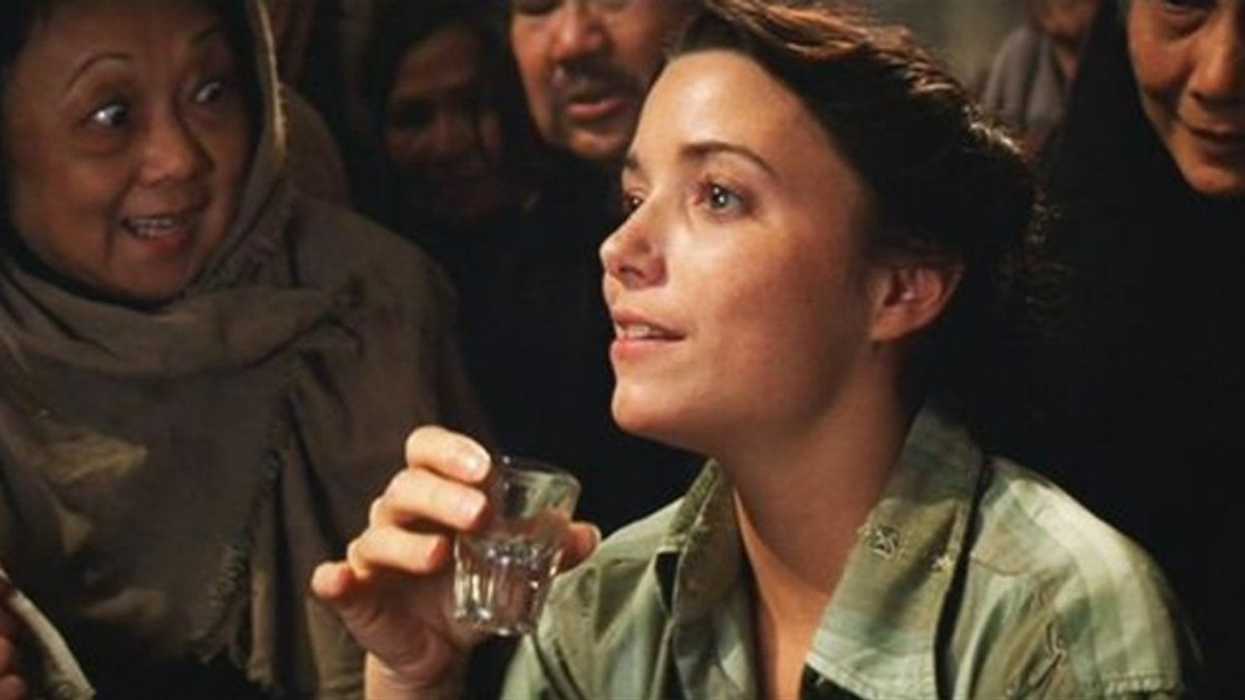
Most first-time directors introduce a character through dialogue. Spielberg introduces Marion (Karen Allen) by making her drink a much larger man under the table for 80 uninterrupted seconds.
Soderbergh wrote in his post, "I want you to watch this movie and think only about staging, how the shots are built and laid out, what the rules of movement are, what the cutting patterns are."
That's the assignment, and Marion's drinking-contest oner is where it pays off first. As CinemaHow points out, there's no dialogue, but we get who Marion is immediately. She's crafty, strong, independent. She knows the language well enough to communicate easily with the people of Patan, Nepal. She has a sense of humor.
When you introduce a character, it might be easy for them to just say, "I'm ____. I do ____. My opinion is ____." Can you create a physical action that forces the audience to learn who the person is without them telling us? Marion doesn't announce that she can hold her own; she just does.
Blocking and Power Dynamics
We've talked about this concept before too, but it's something you can analyze until the cows come home.
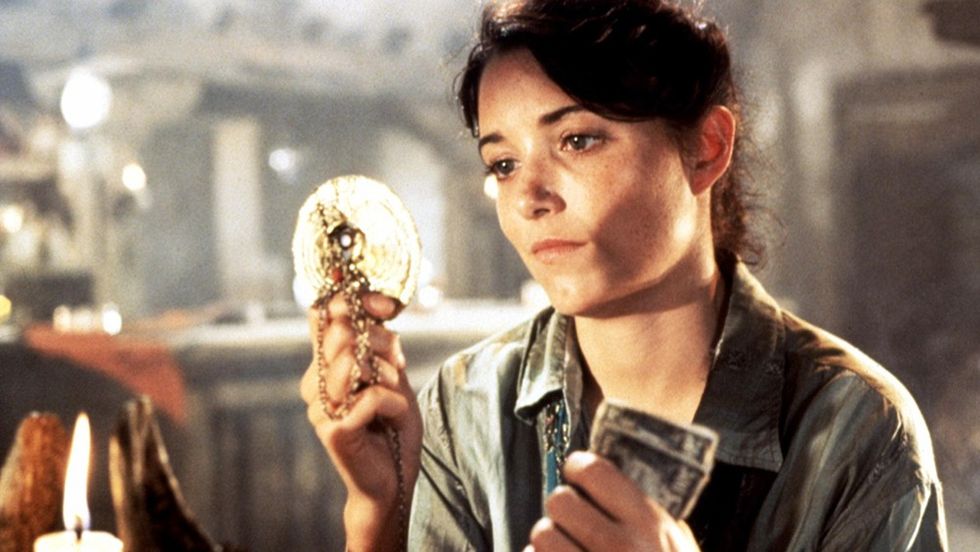
Once Marion is established, Indy walks in. Watch how Spielberg uses two shots to flip the power dynamic between them.
"He introduces himself through a towering silhouette, initially looming over her to impose control, but instead of submitting to this, she immediately crosses closer and closer to the frame until eventually her presence outshines his," CinemaHow says.
Blocking is not one-and-done. If actors are good, they're going to be giving you what we call "toast" (or "the business") and moving around doing something. Movement can make a scene harder to shoot, but it will definitely look and feel more natural. Marion advances on Indiana. When Spielberg cuts, he cuts to a frame that confirms Marion controls the space.
 'Raiders of the Lost Ark' Credit: Paramount Pictures
Blocking as Story Arc
Some screenplays just have to have the exposition dump, and they can be hard to write and harder to shoot and edit. Spielberg's answer in Raiders is a 94-second long take with Indy's old friend Marcus Brody (Denholm Elliott). The scene isn't static. Indiana is excitedly pouring drinks, packing for his expedition, and goes still only when Brody has something very serious to say.
CinemaHow says, "As Brody leads the exposition, he initially holds the center of the frame and faces towards the camera, whilst Indy is turned towards him and positioned off to his side, helping to direct our attention towards his companion."
Then Indy gets kinetic, moving and grabbing things. But then Brody sits and begins to warn Indiana of the danger he's about to put himself in.
"Whilst Indy gets ready, Brody remains sharply in focus, done so to welcome the slow push towards him that we soon get as he begins to warn Indy of the danger, slowing down the scene's pace to create a sense of dread."
The camera pushes in past Indy to Brody. It's tense.
Then Indiana laughs, pats his shoulder, and moves past him to his desk. The camera follows, leaving Brody (and his warning) behind, which is what Indiana is about to do, too.
Like all good scenes, this one has multiple emotional beats and a contained beginning, middle, and end. This one gives us everything in one take with no cuts. The camera adjusts, but it never has to bail out to a new setup. We've covered the animatic for this exact shot.
Soderbergh wrote of his Raiders cut, "This is what I do when I try to learn about staging, and this filmmaker forgot more about staging by the time he made his first feature than I know to this day (for example, no matter how fast the cuts come, you always know exactly where you are—that's high-level visual math shit)."
When a scene has multiple emotional beats, ask yourself whether blocking can carry the transitions instead of the edit. It's harder, but it looks so good.