Often, filmmakers conceal visual motifs in plain sight, which only reveal themselves upon multiple viewings. For instance, the staircases in Parasite are independent narrators only if you have the eye for the story they are telling.
But then, if certain visual motifs are like Easter eggs, what’s the point of using them at all?
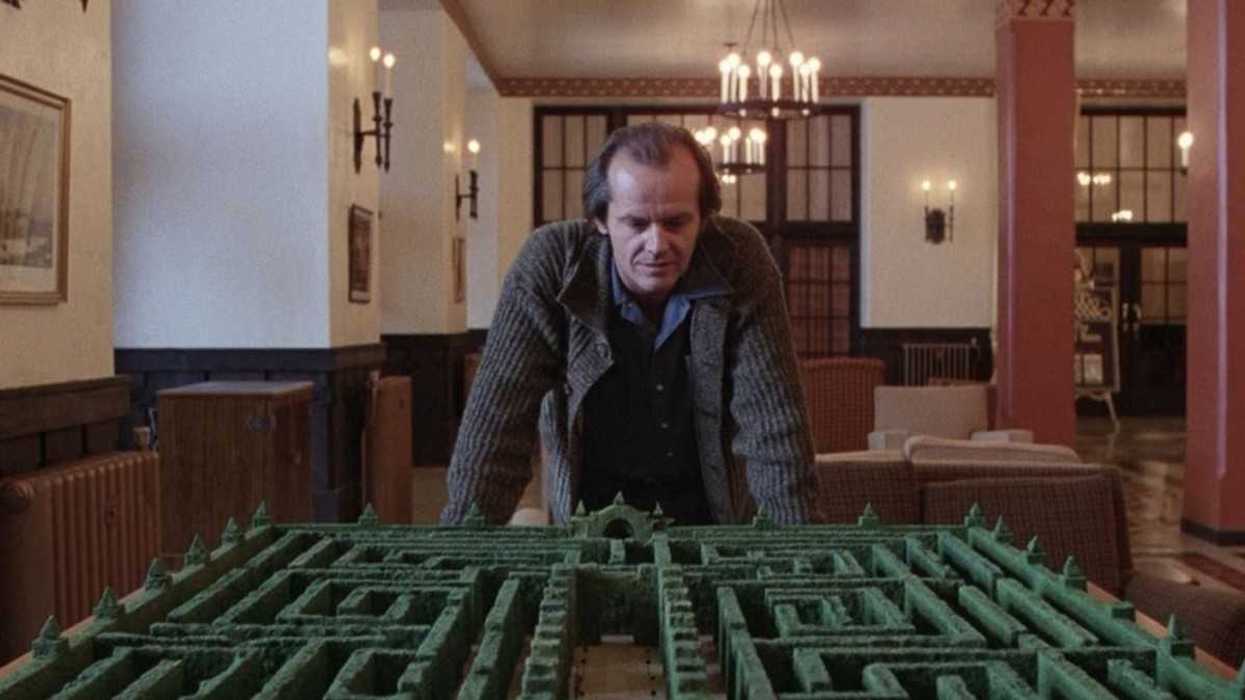
Stanley Kubrick’s The Shining answers this question through its masterful inclusion of mazes in almost every sequence. While the dark green hedge maze is crucial to the film's climax, Kubrick has placed mazes throughout The Shining that are easy to miss on first viewing.
 The Shining (1980)Source: Warner Bros., Columbia Pictures
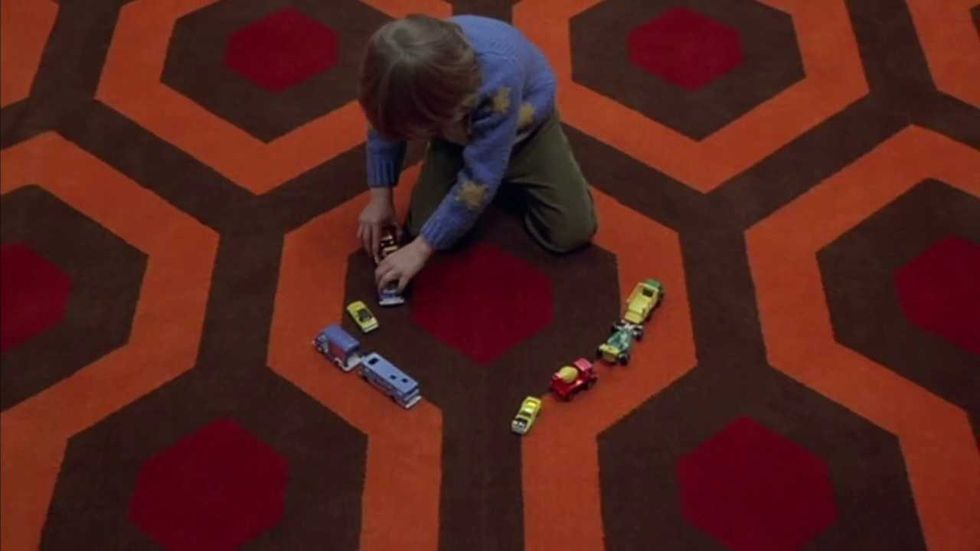
From the carpet of the infamous corridor where Danny sees the Grady Twins to the emerald green textured tie that Jack wears in his interview with Ullman, to Wendy saying out loud that the Overlook Hotel is just like an enormous maze, once you notice, it is pretty clear that mazes are an integral part of The Shining.
But that’s a discussion for another day, because it’s likely to take up an entire article.
Here, we’re opening up a different analysis. Attentive viewers might have noticed that the green hedge maze that is in the backdrop of the hotel lacks a logical layout.
In this article, let’s examine how the maze, with its nonsensical layout, was part of the bigger picture in Kubrick's The Shining.
To Give You a Little Context…
The hedge maze is part of the Overlook Hotel's exterior decor. However, sometime into the story, we cannot help but wonder if the maze is hiding a deeper secret. Soon, after making casual appearances here and there, the maze becomes an embodiment of evil.
In the climax, an axe-wielding Jack follows Danny into the maze to kill him. After a relentless pursuit, Jack finally comes across Danny’s footprints on the snow; however, they disappear. He takes a wild guess and runs in pursuit, only to walk deeper into the maze.
By the time Jack realizes that Danny tricked him, the latter has safely escaped. Unable to find a way out, Jack freezes to death inside the maze.
What Does the Illogical Layout of the Hedge Maze Signify in The Shining?
Film analysts have observed that the Overlook Hotel absolutely lacks consistency in its layout.
 The Shining (1980)Source: Warner Bros., Columbia Pictures
It has constantly shifting floor plans, with rooms and staircases changing locations, doors that lead nowhere, and impossible structures, such as the window in Ullman’s office. Even furniture and decor are never found in the places where they were last seen. The chef’s office and the chalkboard outside it are in one place during the beginning of Wendy’s kitchen tour with Hallorann, but by the end, they have moved.
Come to think of it, maintaining set-up continuity in The Shining seems to have been a joyride.
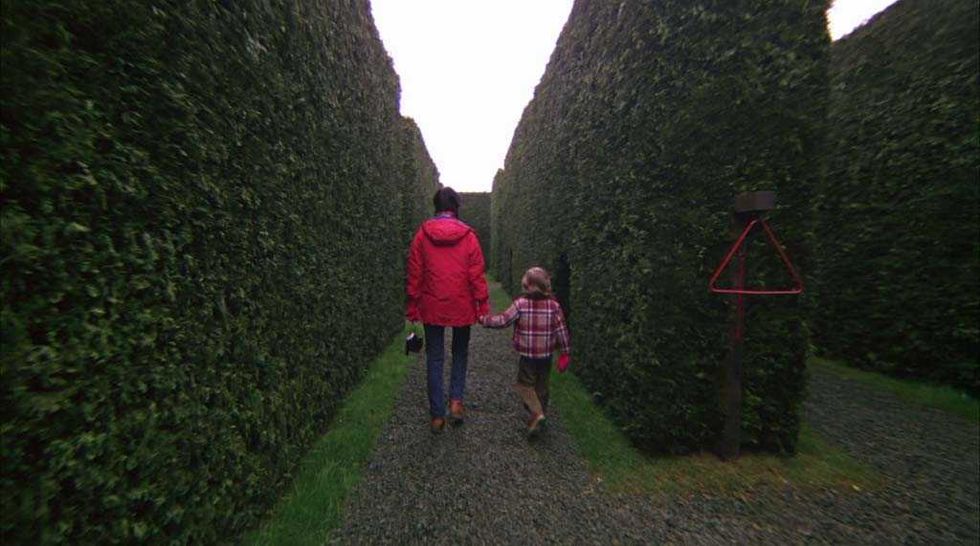
Just like the hotel, the maze seems to change its form and shape every single time, mocking visual continuity.
Over the course of the movie, various characters are seen inside the maze; however, its exact layout is never established through their experiences there. Our only reference is the model maze in the hotel. But whenever we are inside it, each time the maze feels a little different.
 The Shining (1980)Source: Warner Bros., Columbia Pictures
The disorientation in the maze’s layout mirrors the disorientation in Jack’s mind and in the situation. The moment Jack moves to the Overlook Hotel with his family, nothing goes according to plan.
Soon, the hotel's evil forces begin to influence Jack, rendering him seemingly insane. Under the influence of paranormal entities, Jack simply keeps changing personalities, mirroring the hedge maze's shifting layout and form.
The fact that Kubrick ensures that you cannot logically map the maze’s layout reinforces the experience of getting lost in a constantly changing maze, both physical and psychological.
In short, the maze, along with the Overlook Hotel, symbolically represents the characters' labyrinthine mental state.
The use of such an impossible architectural visual motif to realign the narrative with its own horror is a testament to Kubrick’s genius.
Let us know which is your favorite visual motif from The Shining in the comments.
- This Video Might Be the Most In-Depth Exploration Into the Making of Kubrick's 'The Shining' ›
- Why Did Kubrick Change 'The Shining' Against Stephen King's Will? ›
- Merry Kubesmas! Here's a Creepy New Discovery in the 'The Shining' ›
- This New Book on 'The Shining' is Blowing My Mind ›
- There's a 'Shining' Prequel You'll Never Get to See ›
- The Creepiest Reveal in 'The Shining' Has Nothing to Do With Ghosts ›
- Seriously Exhaustive Analysis of 'The Shining' Shows Kubrick's Inversion of King's Novel ›