
Three Days of the Condor opened in September 1975, just as American audiences were still processing Watergate. There was plenty to be paranoid about. The film is also a standout entry in the middle-of-the-'70s film Renaissance that gave us some of the best movies of all time.
Sydney Pollack directed the thriller. Robert Redford starred as Joe Turner, a CIA analyst whose entire job is reading books, magazines, and documents in multiple languages, scanning for anything that might matter to the agency. Turner slips out the back door to grab lunch and comes back to find everyone in the office dead. From there, it's a chase through New York and an extended meditation on whether the people hunting you are any worse than the ones claiming to protect you.
Its 50-year life in screenwriting conversations is warranted for multiple reasons. It's a taut adult actioner with fully developed characters, which unfortunately we don't always see in service of lighter genre fare. We thought it would be fun to revisit this one today, particularly to look at its iconic final scene and one of the film's best lines.
- YouTube youtu.be
Why This Line Still Hits
The quote comes from the film's final scene. Turner faces Higgins (Cliff Robertson), his CIA superior, in front of the New York Times Headquarters building.
Higgins has just explained how Atwood's renegade murder plot grew from the same war-gaming the agency does every day.
"What if? How many men? What would it take? Is there a cheaper way to destabilize a regime? That's what we're paid to do."
Atwood just took the games too seriously. The plan was fine. The plan would have worked.
"What is it with you people?" Turner says. "Do you think not getting caught in a lie is the same thing as telling the truth?"
What makes the line is Higgins' response. He doesn't deny it. He says "no" and immediately pivots.
"It's simple economics. Today it's oil. In 10 or 15 years, food, plutonium."
When resources run out, people will want results. "They won't want us to ask them. They'll just want us to get it for them."
Higgins doesn't experience the withheld truth as a lie. He experiences it as a service. That pivot is the whole film thematically summarized.
The Space Between Not Lying and Telling the Truth
Screenwriters Lorenzo Semple Jr. and David Rayfiel, adapting James Grady's novel Six Days of the Condor, built the film's moral architecture around the idea that institutions protect themselves through process rather than through active deception.
The CIA's "games" (the planning exercises, the hypotheticals, the war-gaming scenarios) create plausible deniability from the start. Nobody officially orders anything. The games produce the plan, the plan produces the outcome, and the institution can claim the outcome wasn't authorized.
From inside the institution, the distinction is everything. Higgins isn't lying about Atwood acting alone. He's just not telling Turner the rest of it.
This is why the paranoid thrillers of the 1970s still hold up and why they feel newly relevant every few years.
The Parallax View, All the President's Men, The Conversation... each one built its protagonist around the same dramatic function. Keep pressing until the institution either tells the truth or is visibly seen refusing to.
These protagonists don't uncover lies. They expose the architecture of omission. In Condor, Turner forces the acknowledgment. Higgins' oil speech is it. He's not defending the lie. He's arguing the lie was necessary. Which is worse, really.
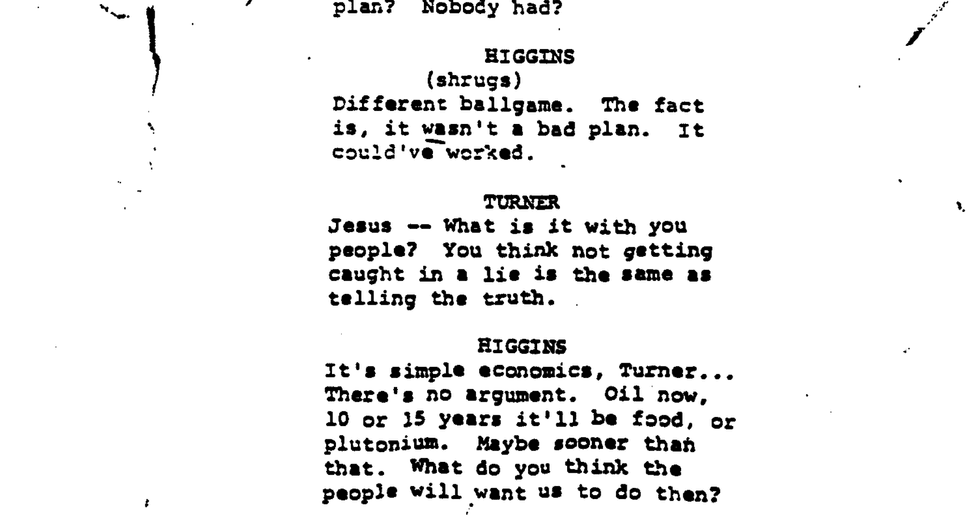 Three Days of the Condor screenplayCredit: Paramount Pictures
What Morally Complex Authority Figures Believe
Higgins doesn't experience himself as a villain. He's a pragmatist with a coherent internal logic. The public isn't equipped to make the hard calls, of course. So someone has to make them.
The screenplay lets him hold this position without irony. There's no scene where he privately doubts himself, no moment of reckoning.
When you're drafting a character in this mode, you can pose the question of what they're hiding, but that's a plot question.
The character question is what internal reasoning enables them to function day-to-day.
A character who has decided that withholding the truth is morally neutral has built a whole belief system around that decision, and that belief system has texture and makes for a more real character. We've written about how subtext operates when characters can't say what they mean. Withholding characters generate it almost by default, because every conversation runs on two tracks at once.
The payoff is that every exchange carries weight you don't have to engineer. Condor is full of scenes where Higgins' calm, measured responses are exactly the problem.
There's no competing with a character who has quietly decided that they're doing the right thing, no matter what. And it's so fun from a writing perspective.
"What Then?"
Try pulling any authority figure from your current script and asking whether they're a liar or a withholder.
If they're a liar, try converting them into someone who withholds information instead. Strip out the direct falsehoods and replace them with strategic silence, half-truths, and technically accurate statements that mislead. See if the scenes get more interesting or more unresolved.
Can you give them a Higgins-style speech? Give them the sincere justification for why the withholding is not only acceptable but necessary. A character whose internal logic you can follow, even when you'd never endorse it, is a different order of antagonist. It might feel a little less mustache-twirling, which can be great if you're in serious drama territory.
"What then?" is Higgins' entire argument. When resources run out, when people are cold, when engines stop... what then? They'll want results. And he'll be trusted to deliver, no matter what.
His case for institutional deception is coherent, and the screenplay doesn't undercut it. Turner doesn't technically win this argument; he just puts in motion a plan to expose it all. He walks away into an uncertain future.
Semple and Rayfiel certainly knew what they were doing. Have you seen this incredible political thriller?