8 "Save the Cat" Moments of Villains That Made the Audience Like Them
You thought only heroes could save the cat?
The “Save the Cat” term comes from Blake Snyder’s book and is most commonly used to establish a kind hero. But sometimes, even bad guys save the cat.
This act of kindness doesn’t need to happen on the first page of the script, and the character doesn’t have to be a saint, but the audience needs to feel a small perceptual shift when it happens. So, saving the cat is less about “proving the character is a good person,” but more about getting the audience to believe they understand the character or agree with their flawed integrity.
Let’s quickly jump into the list of scenes showing villains and antiheroes engaging in a moment of kindness.
8 Films Showing That Even Villains Can Save the Cat
1. Joker (2019)
The Joker is kind towards Gary.
A great example of Save the Cat is when the soon-to-be clown prince spares Gary’s (Leigh Gill) life, after brutally stabbing the other one, Randall (Glenn Fleshler). Gary, the small guy, never really taunted Arthur Fleck’s (Joaquin Phoenix) oddness as others did at work, and Fleck remembers that.
The fact that in comics, the Joker is a psychopathic villain known for his recklessness, not killing Gary right away (he was a witness), made the audience sympathize with the Joker. As a result, his moral myopia ends up making the people of Gotham justify his unprovoked killings. The scene cemented his righteous anger at cruel people and empathy for people like him (the weak).
2. Blade Runner (1982)
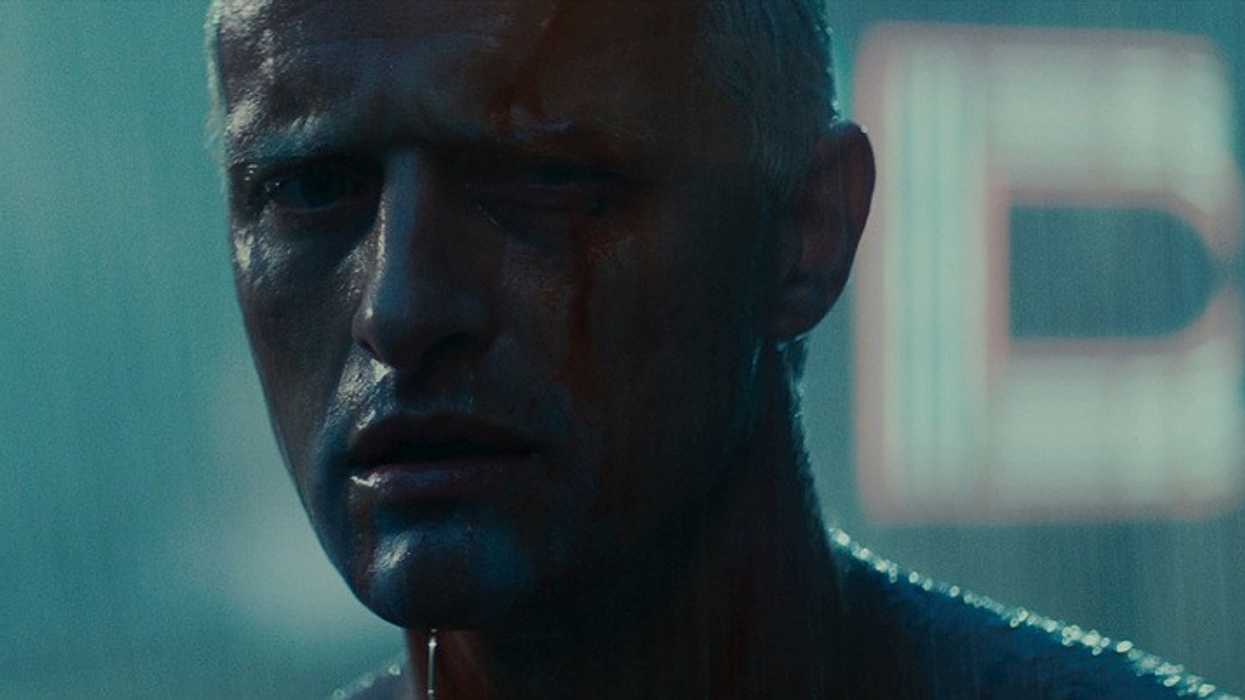
Roy Batty saves Rick Deckard from dying.
Roy Batty (Rutger Hauer) saving Rick Deckard (Harrison Ford) from falling is one of the most iconic “save the cat” moments in Ridley Scott’s Blade Runner. The most obvious reason Batty spared Deckard’s life is to demonstrate that he understood the value of life and what it means to be “good,” better than the protagonist himself.
It is one of those moments that flips the perspective of the entire narrative, and all of a sudden, the “bad guy” is now the sympathetic victim of the system. It is one of the single greatest and most profound moments in a movie, cementing Blade Runner as a true classic.
3. Star Wars: Return of the Jedi (1983)
Darth Vader saves Luke.
Darth Vader has always been a calculating and ruthless Sith Lord in the Star Wars franchise. However, a fascinating moment occurs at the end of Star Wars: Return of the Jedi, when Darth Vader tussles with a tough choice as he watches the Emperor torture Luke Skywalker (Mark Hamill). In the end, he saves Luke and kills the Emperor while sacrificing himself.
Despite his years of atrocities, Vader is a villain who loathes what he has become and knows it’s too late to return from the darkness. This pivotal scene shows Vader’s redemption and is one of the most shocking “save the cat” moments of a villain.
4. Avengers: Infinity War (2018)
Thanos grieves Gamora.
Thanos (Josh Brolin) is the only villain in recent times who convinced a large portion of the audience that he had legitimate reasons to wipe out half of the universe’s population. Being cold and ruthless as he was, Thanos even tears up, letting his emotions take charge for a moment before he kills Gamora to capture the Soul Stone.
After completing his mission, we also see a dream-like scene where Thanos visits a young Gamora. There, she asks him what his victory cost. He replies with, “Everything.” This humanizes Thanos as a tyrant with a soft side for his loved ones.
5. X-Men: The Last Stand (2006)
Magneto verbally defends Charles Xavier.
X-Men: The Last Stand has been one of my favorite superhero movies for years, and no X-Men sequel comes close to that spectacle.
As Magneto’s army prepares for war against humans in the jungle, Pyro (Aaron Stanford), at one point, states to Magneto (Ian McKellen) that he would have killed Professor Charles (Patrick Stewart) if he had allowed. Magneto stops dead in his tracks to respond, “Charles Xavier did more for mutants than you’ll ever know. My single greatest regret is that he had to die for our dream to live.”
As a man who went against Charles and was hell-bent on a war, even if it meant killing the X-Men in the process, Magneto definitely showed that he is more than just a one-dimensional tyrant.
6. Spider-Man 2 (2004)
Dr. Octopus destroys his own death machine.
Spider-Man 2 is easily the best of Sam Raimi’s trilogy and possibly among all Spider-Man movies, with amazing action sequences. Apart from Peter Parker’s (Tobey Maguire) arc, we get to follow Doc Ock, from being corrupted by the AI-driven chip behind his neck to ultimately becoming human again through redemption at the end.
Before his sun-like technology destroys the whole damn city, Doc Ock has a sudden change of heart in time. As a result, he forces his influence over the chip to regain his empathy, and then goes on to destroy his experiment, sacrificing his own life. Before dying, he performs one selfless act, giving him his “save the cat” moment.
7. Captain America: The Winter Soldier (2014)
Bucky Barnes rescues Captain America.
- YouTube www.youtube.com
Arguably, the best Captain America film puts two former friends, Steve Rogers (Chris Evans) and Bucky Barnes (Sebastian Stan), against each other. Bucky, as the Winter Soldier, has no recollection of his past, yet in the climactic moment, he pulls an unconscious Captain America to the shore, saving his life from drowning.
It’s clear that Bucky still hadn’t remembered the past at the time, but Captain America triggered something human in him. The man who was thirsty for Cap’s blood just moments earlier saves him from dying in the next, and disappears.
8. No Country for Old Men (2007)
Anton Chigurh’s coin Toss!
The Coen brothers’ No Country for Old Men features several chilling scenes, one being the coin toss scene between Anton Chigurh (Javier Bardem) and the gas station manager. It shows the power of visual storytelling with subtextual dialogues more than direct dialogue.
Chigurh tosses the coin to decide the manager’s fate with heads as the call. The latter survives as the coin lands on tails. The scene somehow conveys that, despite the villain’s stone-cold demeanor, he lives by some moral code, which in this case is a mere coin Toss. The entire scene speaks more for the villain being under control than a plain “save the cat” moment. But it still holds.
Final Thoughts
If you want to “save the cat” while keeping your villain’s credentials intact, try making them pretend that it’s not coming from a point of kindness, or give them a moral code that doesn’t necessarily undermine their menace.
Let me know your thoughts in the comments.