57 Years Ago: A Western Broke All the Rules and AFI Later Ranked It Among the Genre's 10 Best
Fifty-seven years on, The Wild Bunch still teaches action filmmaking.
'The Wild Bunch'
Imagine you're at the movies in June 1969. You're at the latest Sam Peckinpah picture. You've reached the end of the film, when Peckinpah pointed six cameras at a gunfight and blew up the Western from the inside.
The Wild Bunch opened on June 18, and the reaction split the room. There was surprised applause tangled up with boos, and critics demanding to know why anyone had bothered making it. Thirty-nine years later, the American Film Institute put it sixth on its list of the 10 greatest American Westerns, one slot above Butch Cassidy and the Sundance Kid and two below Unforgiven.
Now the film that offended so many has become the film everyone loves to steal from.
- YouTube www.youtube.com
The Wild Bunch
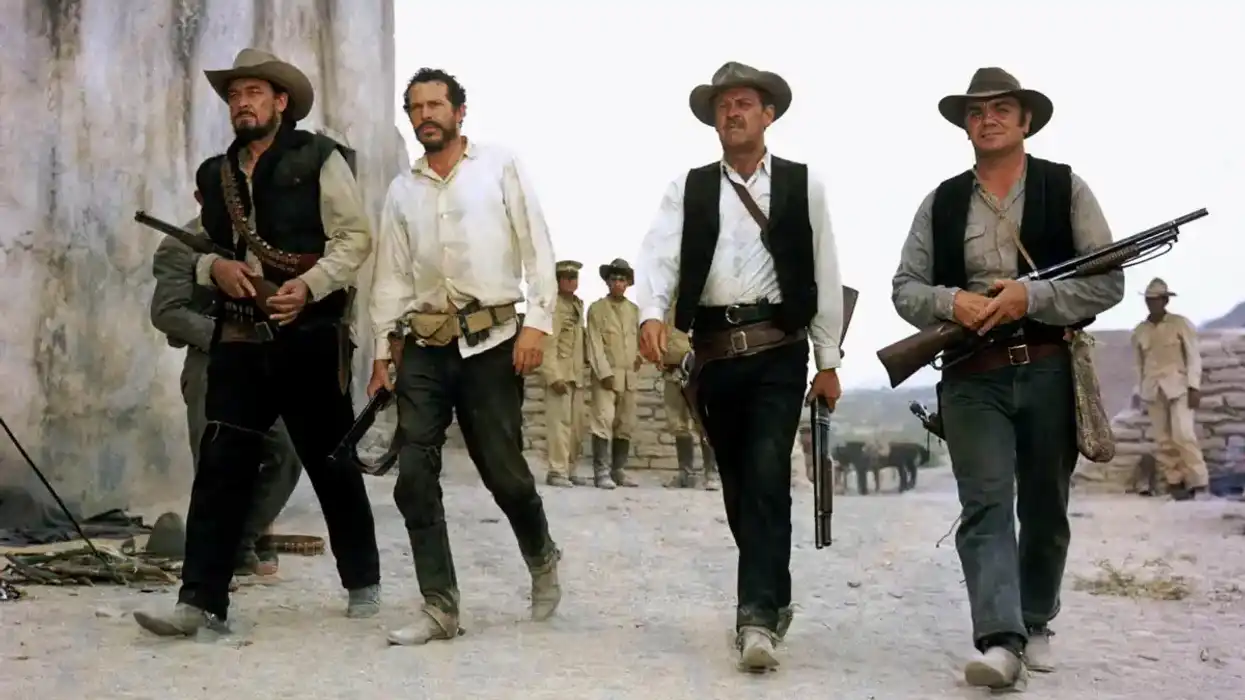
It's 1913 on the Texas-Mexico border, and Pike Bishop (William Holden) leads a crew of outlaws who have outlasted their own era. The group includes Dutch Engstrom (Ernest Borgnine), the brawling Gorch brothers (Warren Oates and Ben Johnson), the ancient Freddie Sykes (Edmond O'Brien), and the young Mexican idealist Angel (Jaime Sánchez).
A railroad man puts Pike's former partner Deke Thornton (Robert Ryan) on their trail with a posse of bounty hunters. Everyone involved knows the frontier is closing. It's all going to end in an inevitable bloodbath.
The Movie Buried the White Hat
Westerns had spent years before sorting men by hat color. The man in black is always bad—the heroes are in white. Peckinpah and co-writer Walon Green threw that whole thing out. Their protagonists rob a railroad office, use civilians as shields, and engage in other wanton violence.
Green built the ambiguity in deliberately.
I wanted to do a film where it would be very hard to say exactly who's bad and who's good in the story," he said in an interview collected in Backstory 3: Interviews with Screenwriters of the 60s (via Diary of a Screenwriter). "In The Wild Bunch, there are definitely people who are innocent and people who are guilty—the townspeople, for example, are essentially innocent—but who’s really good and who’s really bad?"
That move opened a brand-new area that the genre continues to play with. Just consider the moral murk of Unforgiven, the Westerns built around protagonists who never draw a gun, the whole revisionist wave. If you're constructing an antihero today, Pike Bishop can be your inspiration as a man whose competence we admire but whose choices you can't defend.
A Love Letter to Mexico
The script came from an unlikely place. Green was a documentarian who'd spent years south of the border, and as he told film scholar Stephen Prince in a passage quoted by TCM, the material grew out of that time.
"I lived in Mexico and worked there for about a year and a half. The Wild Bunch was partly written as my love letter to Mexico," Green said. He'd also seen Memorias de un Mexicano, footage shot during the actual revolution, which shaped the film's look.
Peckinpah rewrote him, and Green has never once complained about it.
"It was one of the best examples I've ever seen of a writer taking another writer's script and making it better," he said in Backstory 3, adding that on rereading it he couldn't always remember which lines were his and which were Peckinpah's. When the director wanted new flashback material during the Mexico shoot, Green wrote the scenes in a day.
Peckinpah knew what he had. Before filming, he wrote to Charlton Heston that the picture "might turn out to be a reasonably good film," per TCM. Afterward, he dropped the modesty. "Of all the projects I have ever worked on, this is closest to me."
The Slow Motion Was Already in the Script
We've already talked about that famous ending, but do you know how it was made? Contrary to popular rumors, the slow-motion violence wasn't invented on set. Green wrote it in, inspired by Seven Samurai.
"So I started thinking, 'Hmm, I wonder what a whole sequence in slow motion would be like? That would really be something!'" he said (via Backstory 3). Roy Sickner, a stunt performer, backed the idea immediately.
The technique came through editor Lou Lombardo. He had cut an episode of the TV series Felony Squad in which a man is gunned down by police, reprinting individual frames to stretch the moment and intercutting that slowed footage with normal speed — a method Lombardo later described in an interview with Vincent LoBrutto for the book Selected Takes. Peckinpah saw it and wanted it too.
So he shot the two big battles with as many as six cameras rolling simultaneously at different speeds, according to TCM, handing Lombardo the same action captured at multiple values of slow motion. Variety put it at up to six cameras as well, and noted the editors ended up with miles of negative to sort through.
Slow motion works as an accent, so don't overuse it. Peckinpah captured every beat at several speeds so the edit had options.
- YouTube www.youtube.com
3,643 Cuts
Film historian Daniel Eagan, assessing the picture for America's Film Legacy, counted 3,642 edits, which was more than five times the Hollywood average for a feature, a density he compared to Eisenstein in the 1920s. The number was already lore by the time Green spoke with Backstory, where his interviewer put it to him as a record for any color picture ever made.
Green, asked about the density, pointed at his own influences as an example.
"Kurosawa cut a lot," he said, citing the opening of Rashomon. He described the film as part of a new sensibility already in the air.
Cutting that fast between multiple angles and speeds doesn't really clarify a gunfight, but it does overwhelm you, which is what they were going for. Later, Spielberg chased a similar disorientation on Omaha Beach and changed war moves.
"Dying Is Not Fun and Games"
The film screened for roughly 350 critics at a Warner Bros.-Seven Arts festival in the Bahamas, and the press conference turned into an interrogation. Roger Ebert was there and wrote it up. A reporter from Reader's Digest opened by asking why the film had been made at all.
Peckinpah didn't flinch.
"We wanted to show violence in real terms," he said. "Dying is not fun and games. Movies make it look so detached. With The Wild Bunch, people get involved whether they like it or not."