8 Westerns Films That Proved You Don’t Need a Traditional “Gunslinger Hero”
These 8 Westerns put a spotlight on heroes who rely on grit, morality, and survival instincts instead of fast draws and shootouts.
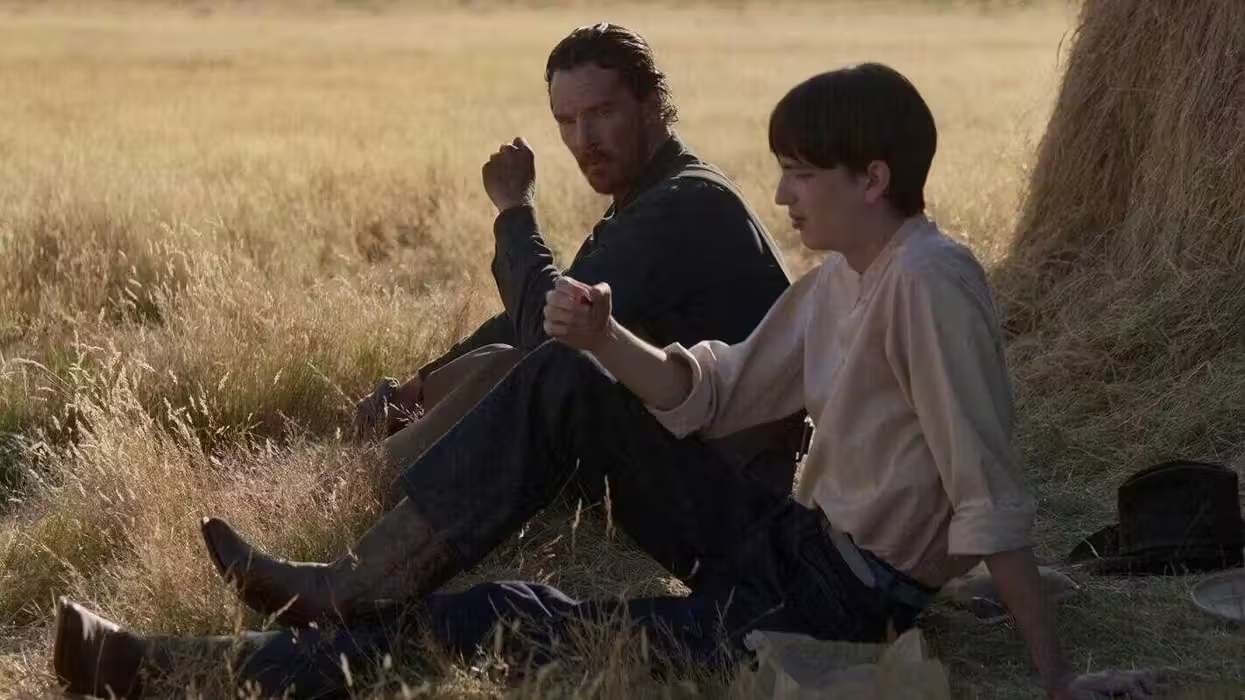
‘The Power of the Dog’ (2021)
In the creative field, branding can be quite a double-edged sword. It works well in the obvious/intended direction, but the moment you try to step outside of it, the same branding starts to limit you. That’s why actors get typecast or locked into a “bankable persona,” directors get boxed into one genre, and storytelling begins to bend around franchises.
Another, perhaps the most visible effect of this branding, is the rise of movie tropes. Left unchecked, they settle in and take over the storytelling. Before you realize it, characters start following the tropes instead of their organic arc.
That’s somewhat true about Westerns. Say the word, and most people instinctively picture a lone gunman squinting into the sun and ready to settle everything at the pull of a trigger. The image is clean and very defining, but that’s also why it’s limiting.
And it’s not like the genre doesn’t have any wider scope or more range. Because these guns and standoffs are ultimately just Western tropes, what’s at the core is the beating heart of the genre: the themes of survival, identity, greed, love, and control. Guns exist in the periphery simply as tools that make the loudest noise.
Some directors tried to take these guns away or make them secondary. And when they did, something interesting happened. The hero was forced to think, endure, negotiate, or simply find other ways to outlast. Guns became hazy, and human nature came into focus. The flashy shootouts stopped, and the grueling reality of survival and the complexities of human ego started to rise.
Yes, it reduced the noise (not always, but sometimes), but the conflict? Weirdly, it became sharper and more piercing.
Let’s look at these eight films that tried to do away with a quick-draw duel.
8 Westerns Where Heroes Aren’t Gunslingers
1. The Ox-Bow Incident (1943)
Written by: Lamar Trotti | Directed by: William A. Wellman
Main Protagonist: Gil Carter | Portrayed by: Henry Fonda
Gil Carter, a drifter, along with his friend, joins a lynch mob of townspeople to capture three men accused of killing a local rancher. Eventually, the men are caught and hanged. However, Gil faces a tremendous moral crisis when he learns all three men were innocent. Here, Gil is not a hero. He doesn’t save anyone and doesn’t serve justice. He is a helpless, scared witness to the pig-ignorant mob mentality. What drives the story is not his grit or bravado, but his internal struggle and failure to use reason against collective rage. Gil represents the tragic limitations of a moral man in a lawless world.
2. The Treasure Of The Sierra Madre (1948)
Written by: John Huston | Directed by: John Huston
Main Protagonist: Fred C. Dobbs | Portrayed by: Humphrey Bogart
In 1920s Mexico, Fred C. Dobbs leads two down-and-out American prospectors in search of gold in the Sierra Madre mountains. They indeed find the fortune, but their camaraderie falls apart under the weight of mistrust, greed, and the threat of bandits. In a regular Western, Dobbs would have faced the bandits in a heroic stand, but here, he is consumed by his own mounting paranoia and desperation. Interestingly, that’s what drives the narrative here: Dobbs’ frantic distrust. He proves that in the West, the deadliest enemy could be your own reflection.
3. Giant (1956)
Written by: Fred Guiol, Ivan Moffat | Directed by: George Stevens
Main Protagonist: Bick Benedict | Portrayed by: Rock Hudson
This multi-generational epic follows a Texas cattle rancher, Bick Benedict, and his tense relationship with a rising oil tycoon, Jett Rink (James Dean), as he navigates wealth, family, and the massive cultural shifts. This film replaces the usual physical showdowns with cultural and personal challenges. Bick’s personal evolution, in particular his views on race and legacy, shapes the narrative. Here, the standoff is between values, not guns.
4. A Big Hand for the Little Lady (1966)
Written by: Sidney Carroll | Directed by: Fielder Cook
Main Protagonist: Mary (often identified as “the little lady”) | Portrayed by: Joanne Woodward
In the 1890s, Texas, a naive homesteader and a recovering gambler, Settler Meredith (Henry Fonda), wagers his family’s entire savings into a high-stakes game of poker, and collapses due to stress. It forces his inexperienced wife, Mary, to take over the reins and save the fortune. Here, not only is the protagonist not a gunslinging cowboy, but is instead a housewife playing a psychological game against the region’s wealthiest men to salvage her family’s future. The plot entirely hinges on her wit, poker face, and her ability to navigate the male-dominated world by “bluffing.” You don’t even miss the guns.
5. Brokeback Mountain (2005)
Written by: Larry McMurtry, Diana Ossana | Directed by: Ang Lee
Main Protagonists: Ennis Del Mar and Jack Twist | Portrayed by: Heath Ledger and Jake Gyllenhaal
Ennis and Jack, two young ranch hands, unexpectedly develop an intense emotional and sexual bond. They spend the next two decades struggling with societal repression and meeting periodically for secretive but passionate “fishing trips.” The movie is set in the early ‘60s, a far cry from the Old West. Their fight is not against cattle rustlers or outlaws; it’s against the rigid, suffocating societal expectations of the time. The conflict here is not external. It comes from their internal longing and the fear of exposure. This groundbreaking Western shifts the focus from gunfights to intense emotional survival.
6. Meek’s Cutoff (2010)
Written by: Jon Raymond | Directed by: Kelly Reichardt
Main Protagonist: Emily Tetherow | Portrayed by: Michelle Williams
In this slow-burning revisionist Western, a group of settlers gets lost in the Oregon desert because of an unreliable and egoistic guide. As time goes by, Emily rises to be the group’s moral and perceptual center. Emily’s role is to drive the narrative by challenging the male authority, even in the life-or-death decision regarding a captured Native American man. Emily is a shining example that survival often depends on judgment rather than a fast draw.
7. True Grit (2010)
Written by: Joel Coen, Ethan Coen | Directed by: Joel Coen, Ethan Coen
Main Protagonist: Mattie Ross | Portrayed by: Hailee Steinfeld
In the 1870s, Arkansas, a 14-year-old Mattie hires the “meanest” U.S. Marshall, Rooster Cogburn (Jeff Bridges), to track down the drifter who killed her father before fleeing into the Indian Territory. While Cogburn serves as the stereotypical gunslinger, it’s Mattie’s negotiation skills that keep the mission on track. Her lack of gunslinging prowess is compensated for by her sharp brain and tongue. As a logistical powerhouse, she displays “true grit” that drives the narrative. In short, she replaces “steady aim” with a “clear objective.”
8. The Power of the Dog (2021)
Written by: Jane Campion | Directed by: Jane Campion
Main Protagonists: Phil Burbank and Peter Gordon | Portrayed by: Benedict Cumberbatch and Kodi Smit-McPhee
In 1925 Montana, Phil Burbank, a charismatic but volatile rancher, wages a psychological war against his brother’s new wife and her teenage son, Peter. Pretty soon, his repressed homosexuality and toxic masculinity are exposed, shifting the power dynamics. While Phil uses his hyper-masculine cruelty and intimidation to assert his control over the ranch, Peter observes his power play from the fringes with a clinical detachment. You can say the guns are, at one point, replaced by biological warfare—Peter using anthrax to tackle Phil. The film completely replaces guns (which are practically not to be seen throughout the film) with a sharp mind.