Film Quote of the Day: The 1957 Glenn Ford Western Line About Time That Still Hits Hard
Outlaw Ben Wade speaks a Zen truth.
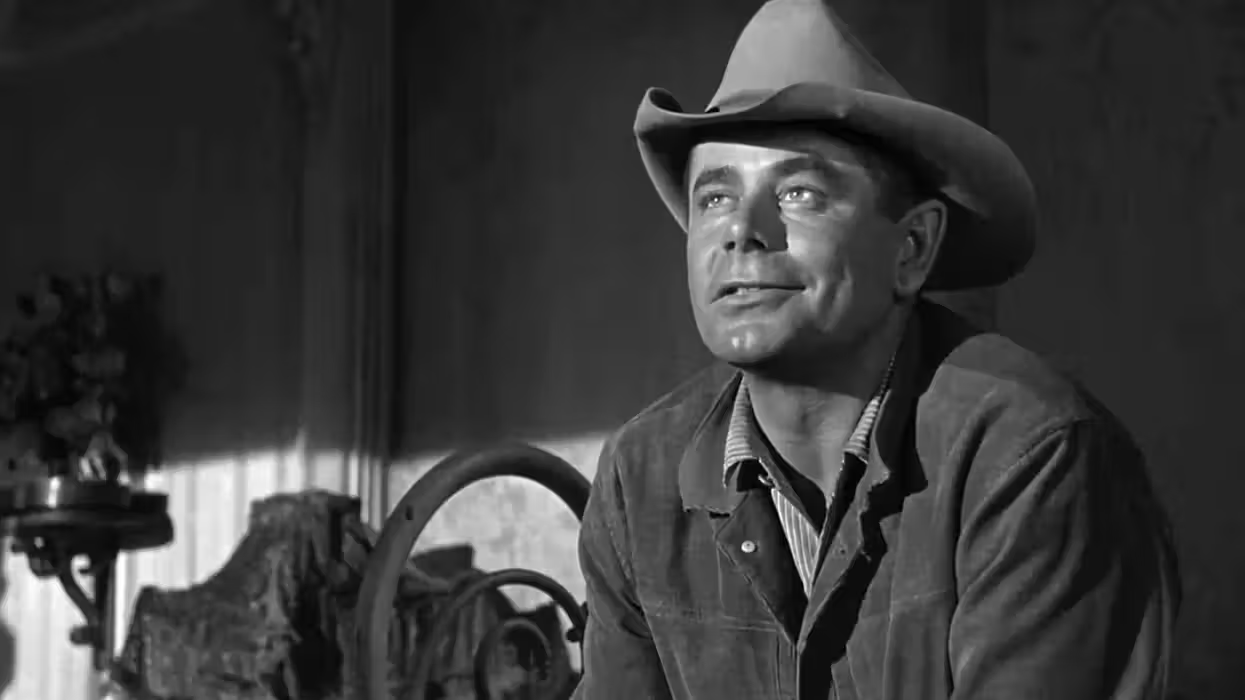
'3:10 to Yuma'
1957's 3:10 to Yuma was directed by Delmer Daves from a screenplay by Halsted Welles, which itself was based on Elmore Leonard's 1953 short story "Three-Ten to Yuma." Iconic screen star Glenn Ford plays outlaw Ben Wade, with Van Heflin as the rancher Dan Evans.
In the Western film, the drought-stricken rancher captures Ben Wade and agrees to hold him in a Contention City hotel until the 3:10 train arrives to take him to prison in Yuma.
Partway through their fairly calm standoff, Wade watches and observes something about Evans that feels like a taunt at first but betrays his inner calm. It's one of the great examples of a villain (even an anti-villain) accidentally becoming philosophical and a moment of insight from an unexpected character.
Watch the scene below.
The Scene
The whole film has narrowed to a hotel room, nearly at the climax of the story. Wade's gang is riding toward town. The men Evans expected to help him have fallen off one by one. He's alone with Wade, waiting for the train, the tension rising.
Evans has a pocket watch in his hand. He keeps checking it, then squeezing it, as the minutes crawl toward 3:10. The physical business is doing most of the acting.
Wade watches Evans do this. Then he speaks.
"All you gotta do is drop the gun and let me walk out the door."
"Wade, listen—" Evans says.
"What are you squeezin' the watch for?"
"Are you sure that no one would ever know?"
"Squeezin' that watch ain't gonna stop time," Wade says with a smile.
A shootout ensues minutes later, but Evans manages to drag Wade through the town to the train, making it despite being outnumbered.
Wade isn't wrong about the watch. Evans is squeezing it as if he can crack it, maybe to make the minutes move faster. The line is Wade reading Evans precisely, in an almost quiet and nonthreatening way.
Why Wade Is So Threatening
Ford's Ben Wade is the archetype of the anti-villain. He's a killer with a code, charm, and a philosophy. He's a bandit who reads Bible verses and quotes them accurately. He flirts.
He also knows when to shut up. He watches Evans the whole time and tries to assess what will work on a man so desperate and so resolute. So the character does not necessarily read as evil. He reads as observant.
And we, as the audience, have watched Wade study Evans for an hour, so when he articulates something about Evans that Evans might not have realized, it tells us how smart Wade is. The tension of the scene is whether Evans might accept Wade's deal, even though Evans is the person in power. Could he really walk away from all this, to save himself for his family?
Wade knows that's the way in. His line about the watch is a prod. He's saying that he's watching him without being overt about it. And drawing attention to the time is him drawing attention to the film's literal ticking clock. The seconds are ticking away, but they might mean imminent death for Evans, not an escape to Yuma.
Elmore Leonard, whose short story is the source, famously wrote that if it sounds like writing, he rewrote it. This line is the opposite of writerly. Simple language, broken sentences.
Other Elements That Increase the Tension
First, look at how it's cut. This is a quick exchange, a back-and-forth between the men edited sharply to make the audience even more on edge. Wade doesn't give Evans room to breathe or even finish his sentences. He just pokes at him.
Then there's the blocking and cinematography. Wade, in a medium close-up, sits comfortably, almost fully turned toward the camera, and is well lit. If you didn't know the film, you might call him the hero in this scene. He's almost shot that way.
Meanwhile, Evans has his back to the audience. His body is hunched, his fist tense around the watch. He's thrown into shadow. As the protagonist, he's going through his "dark night of the soul" beat. He's alone; he has a chance to escape. Otherwise, he faces almost certain death. The darkness of the shot mirrors his grave thoughts.
- YouTube youtu.be
How the 2007 Remake Rewrites the Line
James Mangold's 2007 remake, written by Halsted Welles, Michael Brandt, and Derek Haas, includes the same scene in the same hotel room and gives Russell Crowe's Ben Wade a version of the same line. In this version, the scene is longer, more dramatically staged.
Evans (Christian Bale) is sitting by the window, tense, hands in prayer with his pocket watch between them. Wade is drawing calmly in a book across the room.
Evans checks his watch (five minutes to three), mutters "Goddammit," and Wade overhears.
"You know, squeezing that watch won't stop time."
Then Dan hurls the watch across the room. In the script, it's thrown at Wade, but in the movie it just flies in front of him, non-threatening.
Wade watches this and says, "Don't get so scared. Might back a bad move."
There's a tension lost in the exchange because Crowe chooses to perform the scene almost distracted, above it, rather than needling Evans with insight. Throwing the watch is another choice, and it changes the tone too. Mangold's remake is louder, faster, more physical. Throwing the watch is a moment of catharsis rather than a heavy beat of self-reflection.
When Leonard adaptations work, they trust the audience to sit in the quiet with the character. The remake, for all its craft, doesn't quite.
What to Take into Your Work
Remember the value of subtext. "What are you squeezin' that watch for?" does seem like a real observation a real person might make, but what they're really saying is, "I see how nervous you are." It's calm insight in the midst of another character's worst moment.
Who delivers this line matters too. It can't be someone who isn't observant. When you have a piece of writing that risks feeling authorial, ask which character would make it land. It's the same principle behind writing great villains.
Trust plain vernacular over "meaningful" language. This is a moment that could have gone verbose, but stays basic.
And remember how much more you can get out of an exchange in the performance and the edit.