You know the feeling when you splash out a big portion of your bank balance on something, a trip, a party, home decor, or launching a passion business—only to fall flat on your face. That’s the energy 20th Century Fox brought to one of their super-ambitious projects, and that’s the fate they suffered at the end of it.
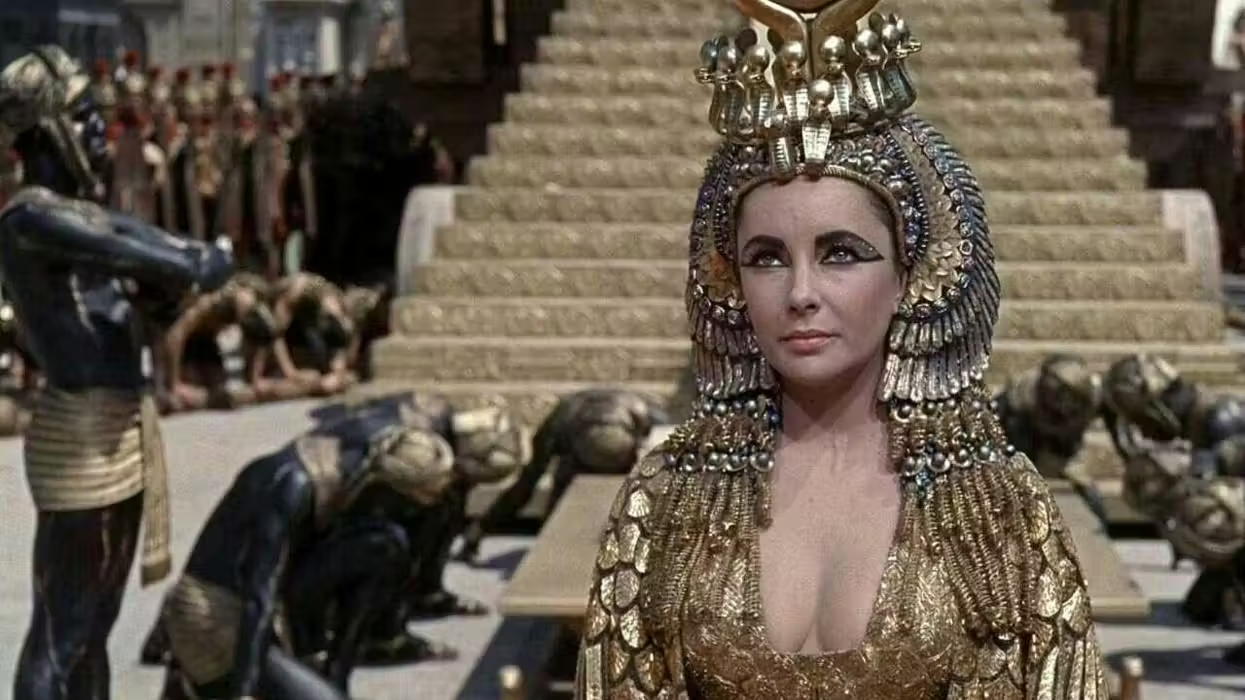
Cleopatra (1963) began as a $2 million peplum flick, but soon spiraled into a massive $44 million megaproject, entering production hell and ending up as a box office disaster. It featured thousands of hand-woven costumes and sets so large they caused a literal building material shortage in Italy. Despite all this extravaganza, it suffered from production delays, constant leadership changes (both on and off camera), filming relocation, set destruction, an unstable script, massive star fees, and, overall, a logistical nightmare. All this was further exacerbated by a chaotic cocktail of ego, bad weather, and unchecked spread of overconfidence. At the end of it, it became a movie so expensive that it brought one of Hollywood’s biggest studios to its knees.
The good news is that 20th Century Fox is still around. It survived. But this survival came with some serious scars that lasted for decades. This is the story of how the Queen of the Nile almost took down Hollywood.
When Ambition Knows No Bounds
It was producer Walter Wagner who first developed a passion for the subject, and once he entered into a coproduction agreement with Fox, that passion soon spread around. One of the driving thoughts was to top the previous biblical and historical spectacles. There is no doubt that the prestige and success of films like The Ten Commandments (1956) and Ben-Hur (1959) would have been a major inspiration.
But once the production actually went on the floor, it was stuck with a multitude of problems. The filming started in London by director Rouben Mamoulian, but soon after, Elizabeth Taylor fell seriously ill. This effectively suspended the production. Until now, only 10 minutes of usable footage had been shot, and both key and below-the-line production had already gone massively over budget—$7 million (roughly $75 million in 2026) for 10 minutes of footage.
While filming was halted, plans were made to relocate the production to Rome. This came with recreating the entire sets and rehiring the entire (almost 10,000) background cast. In addition, some of the supporting cast, such as Stephen Boyd, left the project. If that wasn’t enough strain, Rouben Mamoulian also resigned and was replaced by Joseph L. Mankiewicz. The project was started from scratch.
The Logistics of Absolute Excess
A City Built Twice
In the initial filming stage in London, they had built a few massive (and expensive) sets of tropical Egypt. But, if there’s one thing that you can rely on London for, it’s unreliable weather. And London delivered on its eternal promise. It rained. Palm trees died, sets rotted, and—in a completely unrelated sphere of issues—the original British import, Miss Taylor, also gave in to the health issues. England just wasn’t happening.
So, Spyros Skouras, the president of 20th Century Fox, greenlit the production shift to Rome. This shift necessitated the rebuilding of all the sets. These sets included all the exteriors of Alexandria (including the royal palace and the entire city), the Roman Forum, Cleopatra’s barge, the Sphinx, and other props.
The abandoned Pinewood sets in London were later utilized by the 1964 British comedy Carry On Cleo.
26,000 Reasons to Go Broke
Irene Sharaff may have won the film an Oscar for costume design, but that honor had put a massive, back-breaking strain on the studio’s bankroll. The film required 26,000 costumes, including a golden dress for Taylor, which alone cost $6,500. Sharaff was allowed to use genuine leather for certain key, high-detail pieces for the army uniform, such as the “Phoenix” cape, headwear, and hand-tooled armors for the entire Roman army. Costumes was one of the departments for which the studio footed the heaviest bill.
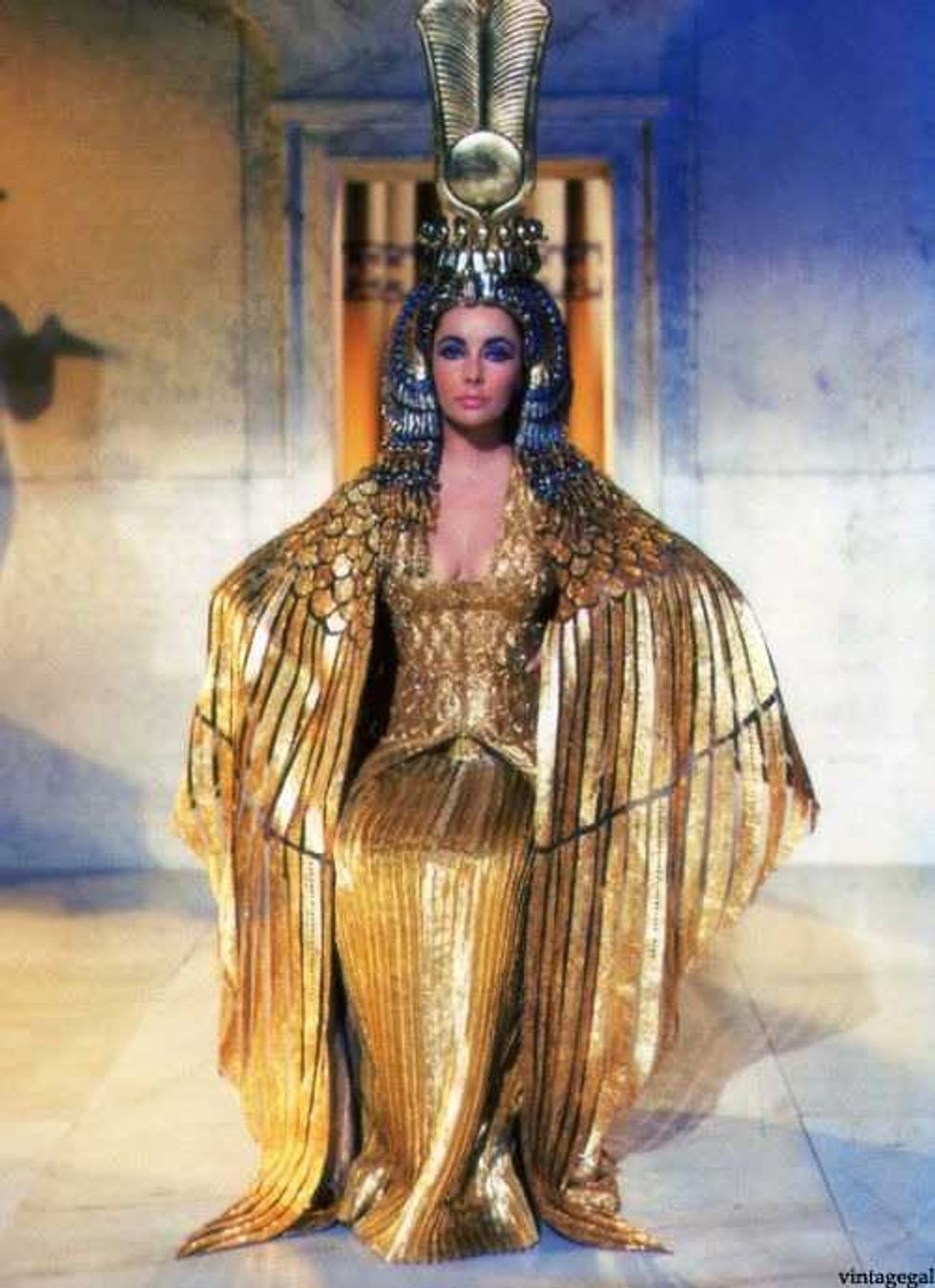 Elizabeth Taylor as Cleopatra wearing the “Phoenix” capeCredit: 20th Century Fox
Personal Problems and Pricey Delays
The “E.T.” Tax
No, E.T. didn’t come from the future to levy any extraterrestrial tax. This is the special Elizabeth Taylor situation I am talking about. She signed the contract for a whopping $1 million fee. It was unprecedented until then, for both male and female artists. What’s more? This whopping, hooting acting fee was just the baseline. She was also given 10% of the film’s absolute gross. Her total earnings were around $7 million.
During the London shoot, Taylor suffered from double pneumonia, which in turn caused a near-fatal respiratory infection, requiring her to undergo an emergency tracheotomy. The medical bill came out to be $2 million. Although it was ultimately covered by insurance, the production delay caused Fox much more than the medical cost. It’s true, a diva doesn’t come cheap.
Directorial Musical Chair
A combination of circumstances, such as script disagreements, not creating enough usable footage against the massive production cost, among others, led the studio to fire Rouben Mamoulian. He was replaced by Mankiewicz, who saw the production as a total mess and ended up rewriting the entire script according to his vision. He would rewrite the script during the night and shoot during the day. I am sure you can see this kind of work setting leading to “vibe-based” filmmaking, and it’s rarely easy on the pocket. For example, this constant pivoting meant thousands of extras were paid to just sit around for weeks doing absolutely nothing but eating lunch on the studio’s dime.
The Aftermath of the $44 Million Headache
Selling the Backlot
Cleopatra was the highest-grossing movie of 1963. But the catch is, it made around $57.8 million during its theatrical release against the production budget of $44 million. It barely broke even. For comparison, the 4th highest-grossing movie in the same year, Lawrence of Arabia, made $45.3 million against the production budget of $15 million, and the 8th highest-grossing, To Kill a Mockingbird, made $13.1 million against $2 million.
After the film’s release (and its less-than-breathable revenue), 20th Century Fox was brought to the gates of bankruptcy. So, just to stay afloat, it decided to sell off about 260 acres of its backlot. This backlot is what you know today as Century City in Los Angeles.
Isn’t it a bit ironic? A movie about ancient history ultimately led to the creation of a modern business district? And all this, just to pay the light bills.
The Sound of Relief
Cleopatra was technically a hit, but its massive production costs made it impossible for it to make any profit for years. The first time the movie showed any signs of profitability wasn’t until 1967, and even then, it was primarily through the sale of television rights for a record $5 million. Until then, the studio was essentially on life support.
However, in 1965, it released The Sound of Music, which was a phenomenal success. It finally took a boisterous singing nun to pull Fox out of the deep Red Sea that the Queen of Egypt had created.
Conclusion
Yes, Cleopatra is a classic, but it’s also a cautionary tale for anyone with grand ideas in their head and a hefty check in hand. The movie quite boldly underlines the importance of astuteness in film production. You might have a big studio, big stars, cartloads of money, massive sets, golden dresses, and a whole marketing machinery, but if your business insight and strategy are not up to the mark, it’s all in vain.
Today, we simply enjoy the spectacle on the screen, marvel at it, and consider it a stunning visual achievement. I doubt the studio executives would have the same patience for “creative appreciation.” It’s too painful.
I would take one simple lesson out of this: Today, you might pull off building Rome in a day; just make sure not to pay for it twice.
- Origins of the Hollywood Sign: It Was Never Meant for the Movies ›
- The 10 Best Movies of Hollywood's Golden Age | No Film School ›
- 8 Movies You Didn’t Realize Were Remakes of Old Classics ›
- These 11 Characters Stole the Entire Movie With Just One Scene ›
- Grindhouse Movies: The Rise and Fall ›
- 25 Timeless Classics from the 1950s That Shaped Cinema ›
- Top 7 Highest-Grossing Disaster Movies Of All Time ›