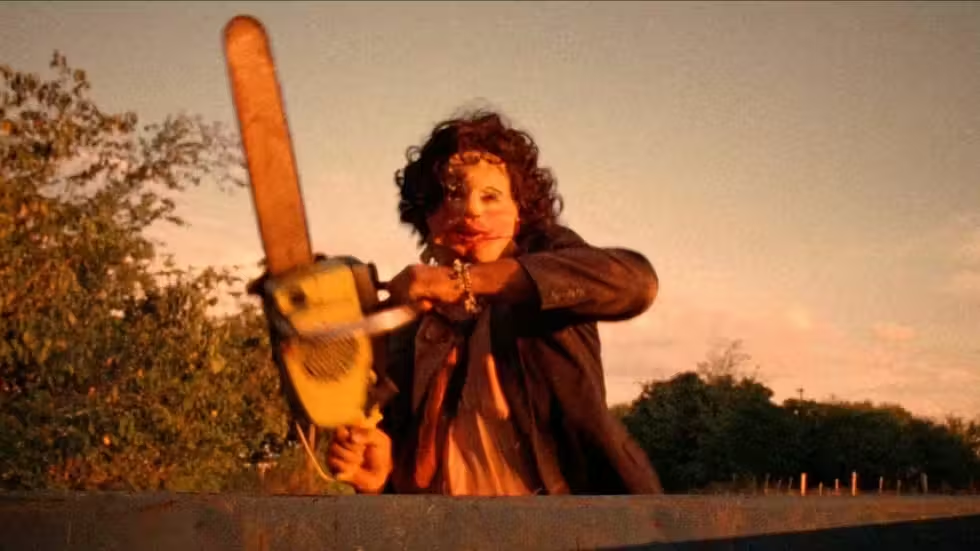
Leatherface is part of the Mount Rushmore of horror movie killers alongside icons like Freddy Krueger, Michael Myers, and Jason Voorhees. It takes a lot to end up in that pantheon, but for him, it was shockingly easy. Even though less than 20 seconds elapse between his first appearance on-screen in 1974’s The Texas Chain Saw Massacre and the end of the scene, his introductory moment instantly cemented him as a legend of the genre.
Let’s break down exactly how this scene works, and why it’s so effective, even more than 50 years later.
Leatherface Provides the Movie With A Short, Sharp Shock
It’s perhaps worth noting at this point that the movies in the Texas Chainsaw Massacre franchise often challenge traditional notions of who is the “villain” in a story. While Leatherface (Gunnar Hansen) is the primary killer in these movies, he is the product of a wildly abusive household and is often simply defending his home from people who he views as intruders.
However, whether or not he is the true antagonist of The Texas Chain Saw Massacre, he is a tremendously powerful person who is capable of terrifying violence, as is made perfectly clear by his first appearance in the movie.
Up to the moment when Leatherface appears (at the end of the movie’s first act), director Tobe Hooper’s magnum opus has treated audiences to a slow boil as Sally Hardesty (Marilyn Burns) and her friends travel first to the graveyard where her grandfather was buried and then to his rural home (which, unbeknownst to them, is next to a farmhouse that is owned by a cannibalistic family of former slaughterhouse workers). While there are plenty of grody, intense moments packed into the first act, they are more surreal than downright scary, forging a sort of gloomy atmosphere.
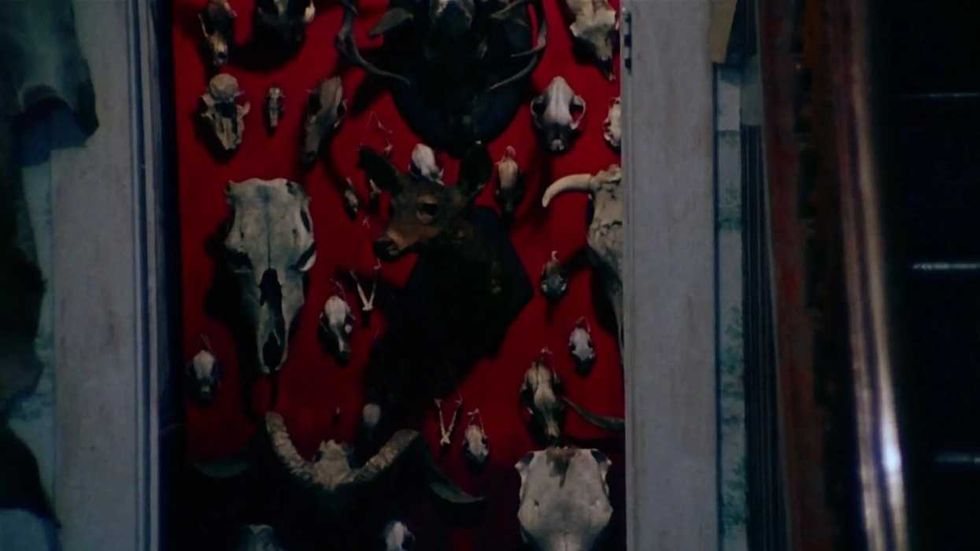
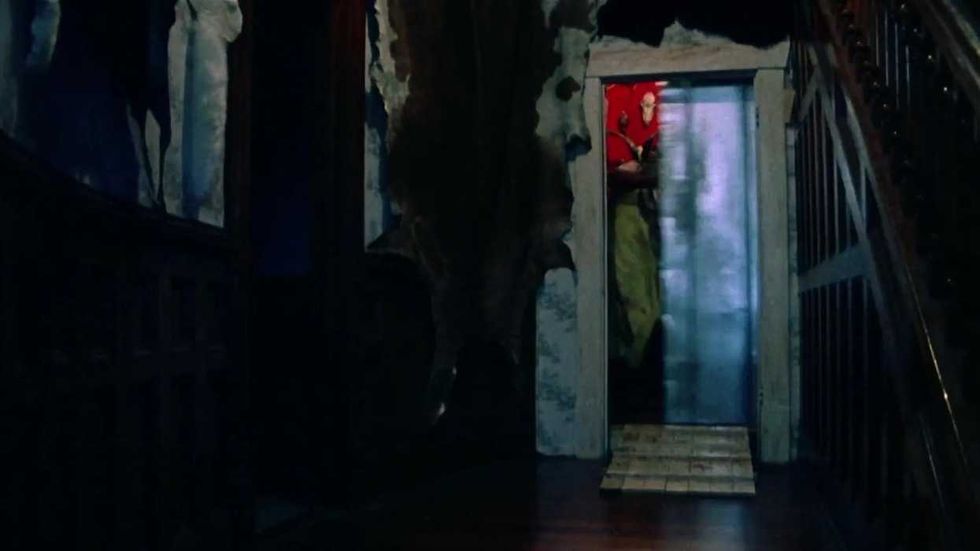
Leatherface’s introductory scene starts with the same type of slow-burn approach that the rest of the movie has been dealing in up to that point, following Kirk (William Vail) as he investigates a nearby farmhouse to see if anybody is home with whom he can barter for gas. The exterior of the house looks perfectly normal (if a little sun-bleached), as does the entryway, except for one detail: There is an open door that leads into a hall, which is painted bright red and decorated with various cow skulls.
 ‘The Texas Chain Saw Massacre’ (1974)Credit: Bryanston Distributing Company
While this type of interior decorating style might not have thrown a Texan in the 1970s, as it could certainly have been read as a display of hunting trophies, it does hint at the terror that is to come. The skulls visually represent death, while the red wall brings to mind ominous associations with blood and violent passions.
The doorway catches the eye both because it is a bright color and because red is only infrequently used in the first act of the film, most notably in the blood that an unhinged hitchhiker (Edwin Neal) smears on the side of the van and in the shorts that Kirk’s girlfriend Pam (Teri McMinn) is wearing. However, while it signals danger, it is of a piece with the atmosphere that the rest of the movie has been delivering up to this point, so it doesn’t necessarily trigger alarm bells in the audience’s minds.
The pig noises he can hear inside make things feel a bit more unsettling, but it’s a rural farmhouse right next to an old slaughterhouse. They’re not impossible noises to hear.
But you know what does trigger alarm bells? The moment when Kirk walks toward the doorway and out emerges a hulking figure wearing an apron and a mask made of human skin. A figure who squeals like a pig (revealing himself to be the source of the noises) and summarily bashes Kirk in the head with a hammer, drags his body into the hallway, and slams a metal sliding door shut, exiting the movie just as quickly as he appeared.
This sudden burst of violence interrupts the slow boil of the first act of The Texas Chain Saw Massacre, forcing the story into a sudden, bubbling crescendo that scorches viewers with its sheer intensity.
Breaking Down the Brutality of Leatherface’s Introduction
There are several touches to Leatherface’s introductory scene that make it a truly elegant display of cinematic brutality. The first is the fact that Kirk trips as he is approaching the door. In addition to leaving the character feeling off-kilter, this moment forces the viewer’s eye to track his fall, making Leatherface’s sudden appearance from the left side of the screen feel more jarring and unexpected.
While most filmmakers would shoot Kirk’s encounter with Leatherface in jagged, quick cuts to emphasize how shocking those moments are, Tobe Hooper and editors Sallye Richardson and Larry Carroll do the exact opposite.
While the scene is short, the shots are relatively lethargic, giving audiences some extra room to breathe and consider what they’re seeing: Leatherface casually raising the hammer. Kirk’s body convulsing vigorously. Leatherface calmly finishing the job. There’s something very matter-of-fact and calm about the way the action in this scene is being presented, which provides a harsh juxtaposition with the almost unbelievably violent way that Kirk’s body reacts to his injury (for the record, there is almost no blood on-screen in The Texas Chain Saw Massacre, but it earns its grotesque reputation from moments of visceral implication like this).
 ‘The Texas Chain Saw Massacre’ (1974)Credit: Bryanston Distributing Company
This aesthetic approach also visually emphasizes the way that Leatherface himself is behaving. For him, this moment very much seems to be run-of-the-mill, like something he’s trying to knock off the to-do list before sitting down for a cup of tea. However, audiences now know what that wall has been trying to tell them all along. That doorway is a portal to Hell, and anyone who crosses it ain’t ever coming back.
However, the most powerful thing about Leatherface’s introductory scene might just be the way he slams the door. The character remains matter-of-fact, but the way the door slamming is staged prevents audiences from seeing behind it. That slam loudly brings the scene to an abrupt close, cutting off the audience from gleaning any more information about who this killer could possibly be, how Kirk is holding up, or why any of this is happening. All they’re left with are terrifying scraps of information that they will spend the next 20 or 30 minutes piecing together as the majority of Kirk’s friends meet their own violent ends, one by one.
It’s a perfect introductory scene to a new horror icon. Simultaneously elegant and brutal, it sets the stage for a game of cat and mouse the likes of which audiences had literally never seen before at the time.
There is plenty more to read about The Texas Chain Saw Massacre on No Film School, which features articles on why Stephen King calls it the scariest movie, how it has one of the best openings in horror, and - to bring things full circle - why Leatherface’s final scene is one of horror’s most iconic images.