What’s in Pulp Fiction’s Briefcase? Nothing and Everything
The unanswered question is the film’s cleverest trick.
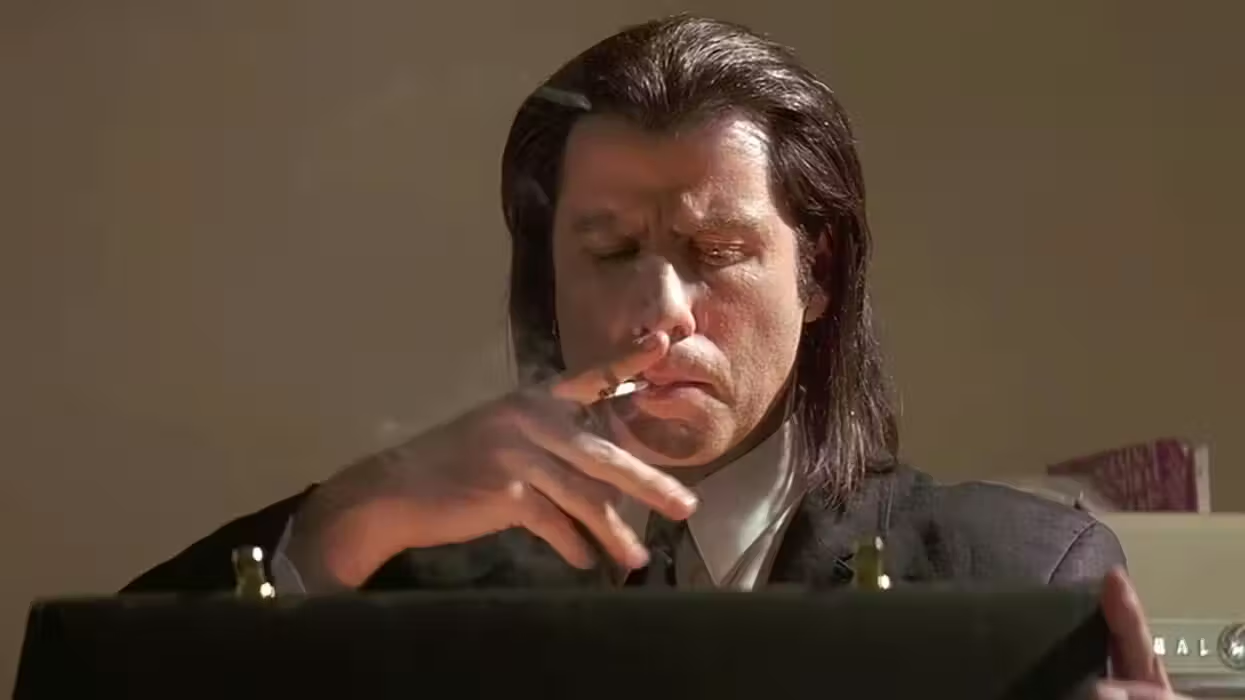
Pulp Fiction (1994)
Vincent Vega (John Travolta) flips open a battered briefcase, and suddenly his face glows as if lit by divine revelation. Jules (Samuel L. Jackson), curious to know, asks him, “We happy?”
And us?
We lean forward, just as desperate to peek inside. In that instant, Tarantino transforms a simple prop into one of the most famous mysteries in cinema history.
What’s in the briefcase?
The question has lingered since Pulp Fiction (1994) first hit theaters. But here’s the trick: the brilliance lies not in an answer, but in the lack of one. Tarantino leaves the case intentionally blank—an empty space that pulls our imaginations into the film and makes us part of the storytelling process. Its ambiguity is not a bug; it’s a feature.
This article digs into how the briefcase works as the ultimate MacGuffin, the cinematic history that inspired it, the practical tricks behind its golden glow, and the lasting impact of leaving a mystery unsolved.
The MacGuffin’s Masterpiece: Function Over Form
It’s What It Does, Not What It Is
Alfred Hitchcock popularized the word “MacGuffin” to describe any object that drives a plot forward but is otherwise irrelevant in itself. Tarantino’s briefcase is a textbook example. The contents don’t matter—what matters is that everyone wants it. That desire fuels the action and elevates the mystery.
Unlike most MacGuffins, which eventually get explained, this one refuses to play along, making it a pure, perfect case study.
The Engine of the Plot
Track its journey and you’ll see the briefcase is the spine of Pulp Fiction. Its theft triggers the diner robbery. Its recovery dominates the “Vincent Vega and Marsellus Wallace’s Wife” chapter. And it anchors the film’s closing showdown, where Jules spares Pumpkin and Honey Bunny in a moment of spiritual awakening.
The briefcase is never idle; it constantly sets events in motion across Tarantino’s famously scrambled timeline.
A Character in Its Own Right
What makes the case so effective is how characters react to it. Jules treats it like scripture, uttering “We happy?” with near-religious reverence. Pumpkin (Tim Roth) sees it as a payday. Marcellus Wallace (Ving Rhames) doesn’t need to explain why it matters—his aura of menace makes it clear.
The briefcase reflects back each character’s motivations, almost like a mirror. While it may not drive the story itself, it shapes how we understand the people in it.
Behind the Glow: The How and Why of Ambiguity
A Practical (and Theatrical) Choice
Here’s the behind-the-scenes magic: that golden light wasn’t CGI. It was just a lightbulb hidden inside the case. Simple, cheap, and stunningly effective. Showing diamonds, gold bars, or drugs would have grounded the mystery in the ordinary. Instead, the glow elevates it to something mythic, an object that looks literally untouchable.
Tarantino’s Homage to History
Tarantino didn’t invent this trick. He borrowed, and then twisted, from cinema history. Kiss Me Deadly (1955) featured a briefcase that glowed ominously when opened, its contents implied to be radioactive material but never fully explained. The Maltese Falcon (1941) gave us the ultimate “great whatsit”—a statue everyone kills for, only to discover it’s worthless.
By riffing on these, Tarantino crafted his own lineage of cinematic MacGuffins.
The Director’s Deflection
When asked what’s in the briefcase, Tarantino put the responsibility of figuring it out on the audience. He said, “It’s your job”. It’s whatever the viewer wants it to be.
That isn’t dodging the question—it’s flipping it back onto us. Instead of feeding us an answer, he lets the audience co-author the mystery. In that sense, the real “content” of the briefcase is our collective imagination.
The Power of the Unseen: Why “Nothing” Means “Everything”
The Ultimate Rorschach Test
The beauty of leaving the case undefined is that it becomes a blank canvas. For some, it’s gold. For others, it’s drugs, or even Marcellus Wallace’s soul. Whatever theory you latch onto says more about you than about the movie.
Like a Rorschach test, the briefcase reflects back the viewer’s psychology as much as the characters’.
Mythology Over Mundanity
If Tarantino had revealed a pile of cash or a handful of jewels, it would’ve been satisfying in the moment—but instantly forgettable.
By withholding the reveal, he turned the case into a cinematic myth. It exists in that rare category of objects—like the Ark of the Covenant or the One Ring—that feel larger than life precisely because we never truly see them in full.
Focusing on the Human Drama
The absence of an answer also sharpens the focus on the characters. The real tension isn’t what’s inside the case—it’s Jules wrestling with fate, Vincent’s arrogance, Butch’s loyalty, and Marcellus’s authority.
The case is just the spark that sets their choices ablaze. By leaving the “what” blank, Tarantino makes us pay closer attention to the “who” and “why.”
The Enduring Legacy: A Mystery Forged in Pop Culture
A Permanent Place in the Cultural Lexicon
Over time, the briefcase has become bigger than Pulp Fiction itself. It’s been parodied in The Simpsons, Community, and countless internet memes.
The glowing case is shorthand for cinematic mystery, recognizable even to people who haven’t seen the film. That cultural longevity comes directly from its ambiguity.
The Fan Theories (A Brief Tour)
Of course, fans have never stopped guessing. Some swear it’s Marcellus Wallace’s soul, pointing to the Band-Aid on the back of his neck. Others argue it’s the diamonds from Reservoir Dogs (1992), linking Tarantino’s films into a shared universe.
A more playful theory suggests it’s an Oscar statue, a cheeky nod to Hollywood’s obsession with awards. And then there’s the simplest one: it’s just gold. None are confirmed, all are fun.
The Real Answer
But here’s the kicker: the fact that people are still debating it thirty years later is proof of success. Theories are the point. The briefcase thrives not on what it contains, but on the conversations it sparks.
Its real power is in making us wonder, argue, and return to the film again and again.
The Perfect Void
Revisit that opening glow: Vincent’s “Wow,” Jules’s silence, our curiosity. The brilliance of Tarantino’s choice lies in giving us nothing—and making that nothing unforgettable.
The briefcase, as it seems, couldn’t care less about the resolution. The briefcase is about desire, mystery, and the power of imagination.
In an era where blockbusters explain every Easter egg, tease sequels in post-credit scenes, and leave little room for interpretation, Pulp Fiction’s glowing briefcase stands apart. It reminds us that some questions work better unanswered.
Sometimes, the most powerful thing a storyteller can give us is the space to dream. Perhaps that’s what really is inside the case.
- How Pulp Fiction Went from Cannes to $100 Million ›
- The Grandeur of the 'Pulp Fiction' Dance Scene ›
- Tarantino Explains Nonlinear Storytelling in this 'Pulp Fiction' Video Essay ›
- 'Pulp Fiction' Gets Deconstructed in This Full-Length Film Analysis ›
- How Pulp Fiction Hacks the Three-Act Structure ›
- The Meaning Behind Pulp Fiction’s “Royale with Cheese” ›
- Everyone Misunderstands the Hand-Drawn Joke in 'Pulp Fiction' | No Film School ›
- The Wolf’s Goodbye in 'Pulp Fiction': One of The Coolest Exits Ever Written | No Film School ›
- Clocks and Katanas: Breaking Down the Iconic Basement Sequence in Pulp Fiction ›
- The Foot Massage Power Play: Why Jules and Vincent’s Debate in Pulp Fiction Was Never About Feet ›
- ‘Pulp Fiction’: The “5-Dollar Shake” Scene’s Secret Weapon ›
- Pulp Fiction Frightening Answers ›