‘Pulp Fiction’: The “5-Dollar Shake” Scene’s Secret Weapon
An in-depth look at how the production design of Jack Rabbit Slim’s anchors the film’s unique retro-modern atmosphere.
‘Pulp Fiction’ (1994)
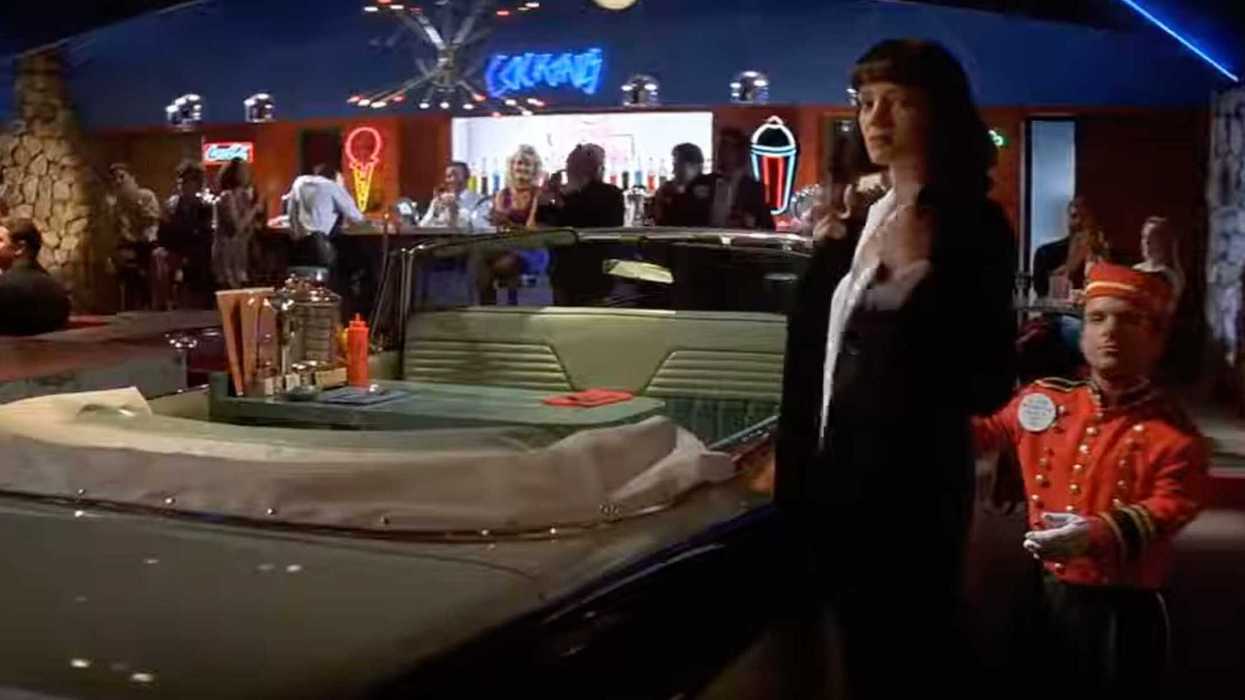
You remember the “5-dollar shake” scene, don’t you? It’s the scene that sits comfortably between “Don’t be a square” and the “twist contest.” All these moments take place in Jack Rabbit Slim’s, a '50s-style themed diner. While Vincent Vega (John Travolta) is mostly preoccupied with how to treat Mia Wallace (Uma Thurman), his boss’s wife, in this particular moment, however, his confusion shifts to a five-dollar mixture of milk and ice cream.
But the scene is more than Vincent’s thoughts about overpaying for dairy. This scene also tells you about the film’s rhythm. For a high-intensity crime film, this scene doesn’t seem to be rushing anywhere. It expects you to sit, look around, lean in, and soak in the quiet, relaxed moment.
At the same time, the setting, Jack Rabbit Slim’s, becomes a neon-drenched fever dream that also functions as the film’s aesthetic soul. During this scene, the film’s narrative shifts from a gritty crime energy to a high-gloss, retro-modern fantasy. The setting becomes a character, and it talks back.
Here, you meet waiters named “Buddy Holly” (Steve Buscemi) and “Dean Martin,” as well as a Marilyn Monroe impersonator. The host speaks in a transatlantic accent. And the diner booths are in the form of mid-century cars. And none of this is random. These visuals are purposeful buffers against the film’s looming brutality.
Think of this scene as a cinematic palate cleanser. In this scene, the world of a ‘90s hitman is balanced with a little 1950s kitsch.
Jack Rabbit Slim’s: A Designed Illusion
A Nostalgia Theme Park That Knows It’s Fake
Jack Rabbit Slim’s reconstructs 1950s Americana as a fancy experience for the dining patrons. The ‘50s’ legends, such as Buddy Holly, Dean Martin, and Marilyn Monroe, can be seen serving tables. Vintage cars, such as the 1950s Chrysler convertible in which Vincent and Mia are sitting, serve as the dining booths. The dance floor mimics a tachometer.
And yet, you cannot point to a single production design element that aims for realism. Everything leans into exaggeration to create a controlled, artificial environment that feels deliberate rather than just decorative.
The Price of Nostalgia
The diner aims to give its patrons an experience as if they have entered the ‘50s. But that effort doesn’t reflect in the pricing. That’s where the illusion breaks. The “5-dollar milkshake” is a representative example. Of course, we are talking about 1994. Today, in 2026, a $5 milkshake is a common deal at a budget fast-food joint. But imagine a milkshake that’s worth $15. That sounds like a bit of a stretch. Doesn’t it?
The point of the pricing is that it highlights the excess of the setting as well as Mia. As an article in VICE says, Pulp Fiction discusses food as a metaphor for the movie itself. A lowbrow food item, such as this milkshake or Jules’ (Samuel L. Jackson) “Royale with Cheese,” or the “Big Kahuna Burger,” packs more unexpected, high-stakes value than we think. In this scene, it’s the “5-dollar” milkshake that becomes the symbol of the “pulp” lifestyle.
A Liquid Icebreaker
The milkshake—with two choices, “Martin and Lewis” and “Amos and Andy”—is more than a beverage. It acts like a functional character tool. Vincent carries his old-school skepticism. He is fixated on the high price. It shows his grounded, perhaps a bit rigid, worldview. Mia, on the other hand, carries her youthful, daring personality. She is at ease with absurdity, and it signals that she is unpredictable. And the milkshake is between them, acting like a bridge. Its creamy, expensive visual also provides a sensory contrast to the hard-edged conversation and the awkward, dangerous tension between Vincent and Mia.
How the Setting Shapes the Scene
Turning Trash into Neon Treasure
What you see as the exterior of Jack Rabbit Slim’s is actually Grand Central Bowl, a bowling alley in Glendale, California, that was no longer in use. The production team transformed the forgotten, dilapidated space into a vibrant, vintage-themed landmark. If you can, draw a parallel between the setting and Pulp Fiction’s broader theme: both find beauty in the trashy parts of culture. A lesson to learn here is that you can build an entire world from nothing using nothing but just the right lighting and a few vintage props.
A Bright Shield Against a Dark World
Pulp Fiction is a crime film, so its world is obviously filled with violence and unpredictability, and most importantly, volatile characters, such as Jules, Vincent, Marsellus (Ving Rhames), even Honey Bunny (Amanda Plummer), and Pumpkin (Tim Roth).
In this scene, the energy flips. This scene gives us funky lights, a cozy atmosphere, clean geometry, playful details, and comforting eccentricity. This meticulously created and controlled environment softens the otherwise pointy narrative edge.
And yet, this change doesn’t erase the danger. It delays it. The scene serves as a breather. That’s the film’s tonal shift that comes off as intentional instead of abrupt.
Conclusion
The “5-dollar” scene does more than just fill the silence. It anchors the narrative in the world of Pulp Fiction, where style is the currency. However, instead of asking for your attention, it earns it by letting the setting do the talking.
And about Jack Rabbit Slim’s: Take it away, the scene would still work. Keep it, the scene will stick.
- Ezekiel 25:17: The Pulp Fiction Scene That Turned Samuel L. Jackson Into a Legend ›
- What’s in Pulp Fiction’s Briefcase? Nothing and Everything ›
- The Foot Massage Power Play: Why Jules and Vincent’s Debate in 'Pulp Fiction' Was Never About Feet ›
- Everyone Misunderstands the Hand-Drawn Joke in 'Pulp Fiction' ›
- The Wolf’s Goodbye in 'Pulp Fiction': One of The Coolest Exits Ever Written ›
- The Wallet Test: How the Final Scene of ‘Pulp Fiction’ Flipped the Script ›
- Pulp Fiction Burger Scene ›