Vincent Vega (John Travolta) and Mia Wallace (Uma Thurman) walking into Jack Rabbit Slim’s is one of those few movie scenes that stick in your cultural imagination.
It’s a surreal time capsule—an old-school diner stuffed with pop icons, themed waiters, and a jukebox that seems like it belongs to another dimension. But beneath all the neon, this is—by no means—a carefree date. Vincent isn’t there by choice; he is on edge, tasked with keeping his boss’ wife entertained without letting anything spiral out of control.
And amidst this tense balancing act comes Mia’s playful jab:
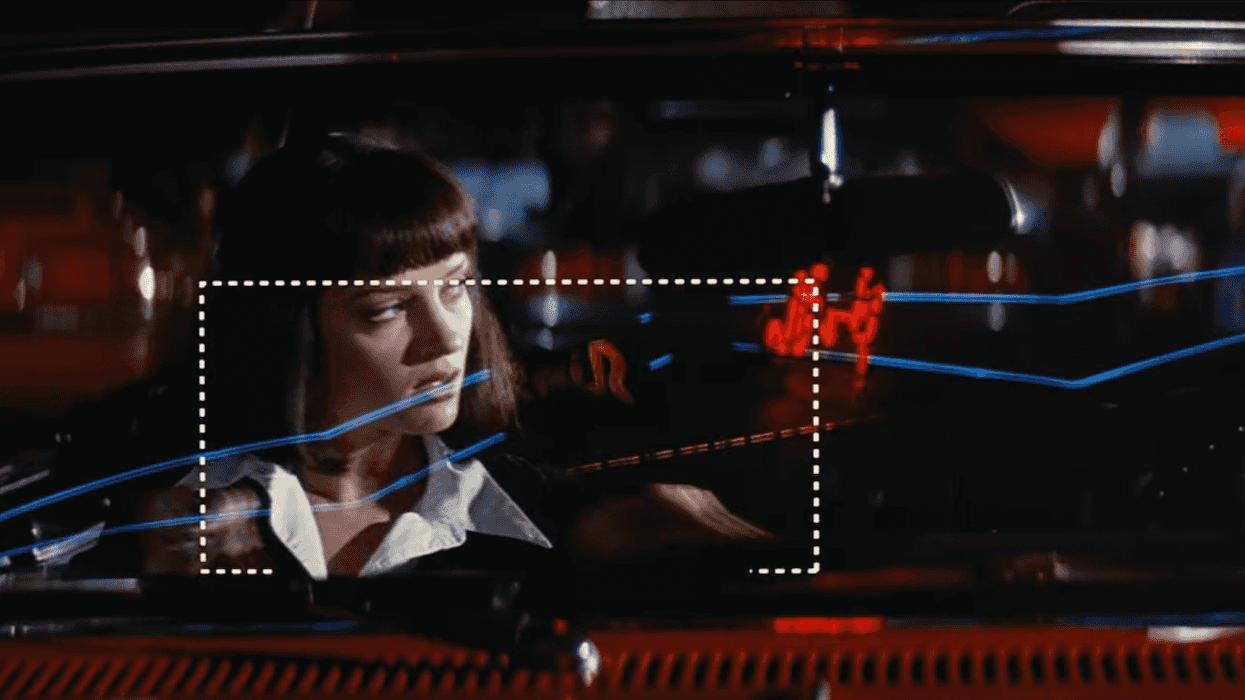
“Don’t be a…,” she pauses, casually drawing a square in the air with her fingers before sealing it—square.
It’s a moment that shouldn’t matter much, yet it has gone on to become one of Pulp Fiction’s most iconic quotes. Why?
Because, in the flick of the wrist and sly grin, Mia flips the power dynamic, punctures Vincent’s nervous energy, and gives the audience a defining glimpse into the film’s language of cool.
That small square in the air is more than a throwaway gag. It’s a Rosetta Stone to Tarantino’s world—where irony, nostalgia, and sharp character beats mix together.
The line compresses the movie’s themes into one cheeky gesture: authority vs. rebellion, old slang reborn as fresh style, and the eternal clash between uptight order and reckless cool.
Power, Play, and Subtext: Deconstructing the Scene
The Hand Gesture: A Non-Verbal Masterstroke
The brilliance of Mia’s line lies in the fact that it isn’t just spoken—it’s drawn in the air. The square she depicts isn’t a subtle one; rather, it’s a stark, concrete indication of Vincent’s inflexibility. In addition to highlighting the conversation as a visual punchline, it gives them a private moment of intimacy. The audience watches Vincent and Mia perform this delicate dance, but only Vincent and Mia share the joke in that moment.
More than that, the gesture serves as a control mechanism. Vincent is put on the defensive when Mia controls the cadence of their conversation. She sets the tone by making fun of his anxious adherence to rules while remaining utterly unaffected. This brief moment of physical humor sticks out as particularly cinematic in a movie that is full of verbal wit.
 'Pulp Fiction'Credit: Miramax
Vincent the Square: The Clash of Cool
Vincent’s anxiety is obvious throughout their night out. He is constantly second-guessing himself, replaying Marsellus’ (Ving Rhames) warnings in his head, and trying to toe the line between politeness and self-preservation. Mia picks up on this immediately. For her, his rigid “don’t break the rules” demeanor screams “square.” It’s not just about being uncool—it’s about being trapped in a mindset that can’t flow with her unpredictable energy.
Tarantino sets Vincent up as the perfect foil for Mia. He is the guy following the code, while she is the wild card testing how far she can push him. By calling him out with that line, Mia breaks the tension in a way that both ridicules him and draws him into her orbit. The scene stops being about Vincent’s discomfort and becomes about Mia’s playful authority.
Mia’s Aura of Effortless Cool
Mia glides through the film like she owns every room she goes into. She is relaxed, authoritative, and always changing the rules of engagement. In contrast, Vincent is rigid and self-conscious. “Don’t be a square” cements that dynamic. She defines Vincent’s uneasiness and incorporates it into their common language rather than merely observing it.
The line positions her as the arbiter of cool. She determines what is playful teasing, what is uptight, and what is inappropriate. This is intimidating and intoxicating for Vincent. In our opinion, it’s a scene where Uma Thurman makes such an impact on the movie that the entire diner scene revolves around her charisma.
 'Pulp Fiction'Credit: Miramax
A Phrase Out of Time: Tarantino’s Nostalgia and Reinvention
“Square” as a Linguistic Relic
The word “square,” as slang, was not a ‘90s invention. In the 1940s and 1950s, it was used to describe someone who was straight-laced, uninteresting, or out of touch with the trendy crowd. The phrase was all but forgotten by the time Pulp Fiction hit the screens. Tarantino purposefully brought it back to life, incorporating a sort of cultural recycling into his film. Perhaps this is why it feels both vintage and modern.
Although the hand gesture isn’t historically accurate—it wasn’t how the word was used back in the ‘40s and '50s—it adds a layer of absurdity that’s pure Tarantino. He remixes the past into something self-aware and cinematic rather than merely quoting it.
Pulp Fiction’s Retro-Futuristic Vibe
The essence of the film lies in its mash-up of eras that shouldn’t coexist, but they do. The characters have a '90s sense of irony, the soundtrack alternates between surf rock and soul, and the Jack Rabbit Slim’s diner screams 1950s Americana. In this patchwork world, Mia’s “square” line fits perfectly. In a scene reminiscent of a nostalgic fever dream, a word from another era is spoken with a contemporary smirk.
The end effect is a scene that seems timeless. Since it is composed of pieces from numerous decades, it cannot be attributed to just one. The fact that the quote is set in Tarantino’s universe rather than our own linear timeline contributes to its timeless appeal.
Defining “Cool” for a New Generation
Tarantino reinterprets what “cool” means by giving Mia an antiquated slang term and allowing her to use it as if it were the night’s sharpest jab. Style, attitude, and delivery are more important than novelty. Mia uses “square” with such confidence that it feels new again, transforming an outdated term into a joke for a new generation.
By repurposing cultural remnants into something fresh and self-aware, rather than by following trends, Pulp Fiction established cool for the ‘90s and beyond. Mia’s casual comment turns into a philosophy: coolness is whatever you can make people believe it is.
Uma Thurman’s Iconic Performance
Naturally, without Uma Thurman, none of this could ever work. Her cool, cunning, and subtly dominant delivery transforms what might have been a casual joke into a memorable cinematic moment. What makes Mia Wallace so memorable is encapsulated in her smirk, her pause before completing the line, and the way her hand drifts languidly through the air.
It’s a reminder that even the sharpest dialogue needs an actor who can give it rhythm and presence. Mia is the type of character that endures in cultural memory for all time because Thurman, instead of just saying the line, chooses to live it.
The Lasting Bite of a Perfect Moment
“Don’t be a square” may look like a catchphrase, but it captures the essence of what makes Pulp Fiction so captivating. It’s a stylistic flourish, character work, and thematic shorthand that encapsulates Tarantino’s fixation with resurrecting the past while transforming it into something new.
The entire movie’s philosophy of cool, Vincent’s rigidity, and Mia’s playful dominance are all conveyed in a single gesture. It’s not just about what’s said; it’s also about how it’s said, how it appears, and how it fits into a world where style and irony are paramount.
More than thirty years later, the square Mia drew in the air is still sharp, still funny, and still defines the movie’s attitude. Coolness isn’t about following rules—it’s about breaking them with style.
And Mia Wallace will always be the one reminding us not to be a square.
- Tarantino Explains Nonlinear Storytelling in this 'Pulp Fiction' Video Essay ›
- How Pulp Fiction Went from Cannes to $100 Million ›
- 'Pulp Fiction' Gets Deconstructed in This Full-Length Film Analysis ›
- Everything You Can Learn From the 'Pulp Fiction' Script ›
- The Grandeur of the 'Pulp Fiction' Dance Scene ›
- Ezekiel 25:17: The Pulp Fiction Scene That Turned Samuel L. Jackson Into a Legend ›
- The Meaning Behind Pulp Fiction’s “Royale with Cheese” ›
- How Pulp Fiction Hacks the Three-Act Structure ›
- Watch: If You Turn the Sound Off, 'Pulp Fiction' is Still Brilliant. Here's ... ›
- What’s in Pulp Fiction’s Briefcase? Nothing and Everything ›
- How Did Fellini's Influences Directly Inspire Tarantino's 'Pulp Fiction ... ›
- Unpacking the Dark Legacy Behind the Gold Watch in Pulp Fiction ›
- The Wolf’s Goodbye in 'Pulp Fiction': One of The Coolest Exits Ever Written | No Film School ›
- 10 Coldest “Before I Kill You” Lines in Cinema ›
- The Secret Behind the Iconic “Walken Pause” in ‘Pulp Fiction’ ›
- The Iconic 'Pulp Fiction' Scene That Survived the Chopping Block ›
- The Foot Massage Power Play: Why Jules and Vincent’s Debate in Pulp Fiction Was Never About Feet ›
- The Wallet Test: How the Final Scene of ‘Pulp Fiction’ Flipped the Script ›
- ‘Pulp Fiction’: The “5-Dollar Shake” Scene’s Secret Weapon ›
- 10 Best Quentin Tarantino Characters: Ranked ›