Clocks and Katanas: Breaking Down the Iconic Basement Sequence in 'Pulp Fiction'
From frozen clocks to the symbolic weight of the katana, we break down the visual motifs that define Butch’s “pit of hell.”
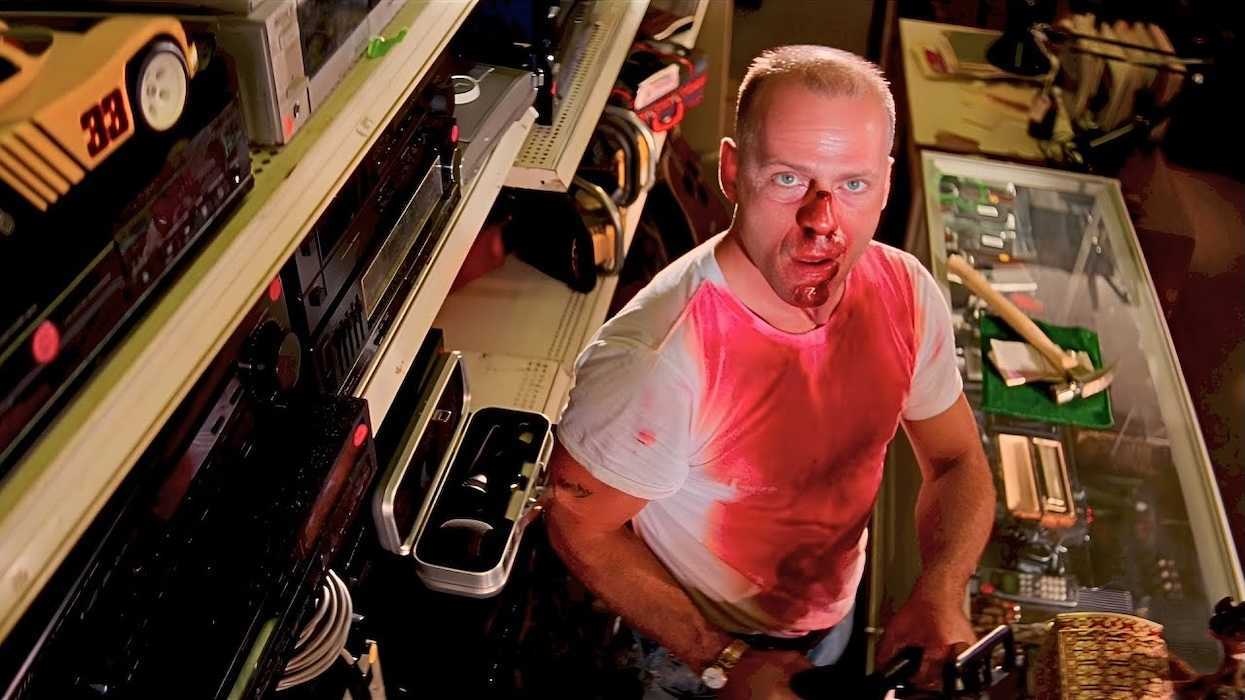
'Pulp Fiction'
If you’re ever in the mood for turning your casual afternoon into a fever dream, look no further than one Mr. Quentin Tarantino. He never disappoints. And with Pulp Fiction’s (1994) “Gimp” scene in context, I say, I rest my case.
In a film known for pushing all boundaries, this scene pushes you to a level of genuine discomfort. It comes equipped with all the tools: chains, a leather suit, masks, gag balls, a stuffy basement, and, of course, degenerate people.
But, if you manage to rise above these superficial "shock value" elements and stop watching it through your fingers, you might be able to see something deeper, more meaningful, and nuanced. And when you do, you will see that the basement is not just a house of horrors; it’s a calculated narrative pivot where Butch Coolidge (Bruce Willis) must decide who he really is.
Here, we will dissect and unravel the layers of this scene to discover who Butch is when he enters the pawn shop and who he is when he leaves it.
What the Scene is About
The movie has a non-linear narrative structure, but, for the sake of clarity, we will explore the events of Butch’s subplot in chronological order.
A young Butch Coolidge (Chandler Lindauer) is visited by Captain Koons (Christopher Walken), who fought in the Vietnam War alongside Butch’s late father. He gives Butch a gold watch, which Butch’s father, before he died, had asked Koons to pass along to his son. Koons explains the watch's epic journey that started with Butch’s great-grandfather during World War I, then passed on to Butch’s grandfather while he fought in World War II, and then to Butch’s father. In short, it’s a family heirloom that holds Butch’s legacy.
Years later, in the present, middle-aged Butch is now a boxer on the payroll of a crime boss, Marsellus Wallace (Ving Rhames). Wallace pays Butch to “throw” a match. Butch, however, defies his orders and kills his opponent instead. This puts him in direct conflict with his aggressive and violent boss. So he goes on the run but realises his girlfriend, Fabienne (Maria de Medeiros), had forgotten to pack his precious gold watch. He throws a major fit and decides to return to his quarters, which are now essentially a tiger’s den, considering Wallace must have his men on the lookout. He indeed encounters one of his men, Vincent (John Travolta), whom he promptly kills and escapes, but only to come across Wallace himself.
A fight ensues between the two men. As Wallace chases Butch, they both end up in a pawn shop. The pawn shop is owned by Maynard (Duane Whitaker) and Zed (Peter Greene), two sadistic criminals who senselessly and randomly torture passersby. They have a leather-clad gimp caged in the basement as a symbol of extreme and absolute victimization and total submission. They take Wallace to another room where Zed rapes him, while Butch remains outside, bound and gagged.
Somehow, Butch frees himself and knocks the gimp out. At first, he attempts to flee but changes his mind and decides to save Wallace. While searching for a weapon, he finds a katana. He uses it to kill Maynard and free Wallace. Wallace, grateful, forgoes his animosity toward Butch and lets him go and gears up to torture Zed.
The Basement: A Moral Place
The basement takes away all social hierarchies. It has low ceilings, harsh lighting, and locked doors. In such a gloomy place, “everyone” is reduced to just bodies. The only ruling element is the crazy duo: Maynard and Zed. Butch tries to navigate the situation tactically, but the space is not conducive to that.
Earlier in the film, the violence follows a definite path: Hit first, get paid, and buzz off. However, the basement is not “sophisticated” enough to hold that logic. There is no “deal to cut,” there is no “leverage to gain.” Maynard and Zed are pure chaos and pure evil. So, violence becomes senseless suffering. And this “alien” dynamic is what drives Butch to take a step back, think, and not run away. So, he instead turns back and helps Wallace.
The Burden of Time
The Gold Watch
The gold watch is more than an heirloom. It’s Butch’s family history. It’s what defines him. It’s what says who he is—via his connection with his ancestors.
But more importantly, it’s his pride. It carries the legacy of the brave, patriotic, and selfless—and loving—father figures that preceded him. The legacy that’s now entirely his to carry. I guess now you can see why it no longer seems stupid or sentimental that he went back to retrieve it. Yes?
In the pawn shop, the watch transforms from a sentimental object into a physical reminder of the masculine and honorable legacy it holds. If he runs, that means he has effectively failed to uphold that legacy. And with this realization, running stops being an option.
The Frozen Wall Clock
In the basement, there is a clock on the wall that’s frozen. It’s not working. This is an indication that Butch is no longer in his usual time zone. His beef with Marsellus, which made sense outside the basement, is not valid inside it. Whatever rules and laws existed in the outside world, or even in the L.A. underworld, they mean nothing here. This situation leaves Butch in a spiritual limbo. Here, the only thing that exists with him is his next choice, whatever it will be.
Choosing the Weapon of Redemption
Cycling Through the Tools of Violence
Once he makes up his mind to stay back and fight, Butch rummages through an assortment of items: a hammer, a baseball bat, and a chainsaw. But these aren’t weapons. These are crude, messy tools. Makeshift ones. Their original purpose is not to fight. Two of them are carpenter’s tools, and the third one is a plaything. There is no “fighter’s grace” in them. There is no “honor.” One can (and most do) use these items to fight, but at best, they deliver basic survival or mindless brutality. Each one he picks up is an improvement in lethality, but ultimately, they all lack the specific character required for the “heroic” rescue he is about to perform.
The Katana and the Return of Honor
The scene’s tonal value shifts as soon as Butch grabs the katana. The katana is the choice weapon of the Samurai and in that capacity, it represents their code of honor and disciplined warfare. When he chooses the katana over the chainsaw, Butch stops being a victim of his circumstances. Suddenly, he is a warrior. This is the moment where he (though symbolically) reclaims the honor that his father and Captain Koons talked about in the Hanoi pits.
Entering the Generational Pit
Escaping the Hanoi Echo
Every one of Butch’s forefathers survived their personal hells during their respective wars. As Captain Koons described, the POW camp in Hanoi was their personal “pit of hell” for him and Butch’s father. This pawn shop basement is the modern equivalent of it. It’s Butch’s pit of hell. Whether it’s an actual POW camp or this basement, these are all places of confinement, humiliation, and the lingering odor of death.
For Butch, saving Wallace is a way to rewrite his father’s story. He refuses to be just a survivor. He chooses to be a protector, a winner.
The “Grace-ful” Exit
After this carnage is over, Butch leaves on a motorcycle named “Grace.” It’s a bit en face, dry humor from Tarantino, but it works, because it marks the end of Butch’s struggle, both internal and external. He has settled his debt with Wallace, and he has settled his debt with his own conscience. He is a free man.
In this basement, he faced those two creeps and one gimp, but finally, he “earned” his freedom. Finally, he moved past those ticking clocks of his old life.
Conclusion
Is the “Gimp” scene uncomfortable? Yes. But it’s also an essential turning point in the narrative where we see Butch trading his ego and his pride for honor and sense of duty. Butch begins as someone who fights for money, but he ends up being someone who fights for principles. He shows that sometimes, to find your missing grace, you have to pick up a katana and walk back into the dark. Because sometimes a “basement” is the only place where you can find your redemption.
- ‘Reservoir Dogs’: The Slow-Mo Walk That Defined Cool ›
- 10 Iconic Quotes from Quentin Tarantino Movies ›
- Unpacking the Dark Legacy Behind the Gold Watch in 'Pulp Fiction' ›
- The Meaning Behind Pulp Fiction’s “Royale with Cheese” ›
- What’s in Pulp Fiction’s Briefcase? Nothing and Everything ›
- Ezekiel 25:17: The Pulp Fiction Scene That Turned Samuel L. Jackson Into a Legend ›
- 10 Coldest “Before I Kill You” Lines in Cinema ›
- The Secret Behind the Iconic “Walken Pause” in ‘Pulp Fiction’ ›
- The Wallet Test: How the Final Scene of ‘Pulp Fiction’ Flipped the Script ›