How to Sell a Screenplay While You're Still in Film School
Screenwriter Ron Mita sold his first spec to Columbia Pictures.
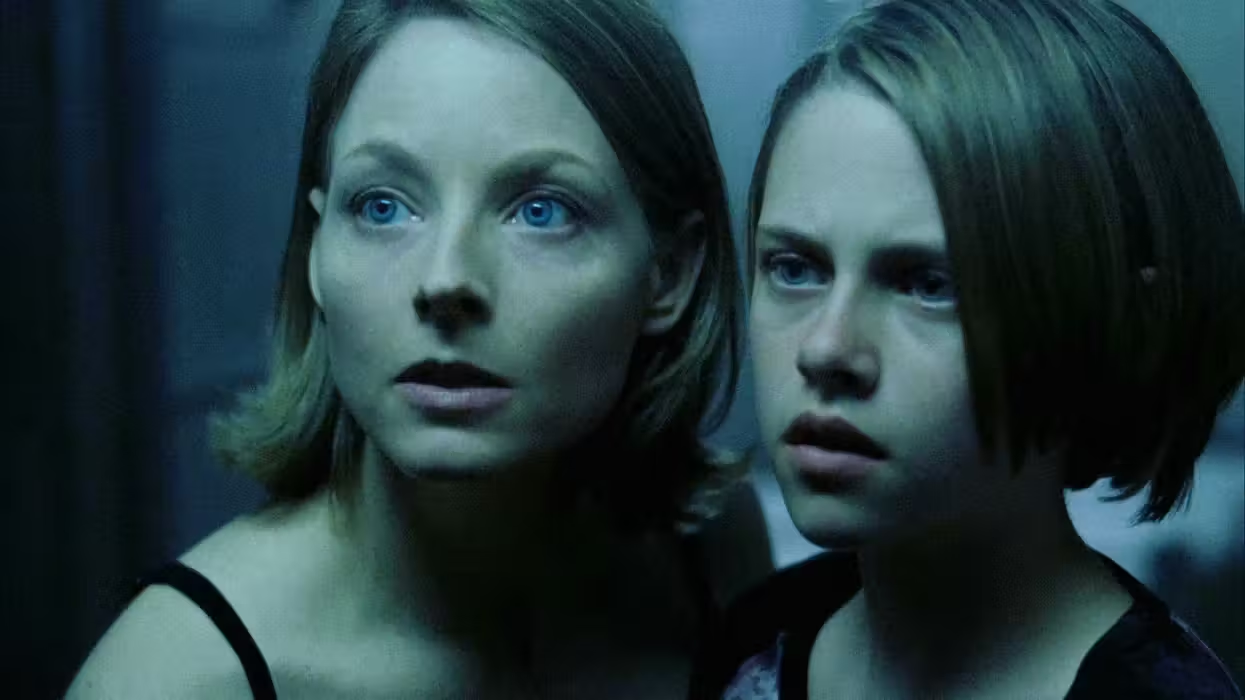
'Panic Room'
Can a student sell a screenplay?
Heck yes!
We've covered Ron Mita before for his screenwriting advice, like how often you should "feed" the audience and what ideas writers should really be concerned about protecting. He's had four produced features (Robots, S.W.A.T., Sniper II, 24 Hours to Live) and teaches screenwriting at College of the Canyons. Mita started out as a graphic artist but flipped to writing and attended Loyola Marymount University to study screenwriting. And there, he sold his first screenplay to Columbia Pictures.
That's not necessarily common. Mita sold Trackdown to Columbia in 1993 during the peak of the spec market, and that market has changed since then. But it's a great example of making moves to put yourself out there, and that's definitely something we can learn from.
- YouTube youtu.be
Get Out of the Classroom
Mita took one or two grad classes a semester and worked jobs around them, but not just day jobs—industry jobs.
He was a two-day PA on Dangerous Love, an internship he cold-asked producer Stan Brooks for after a lecture. He was a runner at Hearst Entertainment, then a Universal tour guide, then an assistant to Nina Jacobson at Universal Pictures.
"I kept thinking, well, this is almost better than going to class. I was still taking one or two classes a semester, working, networking, expanding that network," Mita said.
Look, this is hard, but sometimes you have to hustle. I took night classes at UCLA when I was an intern, then an assitant, and it was difficult, but I loved the experience, and I met a ton of people. Teachers give you feedback, but jobs give you readers.
"We have internships at our college and all other colleges, but go create your own. Go knock on doors and tell people, 'I'm a film student,'" Mita said.
Learn more about how to sell a script in Hollywood.
Build Your Network
We've already mentioned how important meeting people is. Mita says he keeps a list of all the people you run into who might be willing to give you a job or read your stuff. These could be people in production, writers, other assistants, whoever, as long as you're respectful and they tell you yes, they'd be willing to read or give you a position.
"And when the time comes because your script is ready, it's ready to be seen ... then reach out to those people and say, 'Hey, I have a favor to ask. Will you take a look at this?'" Mita said.
Universal ran a lecture series for its tour guides, bringing in producers to talk shop. One night the speaker was TV movie producer Stan Brooks. Mita walked up after the talk and asked to intern. Yes, he was offering free labor, but in return he got a seat inside a creative office.
That internship turned into a runner job at Hearst Entertainment, which turned into an assistant seat at Universal Pictures. He was not cold-calling agents.
A cold ask is a one-shot. Mita is emphatic that the writer who follows up every week, drops in with new pages, or hints repeatedly about representation is spending the favor on being remembered instead of being read. The person you approached said yes, or they didn't. Move to the next name on the list.
"But never be ingratiating. Never sit there and say, 'Please do this again and again and again.' You get one good ask, right?" Mita said.
Don't Waste the First Read
Along those lines, Mita points out that you need to be really, actually ready to send the best possible version of your script when it's a high-level person you're asking.
A reader can't tell draft nine from draft four. Many readers won't look at more than one draft at all. You'll only get one chance.
Mita warns his students of this.
"And sometimes as students, they get opportunities. 'Hey, I met a guy,' or, 'I know this person.' 'My neighbor's an agent.' And I say, 'Slow down. Don't rush into showing them your work until it's ready to go because you won't get that second look.' So, it's got to be good. It's got to be great."
This requires enormous patience. Sometimes you have to write some really bad drafts before you get to a place where you're ready to share. And that might mean that you write a script, or five scripts, that no one ever sees. I can't imagine sending out some of my early stuff now, and I'm glad I didn't.
For those early reads, you need trusted friends who will give harsh feedback. Then you rewrite, and rewrite again, and get more notes, and rewrite a third time. Then maybe you'll be ready to send it to someone big.
Another benefit is that you start to gather a stack of scripts you're hopefully proud of.
"You need a body of work to show. So I always tell my students, never show something that's not complete," Mita said.
Write the Character No One Else Will
Mita and writing partner Jim McClain looked at the market when they were writing their script. In the early '90s, Die Hard was the template. A contained location, a group of antagonists, a competent everyman.
Mita's father clipped and mailed him an article about the newly opened Channel Tunnel, which is where they found their idea. A 30-mile tunnel under the English Channel hadn't been claimed as the new Nakatomi Tower.
The default action hero in that genre was, as Mita puts it, an ex–Navy SEAL or a cop on vacation. Someone whose skill set is weapon competence and being real tough. Mita and McClain wondered who would actually be believable inside this specific location. Their answer was a civil engineer who built the tunnel. They also gender-swapped the character, which worked out because Jodie Foster's team was looking for something in the space. Producer Denise Di Novi got the script to her, and Columbia bought it as a Foster vehicle.
So the quick takeaways: look at a familiar and marketable genre. Make one surprising choice, like a unique setting or profession. And be aware of the market.