Why 'Intolerance' Built Enormously High Sets and Hired 3,000 Extras
D.W. Griffith’s silent epic redefined large-scale movies in 1916.
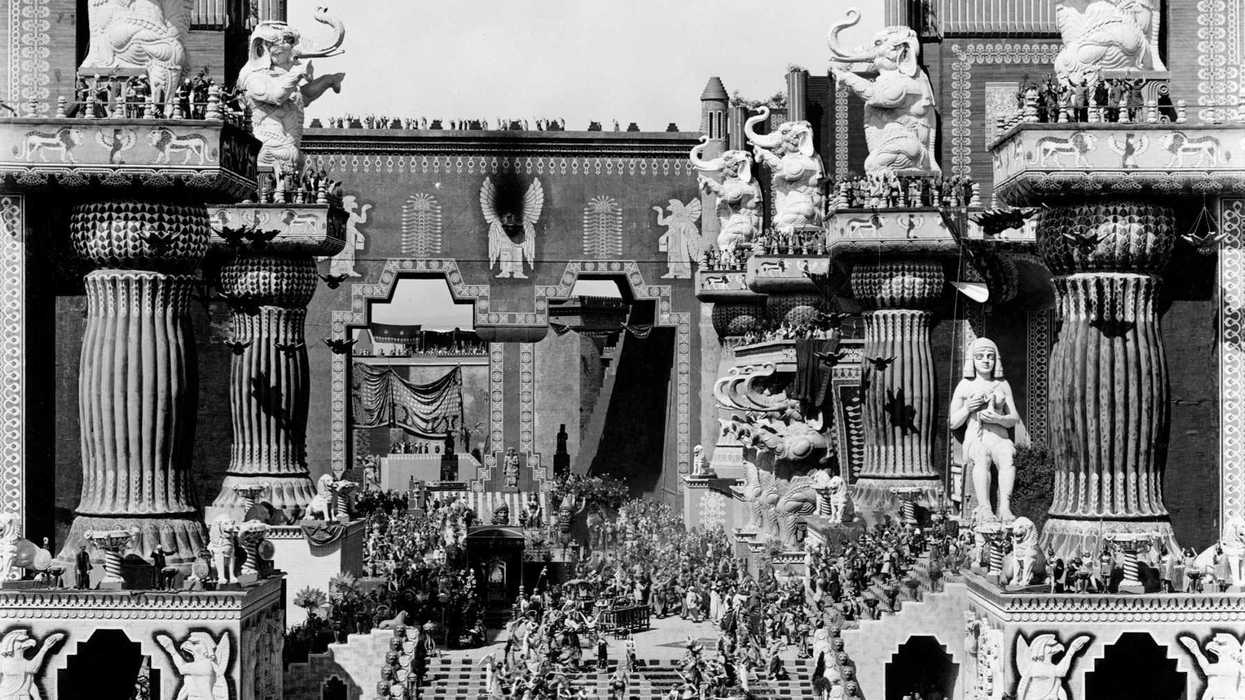
Intolerance: Love's Struggle Throughout the Ages (1916)
The greatest filmmakers did not let the limitations of their time hinder their vision. Few figures embody that ambition more than D.W. Griffith, though his legacy remains deeply complicated and troubling... a filmmaker whose obsession with scale resulted in some of the most jaw-droppingly large-scale films of the early 1900s.
Griffith’s 1916 epic Intolerance stands as one of the most ambitious movies ever made. The film deployed a unique structure that was narratively complex and intriguing. However, its greatest achievement was the movie’s staggering production scale.
To bring this audacious vision to life, D.W. Griffith engineered entire worlds, including the Babylonian sets that dominated the Hollywood skyline and demanded thousands of extras to populate them.
So why did Intolerance require such an enormous scale? How did D.W. Griffith make it possible all the way back in 1916?
Let’s jump right in and explore.
Why Four Interwoven Stories Required Massive Worlds
D.W. Griffith’s Intolerance was ambitious even on paper. The filmmaker structured the movie around four distinct narratives: the fall of Babylon, the St. Bartholomew’s Day Massacre in 1572, France; the crucifixion of Christ; and a modern-day melodrama on the subject of injustice.
Griffith’s effort to draw parallels between these storylines meant that each timeline had to be imagined and brought to the screen in the most believable way possible. While the cross-cut structure kept each narrative visually distinct, they remained similar in terms of their thematic meanings. Human cruelty and the lack of social justice were represented in remarkably different ways in every section of the film. The vision of the film, which was obviously unparalleled at the time, successfully kept an audaciously unique narrative immersive and engaging.
In simple terms, during an era when audiences were not exposed to large-scale movie productions, D.W. Griffith attempted to create a “life-like” experience that had the potential to enchant and engage in a way that hadn’t been done before.
Moving across time periods with a vision like that of Griffith’s also meant constructing (literally) detailed period architecture for every narrative. The director used frequent wide shots, which proudly establish the film’s architecture, constantly reminding the audience of its enormous and realistic vision.
D.W. Griffith’s Passion For Scale
Before we discuss the director’s obsession with scale, we have to set the context. In today’s age, every movie comes with its own set of expectations from the audience. People have simply seen too much, and every film can remind a person of a long list of other movies that were released before it.
In 1916, when D.W. Griffith was filming Intolerance, perhaps the largest “expectations” related to his film came from the filmmaker himself. It was his obsession with creating a large-scale spectacle, building realistic sets, no matter how big, using thousands of extras in thousands of costumes. This wasn’t audience pressure; it was a filmmaker wanting to set his own standards.
Fresh off the heavy backlash from The Birth of a Nation (1915), a film widely criticized for its racist portrayals and harmful legacy, Griffith poured his energy into Intolerance as both an attempted rebuttal and an artistic evolution. Many believe that Griffith drew inspiration from Cabiria (1914) but wanted to push further and create something even more spectacular and audacious.
Architectural grandeur was an artistic goal that defined Griffith’s obsession with scale. It wasn’t just about the filming; it was about creating actual, believable worlds. Worlds that were so believable that the sets themselves had the power to make people feel that they had entered a different era. If the naked eye thought that, it was only expected that the movie would look just as convincing.
D.W. Griffith directed a film that feels monumental even today. The sheer audacity of its sets, extras, and the architectural marvel in itself is widely regarded as technically impressive.
Managing 3,000 Extras In 1916
Now that we’ve covered the architectural elements of Intolerance, let’s take a look at the human aspect of it: managing 3,000 extras during a time that was devoid of real communicative technology on set.
If you ask a director, even today, how hard it would be to manage 3,000 people on a shoot, they’d probably be out of breath explaining it to you. Today, we have access to all the technology in the world, and even then, it wouldn’t be easy. D.W. Griffith directed 3,000 extras in Intolerance, way back in 1916.
Particularly in the Babylon sequences of the movie, thousands of extras were employed in various kinds of costumes. Some played soldiers, some played celebrants, and others played citizens. The “chaos” Griffith captured on screen was as real as possible.
Coordinating such numbers in 1916 meant organizing transportation, wardrobe, meals, and staging them without modern production tools. All in all, this would have been an unimaginably difficult logistical task. It was a masterclass in choreography.
While the effort paid off in terms of its cinematic authenticity, it is believed to have heavily burdened the production financially. Daily payroll skyrocketed, and budgets continued to rise, but D.W. Griffith successfully captured his vision on camera and cemented his position in the history of cinema.
Summing It Up
More than a century later, D.W. Griffith’s Intolerance endures because it serves as a testament to Hollywood’s limitless ambition. By constructing enormous sets and employing more than 3,000 extras, D.W. Griffith proved that audacious filmmaking was only possible if directors actively pushed the envelope and embraced uncertainty. When we look back on film history, it is obvious that few filmmakers of his era attempted this on such a scale.
While Griffith’s contributions to film language and scale are undeniable, they are often discussed alongside the cultural harm associated with his earlier work.
Which is your favorite silent-era film? Tell us in the space below.