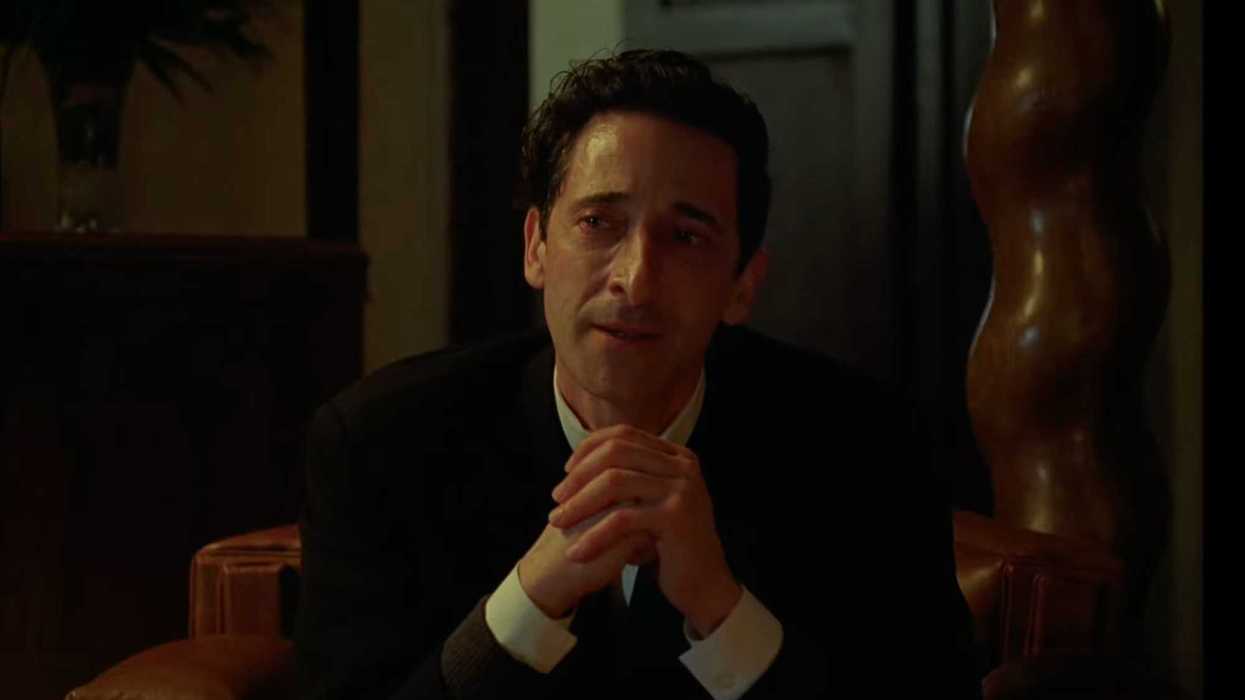
Ostensibly, the scene is pretty generic. Considering the interview-adjacent conversation, one might even get a corporate feeling. But it’s a party scene, with a comfy, dim glow of lights filling the room.
And a question is asked. “Why architecture?”
And what comes next is not an answer but a meditation on where art comes from and how intrinsically it is rooted in one’s pains and psyche. Instead of being just an exchange between two individuals, it unfolds the film’s epic span across decades, from post-war America to Italian quarries. It shows how architecture is not just about bricks and mortar but about survival, defiance, and trauma etched in stone.
Here, we are going to see how one simple “Why architecture?” unlocks one’s tortured genius.
The Question That Shakes the Foundation
Architecture: A Tool of Permanency
When Harrison Lee Van Buren (Guy Pearce) asks László Tóth (Adrien Brody) the question, it becomes the cultural flashpoint. How, you might wonder. Well, you need a bit of context here.
László is a man who survived the Holocaust. After that ended, he was forcibly separated from his wife before coming to America. Life in America wasn't kind to him either. Harrison himself, the one showing so much curiosity about László’s motivations, has treated him very poorly before.
So, László—the man who was forced to part with his loved ones, his home country, and his dignity—now has to explain why he is so obsessed with the science of making permanent structures.
And that’s why what seems like a regular question is actually loaded with not only irony but also cruelty and indifference. If you ask “why” to any refugee, the answer will basically be rooted in “building a new life.” But if you ask that of a refugee who is also an artist, the answer can’t be that simple.
Inside László’s Mind
László’s experiences and his understanding of the world around him have made his bond with architecture quite visceral. All he has seen is a violent and chaotic life, and so far, architecture is the only way he knows how to organize it. Architecture is quite a technical and mathematical science, but for László, it’s a life force, so intense that you might as well actually touch it.
And that’s why this moment shifts the movie from a standard historical drama into a deep exploration of a creator’s psyche.
Brutalism as a Survival Strategy
Concrete as a Language of Trauma
First, let’s understand what “Brutalist” means in terms of an architectural style. Yes, “Brutalism” is an architectural movement. It is a mid-20th-century architectural style that was born from the post-WWII reconstruction needs for affordable buildings that could be rapidly constructed. The Brutalist architecture is known for its massive, monolithic, and raw structures. It emphasizes exposed concrete (béton brut), bold geometry, repetitive elements, and structural integrity. It favors utilitarian function over aesthetic value. Brutalist structures are known to be imposing but cold and kind of grim.
Most people make the mistake of thinking they are just ugly, grey buildings. But if you think from the film’s viewing glass, you will understand why and how they represent honesty. László, for his projects, chooses materials that are sturdy and don’t show/imply anything ostentatious or false. That’s László’s truth, and his design choices refuse to sugarcoat it.
He has seen nothing but destruction, so his buildings are designed and made to stand the test of time. And, in that sense, his buildings reflect his very own, personal need for an unbreakable identity—both as a Jewish man and as an immigrant in a foreign land.
 'The Brutalist' Credit: A24
The Power Dynamics
The term “architecture,” when this question is asked, becomes a battleground for power and ego. When Harrison, a wealthy and privileged patron, asks, “Why architecture?" he is not really keen on exploring László’s motivations, let alone his pain. All he is truly curious about is how László’s motivations (whatever they may be) can be used to augment his own reputation and legacy.
László, however, takes this question as an opportunity to reflect on his craft and reclaim agency. At this point in the film, his circumstances have forced him to work as a laborer loading coal, but he knows he is not a laborer. He is the mind that impacts the environment.
This scene highlights the tension between an artist’s vision and a patron’s wallet and brings out the film’s central themes of immigrant experience, the corrupting nature of the American Dream, and the use of art and architecture as a means to process trauma and secure a legacy.
The Philosophical Blueprint
Beyond the Bricks and Mortar
The question slips out of the film and enters our living rooms to ask what we are building in our own lives. The Brutalist is Brady Corbet’s (director) argument that creation is a defiant act against time. The moment Harrison asks “why,” the narrative moves past the technicality of creation and lands on the universal human urge to leave a mark, to make a difference, regardless of how cold or heavy the material is.
Solving the Protagonist’s Riddle
During the film’s epilogue, László has achieved a respectable status. His work is exhibited at the first Venice Biennale of Architecture. At this point, László has answered the question, not through words, but through his work.
“Why architecture? Because I had no other choice, no other outlet. My buildings are my words.”
And this is where the “tortured” part of his genius rests.
Conclusion
“Why architecture?”
Just two words, but they hold up a mirror to a man’s whole life. It encompasses each one of his challenges, his pain, his pride, and his every purpose—all at once. But László doesn’t give a simple answer. He doesn’t owe it to anyone. He doesn’t need to justify his life's work to anyone, let alone to an entitled prick.
The act of creation (building, in László’s case) is the answer itself. It’s actually more. It’s a loud shout against those who not only choose to remain silent but also want you to remain silent. Building something real and resolute is the ultimate flex against a world that forgets.
- What Is VistaVision? Inside the Classic Widescreen Format Behind Hollywood’s Biggest Films | No Film School ›
- 'Brutalist' Director Brady Corbet Reveals He Hasn't Made Any Money Off The Movie | No Film School ›
- 3 Screenwriting Lessons From 'The Brutalist' | No Film School ›
- How Did 'The Brutalist' Utilize AI in Post Production? | No Film School ›
- 'The Brutalist' Director Brady Corbet on Why 70mm Matters | No Film School ›