How ‘The Matrix Reloaded’ Blew $40 Million on One Scene
The “Burly Brawl” fight sequence wasn’t an excess—it was a technological gamble that reshaped blockbuster visual effects.
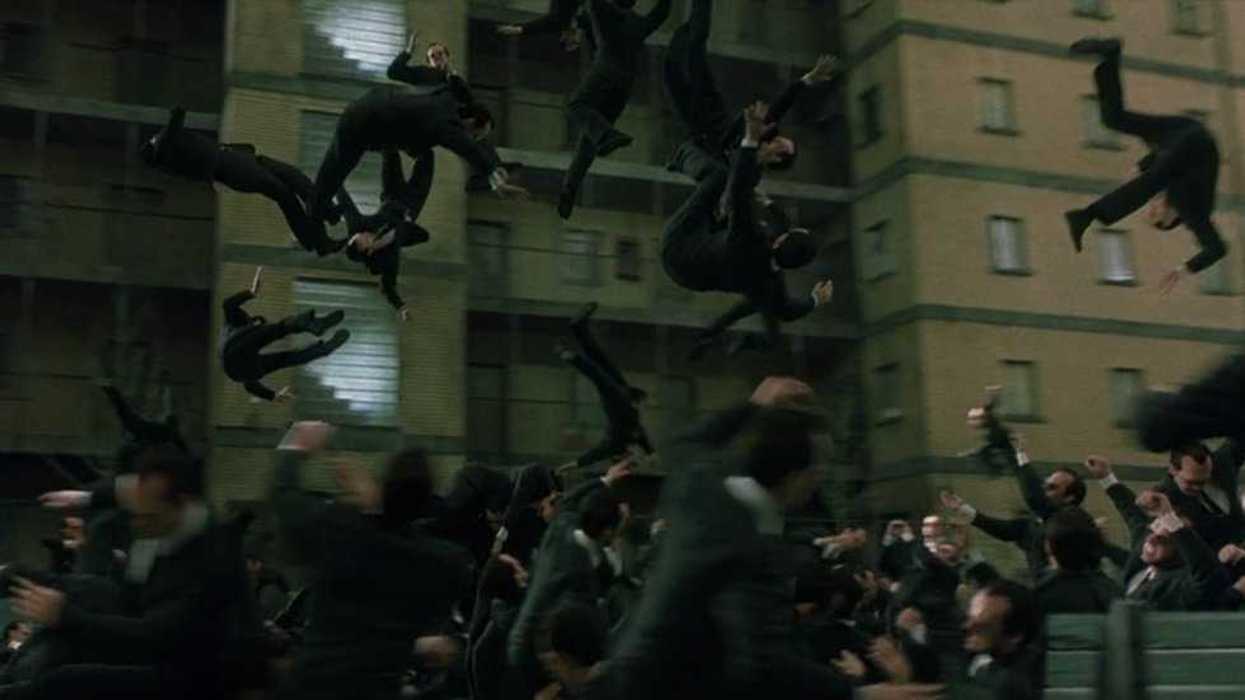
The Matrix Reloaded (2003)
Spending $40 million on one single scene sure sounds like budgetary madness. But when you are riding on the wave of a recent success and have “chasing the future” on your mind, money is but a little compromise you make.
The Matrix (1999), a movie that promised groundbreaking visuals and special FX and yet was firmly rooted in restraint, decided to let go of the grounding shackles in its sequel in 2003. Pretty gutsy move. The original was already a mold-breaking and radical movie; it would be quite a task to top it.
But it did. Well, it tried. Neo (Keanu Reeves) was put in a situation (Burly Brawl fight) where he faced around 100 Agent Smiths (Hugo Weaving). The rules were bent so much for this ambitious scene that they snapped. You can smell that ambition in its budget. $40 million. For one scene.
Yes, at the time, it was viewed as (and generally received as) the future came early. But over 20 years later, it pains me to say that the scene hasn’t aged well enough to justify that monstrous budget. In fact, the scene now sticks to the movie as a warning label: “Will burn through money fast and may not give warranted results.”
This is the story of one movie scene that pushed the technology forward, but its results didn’t justify the means.
The Ambitious Scene
The Context
An army of Sentinels, squid-like autonomous machines, is heading towards Zion, the last city inhabited by humans. At the same time, Agent Smith manages to escape the Matrix and enter the real world after killing and possessing the body of Bain (Ian Bliss), a human crew member.
He then comes across Neo and informs him that his defeat by Neo (in the first film) turned him into a rogue program, which gave him the ability to clone himself. He leaves Bain’s body and tries to possess Neo, but fails. So instead, he clones himself into his own multiple copies, and here starts the fight that we are discussing.
The Fight’s Narrative Purpose
In the narrative sense, the scene is there to provide escalation. At this point, Neo has come far from his doubtful and diffident self in the first movie. Now he has new skills, and he is testing their limits. He has a godlike control over the Matrix. The scene tells us that the older rules are no longer applicable, but at the same time, the threat has also evolved from singular to infinite.
The Limits of Traditional Fight Choreography
The fight required hundreds of identical opponents constantly interacting with Neo, spanning a full 360-degree movement. The opponents may be identical, but each of their expressions and maneuvers would naturally be independent of the others. It would need camera paths capable of overcoming physical constraints. Traditional fight choreography just wouldn’t fit the bill because regular stunt doubles and wire work would not only be insufficient but would have exposed repetition as it happened.
Neo had to look untouchable, but at the same time, cutting away from him was not an option. This brought the makers to contemplate something that cinema had rarely contemplated before: a fully digitized version of their lead actor who would be capable of impossible motion without ever breaking continuity.
The Dispensation of $40 Million
Building a Digital Keanu Reeves
Here came Madame Tussauds-like physical scrutiny. The production scanned the actor’s face and body in great detail. This led to a digital double that was detailed enough to hold up in close-ups. Motion capture recorded expressions and movements. And even after all this, animators were brought in to manually hand-correct physics, weight, and facial nuances.
You may think, “What’s the big deal?” All this happens regularly. But think 2003. All this realism was not standard back then. You couldn’t just decide and opt for these technologies. Every improvement needed a different tool, special software had to be created, it took longer rendering time, and endless testing was a daily task. A little jerk, and the uncanny valley could swallow the whole scene.
Each of these tasks needed expert professionals, advanced technology, and modern infrastructure. If you want something done right, it hardly ever comes cheap.
Paying for Problems Nobody Had Factored In
The scope for research and development turned out to be much vaster than anticipated. Custom software, hardware upgrades, rendering farms, and revisions piled on fast. Limitations became clear in real time as the shots were being created. This required scrapping them and building them from scratch.
The scene became so expensive because much of the budget dissipated in figuring out how to make it.
How the Technology Gamble Fared
In 2003, the Burly Brawl was a novelty. At first, it felt radical. It felt like cameras were flying freely. People wouldn’t have guessed Keanu Reeves’ body was so freaking agile that it could move in angles no other humans could. Agent Smith looked everywhere, all at once, and yet there was not a single cut that could expose the illusion.
It was the first time a movie star was entirely duplicated. No one could tell that it was a digital Keanu Reeves, not the real one. This caused disbelief and shock. But only for a while. As the initial disbelief subsided, people built on the first film’s reputation and convinced themselves that the sequel had leveled up to it.
Then, Why Didn’t It Age So Well?
Fast forward 20+ years into the future. The audience is now accustomed to advanced special FX, which have become mainstream and quite common. The audience’s eyes have become accustomed to spotting intricacies and peculiarities. So when we watch the scene now, the seams show. Digital Reeves doesn’t quite seem to have a natural skin texture. The movements feel weightless. It’s not a sweeping revelation, but just enough to break the sense of realism.
Funnily, this CGI attempt worked in a way nobody expected—or desired. It exposed the limitations of the CGI realism, and that too, right when it was beginning to catch on. This was a lesson for the studios: you could force CGI into storytelling, but it was the practical effects that still led the charge.
Conclusion
I want to stress, in no uncertain terms, that the Burly Brawl scene still holds tight. It’s impressive, innovative, and daring. Its scale, camera ambition, and choreography remain bold—even when the visuals drift into artificiality.
But still, at $40 million, it was an expensive gamble and experiment. Yes, it redefined using digital doubles, previsualization, and effects-driven action, but it also proved that innovation can carry a visible cost—money, time, effort—that you may not be able to justify.
- How the First Trailer Sold ‘The Matrix’ Without Giving Anything Away ›
- The Matrix’s Most Iconic Move Was Almost Impossible ›
- ‘The Matrix’: Morpheus’ Most Potent Lesson ›
- What ‘There Is No Spoon’ Really Means in 'The Matrix' ›
- The Awesome Action In 'The Matrix' Was More Important Than You ... ›
- The $200 Million "Joke": Why ‘Evan Almighty’ Cost More Than a Marvel Blockbuster ›