The Wallet Test: How the Final Scene of ‘Pulp Fiction’ Flipped the Script
The dinner standoff becomes a moral crossroads, with a single object representing Jules’ violent past and the life he’s choosing to leave behind.
‘Pulp Fiction’ (1994)
When the patrons visit Hawthorne’s Diner for breakfast, they expect coffee and greasy food, not high-voltage soul-searching at gunpoint.
But that’s what happens in the finale of Pulp Fiction (1994). The film suddenly runs a brutal audit of a dangerous man’s character, right when he is at the business end of a robbery. Two small-time (immensely chaotic and nervous) robbers hold this seasoned contract killer at gunpoint. Usually, this is a cue for him to launch into a bloodbath, but, strangely, he’s reeling in a moment of clarity he had in the morning.
Right now, he’s not an angry criminal; he is a man caught between two worlds—the violent life he knows and the “shepherd” he wants to become.
This standoff, not the one involving pointed guns but the one involving a moral crossroads, is Pulp Fiction’s final and ultimate test of the contract killer’s eligibility for what he is seeking. He, too, has a gun in his hand, but the object he uses to navigate this life-and-death situation and to facilitate his life-changing transition is something else, something strange and vulgar, much like him.
Context
In the film’s nonlinear narrative structure, this scene comes at the end of the film, but in the linear, chronological sequence, the event takes place much earlier.
Immediately after dramatically interrogating and killing their boss’s underhanded business partner, Brett (Frank Whaley), Jules (Samuel L. Jackson) and Vincent (John Travolta) are attacked by a gunman, but they manage to kill him first. They retrieve a mysterious briefcase, which belongs to their boss, and leave with Brett’s associate and informant, Marvin (Phil LaMarr). In the car, Vincent accidentally kills Marvin, splattering him and their car in blood and flesh. After a cleaner, Winston Wolfe (Harvey Keitel), takes care of the mess and they dispose of their bloody clothes and the car, they go to a diner for breakfast.
This incident, especially surviving the gunman’s attack, has had a significant impact on Jules. He thinks they are alive because of “divine intervention.” He tells Vincent of his plan to retire from the life of crime. Vincent, a rational man, doesn’t believe in divinity and dismisses him before going to the bathroom.
All this time, Pumpkin (Tim Roth) and Honey Bunny (Amanda Plummer), two petty criminals who had been discussing their robbery plan, launch into action and hold the diner at gunpoint. Pumpkin sees the briefcase with Jules and demands it. After a tense conversation, Jules suddenly overpowers Pumpkin and holds him at gunpoint. Honey Bunny, utterly hysterical, points her gun at Jules, but Vincent returns and holds her at gunpoint, creating a sort of Mexican standoff.
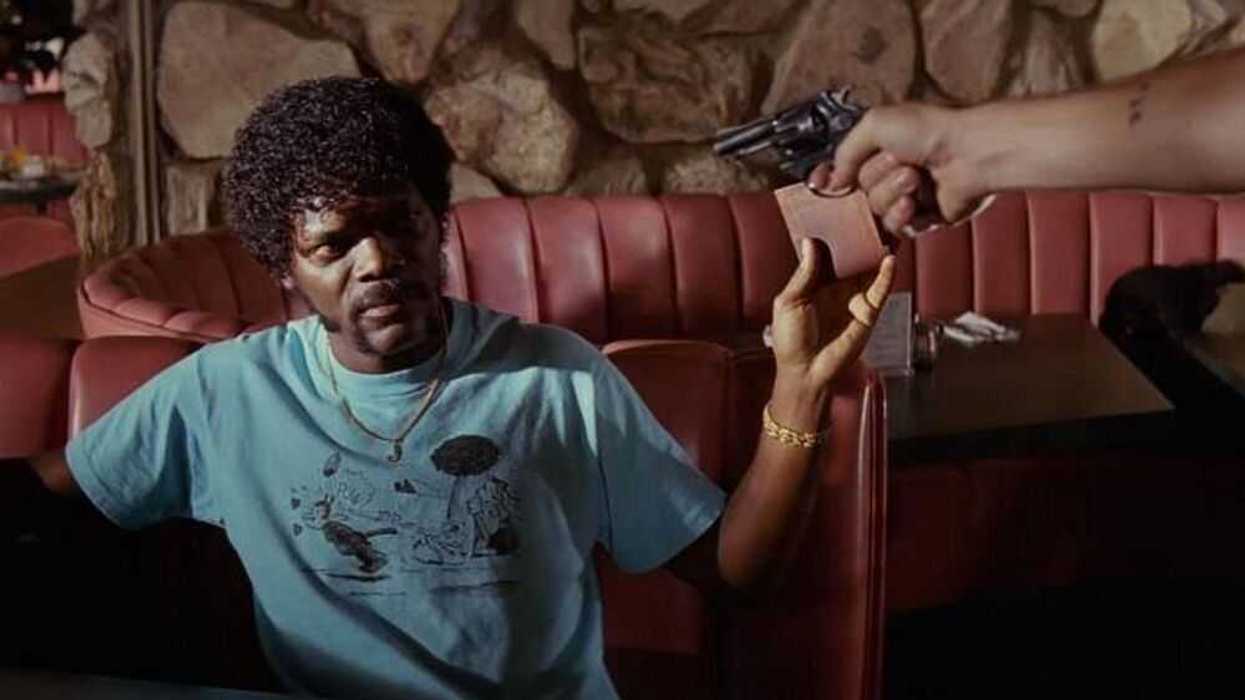
Despite being in the dominant position, Jules makes a proposition to Pumpkin: He cannot have the briefcase, but he can have whatever money is in Jules’ wallet. He makes Pumpkin scrabble around in a bag and retrieves a wallet that has “Bad Mother*****” written on it. He allows the couple to keep the money and lets them leave. Jules and Vincent leave with the briefcase.
- YouTube www.youtube.com
The High-Stakes Identity Audit
From Executioner to Shepherd
At the beginning of this day, when they visited Brett’s apartment, Jules had dramatically (actually menacingly) recited his favorite Bible verse, Ezekiel 25:17, to Brett, right before killing him. As he says, he has recited this verse (possibly in similar gun-involved situations) multiple times.
In this scene, while holding Pumpkin at gunpoint, he does it again. He recites the whole verse again, but much less dramatically. This time, he actually listens to the words he is reciting. When he does so, he realizes that he has been the “tyranny of evil men” for a long time. Now he wants to try being “the shepherd.” Not killing Pumpkin is his way of testing his ability to be that shepherd.
If you look at it, this is a high-pressure career pivot happening in real time in a violent hitman’s life.
The $1,500 Peace Offering
Vincent is appalled when Jules—a dangerous, dominating killer who no one should mess with—inexplicably offers Pumpkin (the guy who messed with him) the $1,500 in his wallet. Vincent’s “killer” brain cannot comprehend this “lame and limp” stupidity.
Jules, however, claims that he is not just giving away the money; he is “buying” Pumpkin’s life. This transaction is both literal and metaphorical. He is trading his old habits for a chance at a peaceful future. Vincent sees it as Jules’ loss of money and reputation, but Jules sees it as a “registration fee” for his new identity—a man who doesn’t kill.
The Wallet as a Material Witness
A Label for the Past
The “Bad Mother*****” wallet, as the name literally suggests, is a direct link to the man Jules “used to be.” Loud, aggressive, a crazy, impulsive killer. In this scene, when Jules is holding a gun in one hand and the wallet in the other, while stating his peaceful intentions, he is creating a literal contrast. He is giving an audio-visual presentation to Pumpkin about what he still possesses (the tools and reputation of a dangerous man, the “tyranny of evil men") and who he intends to be (the shepherd).
How Is This a Test?
Jules asks Pumpkin to take the “Bad Mother*****” wallet out of the bag and take the money. How is this a test? What does it prove?
Imagine for a second that Jules is just playing with Pumpkin. He is not a changed man. He is still the same Jules as he was before. Now, Pumpkin takes the wallet, counts the money, and takes it, just as Jules asked.
What are the chances the (old) Jules actually meant it? No, right? The old Jules just “cannot” mean it. It can only be construed as “playing with his prey.” And in that version, the only conclusion is that Pumpkin is lying in the pool of his own blood, while Vincent blows up Honey Bunny’s head.
But here, Jules not only means it but actually lets the couple walk away with his money, for real. With this test—him allowing low-level thieves to walk away with his money—Jules proves to himself (and others) that his ego is now officially under control.
Conclusion
At the end of this scene, when Jules exits the diner with Vincent, he has left his “Bad Mother*****” wallet behind as a relic of a dead life. And he has proven that identities are not fixed. You can change it if you are willing to pay the price.
The scene’s life is in the fact that Jules, a criminal, successfully walks away from the “valley of darkness.” He entered the diner as a hitman but walked out as a free man.
- The Secret Behind the Iconic “Walken Pause” in ‘Pulp Fiction’ ›
- How Pulp Fiction Hacks the Three-Act Structure ›
- Clocks and Katanas: Breaking Down the Iconic Basement Sequence in 'Pulp Fiction' ›
- The Meaning Behind Pulp Fiction’s “Royale with Cheese” ›
- Unpacking the Dark Legacy Behind the Gold Watch in 'Pulp Fiction' ›
- Ezekiel 25:17: The Pulp Fiction Scene That Turned Samuel L. Jackson Into a Legend ›
- Everyone Misunderstands the Hand-Drawn Joke in 'Pulp Fiction' ›
- The Iconic 'Pulp Fiction' Scene That Survived the Chopping Block ›
- ‘Pulp Fiction’: The “5-Dollar Shake” Scene’s Secret Weapon ›
- Pulp Fiction Frightening Answers ›