One Sick Day, One Gunshot: How an Accident Created an Iconic Indiana Jones Moment
An abandoned stunt sequence gave Indiana Jones one of his coolest character-defining moments.
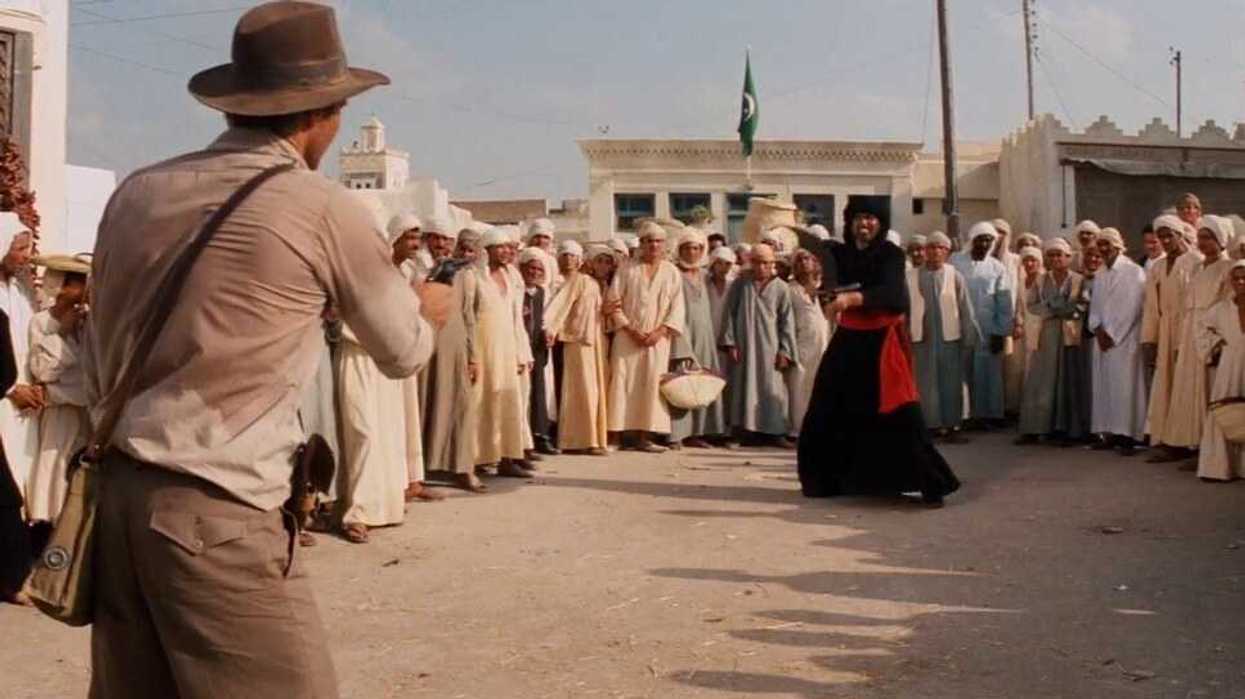
Raiders of the Lost Ark (1981)
This is Indiana Jones’ first fight sequence—ever. One would imagine that the first fight of a great hero would be grand, with lots of fight choreography, jumping, kicking, and whatnot.
On screen, what do you see? The big, bad Arab swordsman jumps in front of Indy, gives an evil smirk, and swirls his sword in a menacing display of his swordsmanship. We hold our breath for a nice fight.
Indy, however, sighs, takes his pistol out, and shoots him.
Today, this may not surprise you, but think of 1981. It was a time when heroes became heroes doing heroic things. Display of talent was a big factor in whatever they did. Indy chose a different path. Instead of being valiant, he chose to be clever. And in those three seconds, he established exactly who he was.
You might think that if this moment was so iconic, pivotal, and character-defining, then it must have been meticulously scripted. Wrong. The moment was the product of, wait for it—fatigue.
Let’s dive into it and see who got fatigued and how this sassy scene came to be.
The Scene As We See It
The Iconic “I Don’t Have Time” Moment
Indiana Jones (Harrison Ford) and Marion Ravenwood (Karen Allen) travel to Cairo in relation to the Nazis trying to find the Ark of the Covenant, which they think will make their army invincible. Soon after they reach there, the Nazis and a group of Arab mercenary aides attack them. Indy and Marion evade most of them.
The last remaining one, an Arab mercenary wearing a long black robe and wielding a sword, confronts him in the middle of a gathered public. In an attempt to establish his dominance and superiority, he expertly swirls his sword around a few times. Indy sees that and sighs. He has no time for an extended fight—perhaps also no skills to match his—and does the smart thing. He removes his revolver and shoots him dead. Just like that. Game over.
Indiana Jones: A Different Kind of Hero
This sequence instantly made Indiana a hero with a difference. Unlike the swashbucklers of the past, Indiana didn’t revel in daring and dramatic duels with bravado. Instead of engaging, he chose the quick, sure-shot way. No build-up, no flair. There are humbling signs on him: he is weary, bruised, and tired.
He permits himself to think he is less than perfect and accepts his flaws. But also figures out a way to work around them. And that’s what makes him brilliant yet relatable.
The Scene As It Was Meant To Be
The Abandoned Fight Choreography
As we can see, in the scene, Indy faces the swordsman with a whip. It was quite an interesting premise for a fight. It required precise timing, physical stamina, and multiple camera setups. The scene’s intention was to escalate the drama, not just interrupt it. Since it was the hero’s first fight, it was written and storyboarded to be impressive, athletic, and very much in line with the traditional action filmmaking of the time.
Come, Harrison Ford
The Egypt sequence was shot in Tunisia, in North Africa. Spielberg calls this phase one of the worst filming experiences of his career. The temperature was often over 130°F (54°C). Many crew members suffered sunburn, facial swelling, and dysentery from the local food. Ford also suffered from dysentery. He was beat and had no energy. He urged Spielberg to drastically shorten the extended fight sequence. And Spielberg agreed. Stuntman Terry Richards, who plays the Cairo swordsman, had been practicing sword skills for weeks. Sadly, he didn’t get to show off his swordsmanship.
The Creative Choice That Saved the Scene
Prima facie, it may look like the scene was downgraded. And it could be so, if it weren’t for the choices that sharpened its intent. Aside from the health-and-exhaustion-related issues, Spielberg found another reason to go a different way. Call it a silver lining or a blessing in disguise, but he understood that, at this point, it was speed that could serve the character and not spectacle, especially in a film already packed with enough action.
So, when the expectedly thrilling confrontation ended in such an anticlimactic manner, it instantly preserved momentum. It also trusted the audience to get the joke without any explanation.
But most importantly, the choice aligned with Indiana Jones. Indy was, anyway, portrayed as impatient, practical, and unswayed by the appeal of theatricality. The Cairo swordsman may be fast with his moves, but Indy is fast with his brain. While the swordsman shows off, Indy wins by thinking fast.
Conclusion
The secret of the everlastingness of this scene is in its economy. It wastes nothing. The humor is effective because it doesn’t feel misplaced or forced. It grows naturally from the situation. A good, well-executed fight sequence wouldn’t be bad, but the way it turned out, it managed to define the character beat instead. And that makes it iconic, not just another fight sequence.
Also, it reminds me of my drawing teacher in school. He once told me, “The secret of a good painting is knowing when to stop.” I guess he was right. Sometimes, the smartest move is not adding more but knowing exactly when to stop.
- What Phoebe Waller-Bridge Could Bring to 'Indiana Jones' | No Film ... ›
- Will 'Indiana Jones 5' Be Composer John Williams' Final Film Score ... ›
- 10 Screenwriting Lessons From 'Indiana Jones' | No Film School ›
- What Indie Filmmakers Can Learn From 'Indiana Jones' | No Film ... ›
- An Adventurous Ranking Of Indiana Jones Movies | No Film School ›
- Here's Why the Boulder Scene from 'Raiders of the Lost Ark' is So ... ›
- How Lucas, Spielberg & Kasdan Created 'Raiders of the Lost Ark ... ›
- Watch How Spielberg Shot This Classic 'Raiders of the Lost Ark ... ›
- What Does Soderbergh's B&W Edit of 'Raiders of the Lost Ark' Teach ... ›
- Indiana Jones Almost Had a Completely Different Name by George Lucas ›
- 10 Most Iconic Harrison Ford Movie Lines ›