Steve Martin is one of modern film and TV’s most prolific comedians and performers. Most recently, he helped create and star in the Hulu hit, Only Murders in the Building, which he also writes on. But before that, he grew into a famous comedian and movie star, eventually branching out into music too. He’s a legend.
To describe him another way, he’s one of the most analytical comedians alive, and in his MasterClass, he gives some advice that sounds simple but lands hard.
He says, as a creator, don't look to the audience, because what you'll see will lie to you.
This is aimed mostly at comedians, but the basic principle applies to anyone making something for an audience, whether it's a stand-up set, a short film at a festival, a cut of something you're screening for the first time, whatever.
Your real-time read of any room is almost always wrong, so here’s why that matters and what you should do with that knowledge.
- YouTube www.youtube.com
The Room Is Lying to You
Imagine a scenario like this. You're on set, you just called “cut” on what felt like an okay take, but the energy is down, so you're just about to move on, at a loss. Or you're in a festival screening, and the laughs aren't coming in your comedy film as you expected.
Martin says of performing, "Never look at the audience. Look over their heads. Look somewhere else. Look into the darkness maybe occasionally, because what you're going to see is people not laughing."
If you're not in a live performance scenario, think of those moments we just mentioned with a low-energy crew or quiet audience. Silence can read as failure. The good news is, it usually isn't. Maybe your crew is just tired. Maybe your comedy just isn't laugh-out-loud funny, but more intellectual.
If you’re not prepared for this reality, maybe don’t attend your test screening or premiere. But why does he give this advice?
Engaged Audiences Don't Always Show It
There are few things more stressful than finally putting your creative baby into the world, either in a screening situation or during a read. It’s doubly stressful if you’re there. You’re searching for every signal. When do people lean in? When do they disengage? You, as a filmmaker or director, might watch the audience instead of the film, and you might be reading the wrong signals.
Martin can speak to being on both sides.
"I've been to plays where I was aware I wasn't laughing, but I thought it was really funny and I loved it afterwards."
The conversation after the screening provides more reliable information than what you observed during it. Seek that out deliberately. Maybe you do Q&As, post-screening feedback forms, or one-on-one conversations. If you're wondering what people thought... just ask!
Same with your crew. If you can't tell what they're feeling, have a conversation.
Paul Feig has said he loves most test screening processes. He’s looking for those physical reactions. But as Martin points out, you might get no reaction at all.
And since we’re talking about Feig…
Distracted Audiences Are Part of the Job
Feig has also screened his work for streamers, meaning audiences at home, which is a whole other ballpark of distractions (and requires further recalibration of expectations). They are not going to be in a dark room, fully focused on the work. Feig knows this.
Based on this knowledge, we can arrive at the same point Martin makes above, which is that someone can be watching something at home, multitasking while their dog barks and the mail comes, and still love the work. It just might not be visibly obvious in their reaction.
Your film will not always get a room full of people who came to see it. Industry screenings are half-distracted. Festival blocks are long, and people are tired. But none of that means that the audience hates you and what you made.
Speaking of a Vegas dinner show he did, Martin says, "You can't blame them. It's not their fault."
What can we take away? Maybe we just need to know that our work has to hold up under those conditions. Make something that earns attention rather than assuming it. Know how to hook your viewers and maintain tension throughout a work.
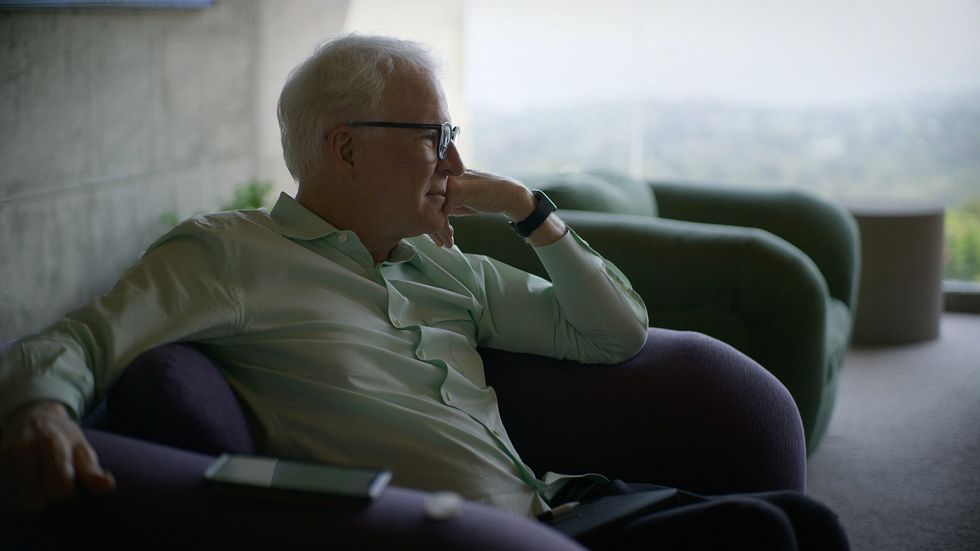 STEVE! (martin) a documentary in 2 pieces Credit: A24
You Are the Worst Judge of Your Own Work
The closer you are to your material, the less reliable your read of it. This is why directors need editors, why writers need readers, why you do table reads to gauge performance, and join writers’ groups. A second set of eyes on a cut is so important.
Martin talks about a moment he shared with his agent after a show.
"I'd come off, and I'd say, 'God, it was a fantastic night. It was fantastic.' And he would say, 'It's okay.' I go, 'Really?' And then another night I'd do what I thought was an average show and he'd come up and say that was one of the most special shows."
If you don’t have the resources of collaborators, sometimes all you need is time.
Work on something, leave it for a while, and come back to it fresh. You’ll be stunned by how much you can see differently.
Maybe you build in a mandatory cooling-off period before you screen or submit anything. Be patient.
Bombing Is Data
Sometimes, the work just doesn’t land. No one laughs. People walk out. The energy sours. But that’s okay, ultimately, because you can learn from it. (We know it sucks in the moment. We know.)
Martin makes the case for bombing as a necessary education, specifically in stand-up.
"I feel sorry for some younger comedians who don't get to bomb, you know, for years and years and years."
He adds later, "The value in bombing, of course, is knowing how your material works on the worst of nights."
If you do a table read and everyone gets bored, you need to do some revisions. If you get walkouts, determine when they happened and why.
How can you learn from the experience and take it into your next project? Take notes of the shifts and when they occurred. Try to identify the issue—maybe pacing lags or characters become unsympathetic, or dialogue is confusing. When you revise, you're problem-solving.
Trust Your Voice
Early filmmakers might chase reactions instead of developing a point of view. Maybe you just want to disrupt, or gross people out, or confuse them. But what are you actually trying to say, and why? Do you have a unique voice, or are you copying someone else?
Martin says, "The best thing to do is not rely on your material and rely on your personality because your personality is always working. Your personality doesn't require laughs."
For filmmakers, personality is voice. Voice refers to the specific, consistent sensibility that runs underneath your work. A scene can fall flat. A joke can flop. But a point of view keeps communicating regardless and can help the audience connect to your work.
You should be able to write down what your project is actually about in one sentence. Try not to focus on plot, but on theme or point of view. If you can't, that's the problem to solve before you worry about whether the room is responding.