Some cinematic moments stick with you, like the ending of Unforgiven, where Clint Eastwood’s William Munny mounts his horse in the rainstorm.
He has just avenged his dear friend’s brutal murder, but both the rage and grief are fresh. His eyes blazing with rage, Munny throws one last glance at Ned’s corpse displayed in a coffin outside the saloon before leaving the cursed town for good.
While this shot is emotionally charged, it’s also one of those that came to define the evolution of Westerns.
In this article, let’s analyze the impact of that sequence on the Western genre.
To Give You a Little Context…
Unforgiven was a Western that was written to change the rules of the genre.
Traditional Westerns have a remarkably consistent structural formula—a stoic outlaw protagonist who stumbles upon a crisis or a suffering community threatened by lawlessness, invasion, or moral corruption. The protagonist then becomes a mediator, ultimately resolving the crisis.
Unforgiven features a reluctant hero, William Munny, who gets involved in the conflict between the sex workers of Big Whiskey and their culprits, Quick Mike and Davey Bunting, after the latter disfigures a sex worker’s face, punishing her for laughing at Mike’s small penis.
The enraged women declare a reward of $1,000 for anyone who can kill the two men.
Munny is living the life of a repentant widower, raising his two children, having left behind a life as a bandit with a notorious reputation for violence, when a bounty hunter approaches him to accomplish the task.
Munny isn’t ready at first, but eventually he accompanies the bounty hunter and also recruits another retired gunfighter who reluctantly joins them for the mission.
While Munny and his crew eventually manage to kill the two men, Ned gets captured and tortured to death by Little Bill.
In the end, Munny avenges Ned’s death before leaving the town forever.
The Scene
- YouTube
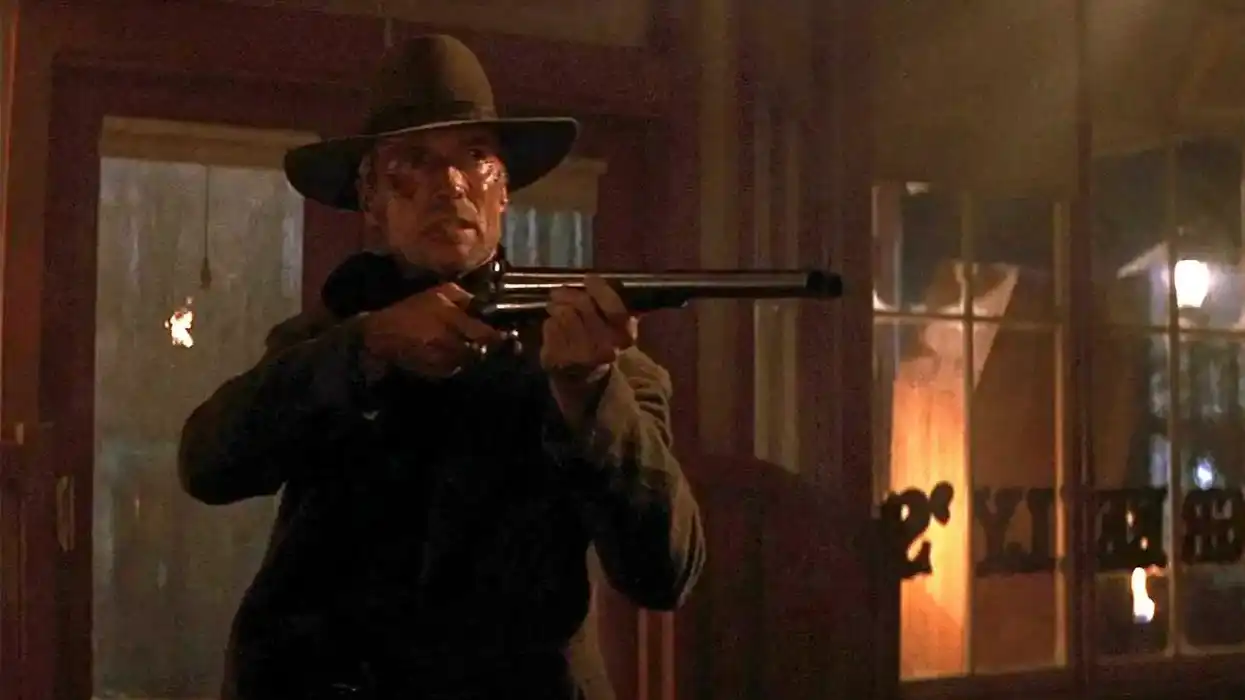
Little Bill is addressing the cowboys in his saloon when Munny walks in with a shotgun. His entry alarms everyone around, but Little Bill notices him only at the last moment. It is pouring torrentially outside, and the sound of the rain is deafening.
Rage leaks through his calm voice as he inquires about the owner of the saloon. The moment Skinny identifies himself as the owner, Munny shoots him.
Little Bill immediately condemns Munny’s actions by calling him a coward for shooting an unarmed man and then commands the men to shoot him down once his shotgun is out of bullets.
A gunfight ensues where Munny single-handedly takes down his adversaries and leaves the saloon in the rainstorm.
How the Sequence Impacted Westerns
 'Unforgiven'Credit: Warner Bros.
Unlike traditional Westerns, which employ sunny landscapes to underscore the hierarchy between the hero and the villain, the downpour in this scene symbolizes the complexity of the victory. The rain muddies the distinction between rules and justice, rendering every movement treacherous and uncertain.
Munny, the protagonist, is a morally complex character with a checkered past, beautifully presented through noir-inspired lighting rather than the high-contrast clarity of traditional Westerns.
When the sheriff calls Munny cowardly because he shoots an unarmed Little Bill, Munny replies, “He should have armed himself if he’s going to decorate his saloon with my friend.”
His reply denotes the inevitability of karma.
The confrontation soon explodes into a full-fledged gunfight, where Munny overpowers the cowboys and avenges his partner’s death.
Munny’s reformation from a now domesticated pig farmer raising kids to a reluctant hero who picks up a gun once again to serve justice is a strong inversion of traditional Western hero tropes. He is flawed, incorrigible, and morally ambiguous, and without the traditional redemption arc.
The moment also marks the protagonist’s complete acceptance of his violent self, which is incapable of change.
Primarily, the sequence is a radical revision of Western’s visual grammar, featuring a morally ambiguous hero against a gloomy setup, serving justice in bullets.
Unforgiven is a milestone in the Western genre, as it twists its rules to bring the true consequences of violence to light.
Which is your favorite moment in the film?
- 10 Best Movies Starring Clint Eastwood, Ranked ›
- 10 Modern Westerns Destined to Become Classics ›
- What Are The Best Western Movies of All Time? | No Film School ›
- This Brutal Line From ‘Unforgiven’ Is One of the Most Honest Moments in Cinema History ›
- How 'Unforgiven' Ended The Western Genre (For A Hot Minute) ›
- 'Unforgiven' 25 Years Later: 5 Ways Eastwood Masterfully Deconstructed the Western ›
- 'Unforgiven' Does This One Goofy Small Thing That's Completely Genius ›
- Why Clint Eastwood Cut the Original Final Scene of ‘Unforgiven’ ›
- 8 Quotes That Prove ‘Unforgiven’ Is the Ultimate Deconstructed Western ›
- The Quiet Truth Hidden In An Iconic ‘Unforgiven’ Line ›
- The Brutal ‘Unforgiven’ Scene That Completely Destroys English Bob ›