The Brutal ‘Unforgiven’ Scene That Completely Destroys English Bob
The moment that reveals the terrifying, calculated nature of Little Bill and the survival instincts of English Bob.
‘Unforgiven’ (1992)
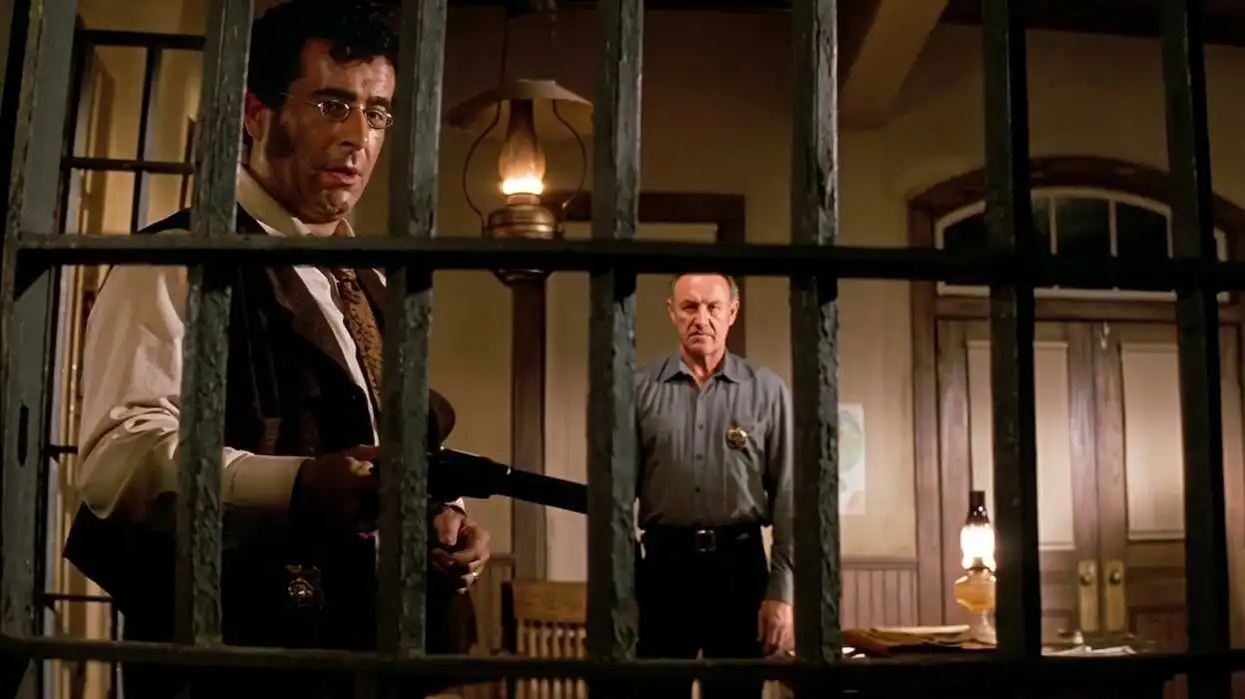
The jailhouse in Big Whiskey, just like its town, is a complex, scheming place, both “ruled” by Sheriff “Little Bill” Daggett. You might as well call it Little Bill’s laboratory, where he takes apart every concept of the Western legend and conducts experiments on it.
In this scene, his test subject is English Bob, his archnemesis. Currently, he is in Bill’s jail, but he is not only Bill’s prisoner but also a prisoner of his own carefully constructed persona. Of course, Bill, who views myths as dangerous distractions, is going to dismantle it.
This scene is a lesson in crafty psychological warfare. Bill doesn’t fire a gun, or so much as throw a single punch. He uses a gun, but not to fire. He uses it as a loaded prop to strip Bob of the remnants of his dignity. This is where English Bob, the “Duke of Death,” meets the cold, hard floor of reality.
This scene appears to offer a fair chance to everyone, but that’s not true. The shot is taken beforehand, and the damage is already done. It’s no longer about who can shoot. It’s simply about who understands the moment better.
This is a very sensitive gap where reputations don’t fade; they get rewritten.
The Scene
In 1881, in a lawless town of Big Whiskey, a cowboy assaults and mutilates a prostitute in a brothel. The prostitute is left permanently disfigured. The town’s corrupt sheriff, “Little Bill” Daggett (Gene Hackman), instead of giving the prostitute justice, orders the cowboy to compensate the brothel owner for “damage to his property.” Angered by this injustice, the brothel’s prostitutes declare a $1000 bounty on the cowboy’s head. Little Bill counters the bounty by issuing a decree that bars civilians from carrying weapons.
A British-born gunfighter, English Bob (Richard Harris), who has an antagonistic relationship with Little Bill, arrives in Big Whiskey with his biographer, W.W. Beauchamp (Saul Rubinek), seeking the bounty. Little Bill and his deputies, to make an example of him, promptly enforce the town’s anti-gun law, beat him up, and put him in jail.
Beauchamp is fascinated by Little Bill and the control he asserts over the town. During their conversation, Little Bill debunks Beauchamp’s romantic notions about the Wild West and demonstrates the concept of quick draw and its importance for survival in a gunfight. When he offers Beauchamp a gun, Beauchamp mulls over giving it to English Bob. Little Bill allows him to do so. When he offers the gun, English Bob is tempted to take it, but decides against it at the last moment.
Flashing a content smile, Little Bill takes the gun from Beauchamp and empties the barrel, revealing that the gun was indeed loaded. Then he looks at English Bob and says, “You were right not to take it, Bob. I would have killed you.”
The Deconstruction of a Legend
Editing the Myth in Real Time
English Bob intends to use Beauchamp as an architect of his image and fame. The biography he is writing is titled “The Duke of Death,” alluding to Bob’s “legendary” combat skills. Bob needs to appear impressive in Beauchamp’s eyes. Little Bill is aware of Bob’s intentions, and he is not going to let it happen. He even keeps misreading the title as “Duck of Death” to subconsciously demean Bob and his biography. Since Bob wants to appear accomplished and formidable, Little Bill wants the exact opposite, especially in front of Bob’s biographer.
So, when he is explaining a gunfight to Beauchamp or provoking him to give the gun to Bob, he is doing more than just intimidation. He is editing Bob’s biography in Beauchamp’s head. He is creating a situation where Beauchamp will witness the “hero” of his book, who is hesitant and unwilling to duel with Little Bill. Little Bill isn’t killing English Bob; he is killing the Duke of Death.
The Illusion of Choice
Little Bill’s “take the gun” challenge appears gallant and big-hearted, but it’s inherently rigged in nature. Bob is in Little Bill’s prison and is pretty much at his mercy. Little Bill creates a scenario where he appears like a big man for giving Bob a fighting chance, but at the same time, he is the one who holds all the cards—if Bob reaches for the gun, Little Bill shoots him dead; if Bob refuses to pick up the gun, he is essentially admitting that his “legendary” status has hard limits. English Bob may be helpless, but he is not stupid, so he chooses life over legacy. Of course, the wise decision comes at the cost of his pride. That’s all Little Bill had ever wanted.
Reality vs. Reputation
The Speed of Hesitation
In the Old West, the hero doesn’t blink. But in Little Bill’s prison, Bob does. That split-second doubt is all Little Bill needs to understand that Bob’s survival depends on knowing when he is outmatched. Bob’s hesitation is smart and pragmatic, but it also shatters Bob’s myth. In the world of gunfighting, that pragmatic trait is nothing short of an admission of inferiority.
The Loaded Truth Reveal
Bob refused to take the gun because he wasn’t sure if the gun was loaded. He didn’t want to take a chance on deceitful Little Bill. So, after forcing Bob to appear weak, Little Bill takes the gun and, in full display, empties the barrel. This act confirms two things: the threat was real, and Little Bill was playing a (supposedly) fair game. Now, to Beauchamp, it appears as if Bob refused to fight against Little Bill because he knew that between them, it was Little Bill who was a superior shot.
Conclusion
The scene’s impactful psychological brilliance lies in its muted brutality. Little Bill’s objective is not as simple as just killing the opponent; his objective is to make him irrelevant. And that’s a truly lethal blow in the Old West, where reputation and legacy are pretty much everything. Nobody would want to write or read a biography or believe in the legend of a gunslinger who was afraid to pick up a gun.
After this moment, the jail’s iron bars are the least of Bob’s concerns. His real asset, the reputation, is gone. Now this “Duke of Death” will have a reputation for surviving a certain death because Little Bill allowed it.
- The Quiet Truth Hidden in an Iconic ‘Unforgiven’ Line ›
- 'Unforgiven' 25 Years Later: 5 Ways Eastwood Masterfully Deconstructed the Western ›
- Why This One Line in ‘Unforgiven’ Shattered the Western Myth Forever ›
- This Brutal Line From ‘Unforgiven’ Is One of the Most Honest Moments in Cinema History ›
- How 'Unforgiven' Ended The Western Genre (For A Hot Minute) ›
- The Shot In ‘Unforgiven’ That Changed the Western Genre Forever ›
- 8 Quotes That Prove ‘Unforgiven’ Is the Ultimate Deconstructed Western ›
- Why Clint Eastwood Cut the Original Final Scene of ‘Unforgiven’ ›