“Wax On, Wax Off”: The Meaning Behind ‘The Karate Kid’ Quote
We look at how discipline, muscle memory, and mentorship intersect in this memorable scene.
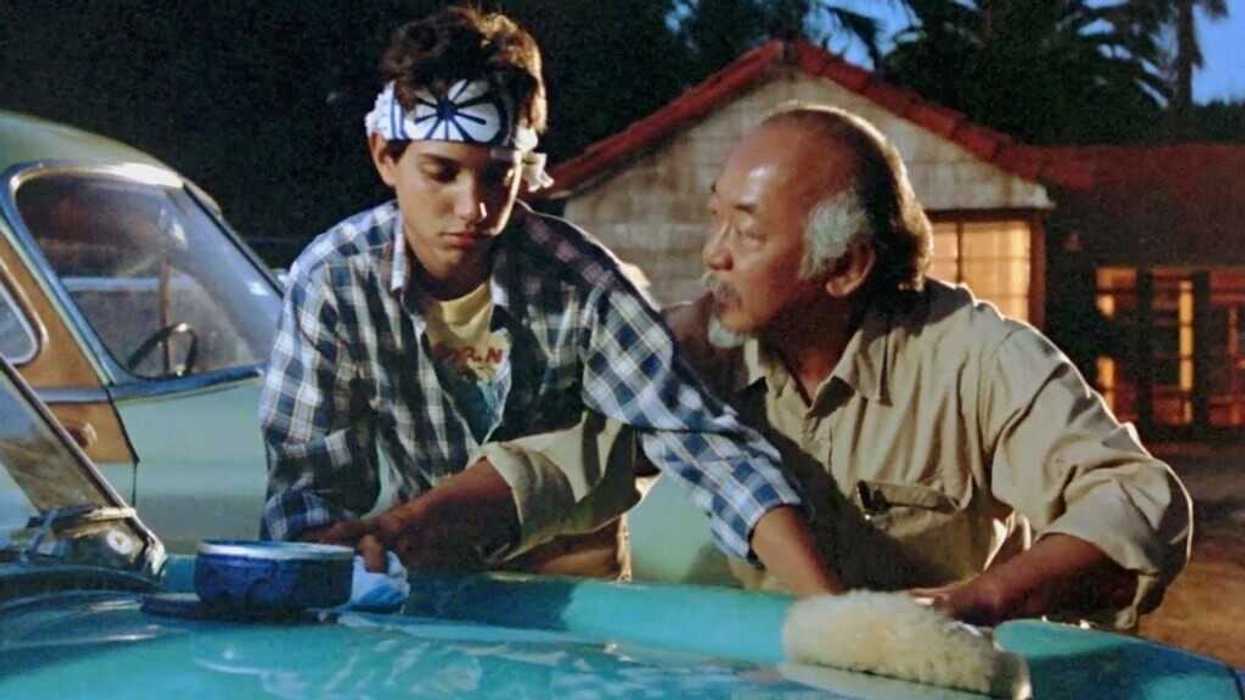
The Karate Kid (1984)
The most profound things have quite a modest, uncomplicated outer appearance. That remains true about the “Wax on, wax off” line from The Karate Kid (1984).
It’s this line that starts the iconic teacher-student relationship between Daniel (Ralph Macchio) and Mr. Miyagi (Pat Morita). When it actually lands, you might not think something far-reaching is set in motion. It comes across like a plain line; some dialogue, a joke, or an old man’s whimsy. And yet, it defines everything about Daniel and Mr. Miyagi.
Just like the line, the scene looks ordinary. Mr. Miyagi asks Daniel to wax his collection of vintage cars. Daniel (taking a muted offense) thinks Mr. Miyagi wants free labor as payback for whatever fighting lessons he may give. The audience thinks the same. But both are proven wrong.
The instruction hints at the training style that doesn’t call itself training; it calls it “forming a habit.” That playful surprise, and the fact that it plants the seed of trust between a mentor and a kid searching for direction, is why this scene has survived for so long and is still being discussed today.
The Brilliant Deception of Mundane Tasks
The Philosophy of Repetition: Muscle Memory Logic
When Mr. Miyagi asks Daniel to wax the car in circular motions—or, for that matter, sand the floor in wide sweeps and paint the fence up and down—it’s not a random instruction. Definitely not a demand for free labor. He had designed each of these movements to hardwire specific defensive blocks into Daniel’s muscle memory.
Muscle memory, also called procedural memory, is the brain’s ability to store and recall motor skills through repetition. It allows you to perform movements like riding a bike, typing, playing a musical instrument, or blocking and counter-attacking without conscious thought.
Why does Mr. Miyagi start his martial arts coaching with this dull, repetitive task? Because it’s the non-negotiable price for automation. When Daniel performs these tasks hundreds of times, his body and brain learn to react instinctively in unison, by bypassing low-level, conscious thought.
Daniel’s Frustration
Daniel, easily irritated on account of being a teenager, is quick to think the task is beneath him. His uncertainty about continuing this “exploitative mentorship” passingly flashes on his face before he gets to waxing on and waxing off.
While he continues doing it half-heartedly, Mr. Miyagi comes forward and fixes his movements: “Wax on, right hand, wax off, left hand, wax on, wax off.” He explains how this repetition is teaching his body and mind the reflexes and instincts that are going to be the foundation on which he will learn karate.
And this is where the switch flips. Daniel receives the validation of the movement’s logic and starts seeing things differently. There is another lesson in disguise here: genuine training often needs a leap of faith.
Mentorship, Trust, and Character Development
Mr. Miyagi teaches by showing instead of explaining. Daniel understands the logic, sees the proof, and begins to trust him. When this block actually works, he understands that Mr. Miyagi’s instructions have a solid footing in definite intentions. This trust prompts him to listen more and question less. Once the doubt vanishes, Daniel embraces the method. He even develops the maturity to realize that progress requires patience and not every move will look like an impressive fighting maneuver. “Wax on, wax off” proves to be a double-edged sword: it trains Daniel’s body, but it also contributes to his character growth.
Conclusion
The “Wax on, wax off” moment has longevity because it reflects the quiet simplicity of Mr. Miyagi’s teaching style. It shows that progress often starts with something that looks like nothing at all. The act is small and humbling, but it produces meaningful and long-lasting physical effects, paves the path for Daniel’s future victory, and most importantly, contributes to his character.
- Hollywood Has a Bullying Problem (And It's Real Bad) | No Film ... ›
- 'The Art of Self-Defense': Blending Darkness and Comedy with ... ›
- What Are The Best Martial Arts Movies of All Time? | No Film School ›
- The Very Best American Martial Arts Movies | No Film School ›
- The Reluctant Mentor Trope, Explained: Why Hollywood Uses It Again and Again ›
- 'Cobra Kai's' Gianni DeCenzo Shares His One Main Tip for Directors ... ›
- Do You Need a Mentor to Succeed as a Writer in Hollywood? | No ... ›
- Reinterpreting 'The Karate Kid' with Daniel As the Real Villain | No ... ›
- 10 Highest-Grossing Sports Movies of All Time: A New Champion ›
- “It Ain’t Dying I’m Talking About”: The Life Lesson Hidden in ‘Lonesome Dove’ ›
- Training Day Lines ›