Vito and Michael Corleone’s 3 Defining Scenes in The Godfather
Vito and Michael Corleone only share three scenes in The Godfather—but that was enough to sculpt Michael’s transformation into Don Corleone.
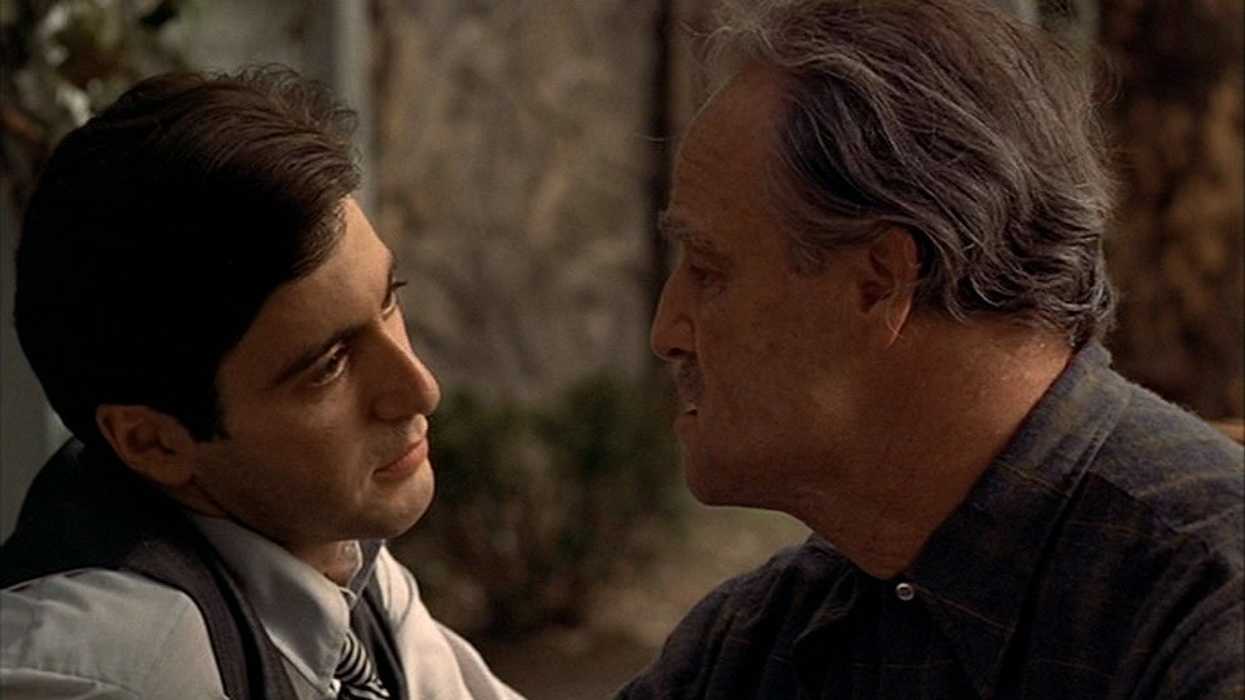
Vito and Michael Corleone in The Godfather (1972)
In a film about family, power, and legacy, The Godfather (1972) gives us only three scenes where Vito and Michael Corleone share the screen—yet these fleeting moments define the entire saga. It’s not the hugs, arguments, or long father-son talks that push Michael toward his eventual fate. It’s the silences. The looks. The weight of words that don’t need repeating.
Vito’s presence looms over The Godfather even when he’s lying unconscious in a hospital bed. Michael, who begins the film as the clean-cut war hero, ends it as a man willing to betray everyone in the name of control.
That arc, massive as it feels, turns on three quiet scenes with his father. These aren’t explosive showdowns. They’re passing torches, subtle chess moves, and warnings dressed as wisdom.
Vito never says “you’ll be just like me,” but that’s exactly what happens—just not in the way he hoped.
These three scenes, or plot points, are transitions. They mark Michael’s slow fade from idealism to power, from son to successor.
By the time he becomes Don Michael, it’s clear: his father’s legacy was more absorbed than inherited. It was repurposed. And ultimately—weaponized.
Scene 1: The Wedding – The First Lesson in Power
A Father’s Warning, A Son’s Disinterest
The first scene Vito and Michael share in The Godfather isn’t a conversation—it’s a glance. As Michael (Al Pacino) arrives at Connie’s wedding with Kay (Diane Keaton), Vito (Marlon Brando) watches silently from the upstairs window. His expression is hard to read—somewhere between curious and quietly sorrowful. In that fleeting moment, you can sense the weight of expectation Vito carries for his youngest son, the only one not yet entangled in the family’s darker dealings. It’s a father watching a future he hopes won’t be shaped by his own past.
But downstairs, Michael’s posture says it all—he’s not part of this world. He wears his Marine uniform like a shield, positioning himself apart from the men in tuxedos and tailored suits who orbit Vito. When Kay asks about his family’s power, Michael tells the infamous “offer he can’t refuse” story like someone repeating an urban legend, not family history. He speaks of Vito like an anthropologist observing a culture he doesn't belong to. He even ends with a firm line: “That’s my family, Kay. It’s not me.” That’s the clearest boundary he draws in the whole film—and the clearest sign he believes he has a choice.
What’s striking is how little direct interaction Vito and Michael have in this scene. Vito never pulls Michael aside, never gives a warning or a lecture. But that silence is the message. Vito wants to keep Michael clean, untouched, maybe even innocent. He doesn’t invite Michael into his office like the other men. At this moment in their story, Vito still has no reason to say “I never wanted this for you”—something he says later, in the garden scene. In this moment, he only shows it.
And yet, even in this early moment of distance, you can already sense the gravitational pull of legacy starting to reel Michael in.
Scene 2: The Hospital – The Birth of a Don
The Night Michael Chose the Family
Vito lies helpless in a hospital bed, recovering from an assassination attempt. Michael walks in, expecting to see guards—but finds none. The scene kicks into high gear without a single gunshot. Instead, we get one of the most intense moments in the film: Michael stands by his unconscious father, moving him to safety, bluffing a defense with Enzo the baker, and then uttering the line that changes everything—
“I’m with you now.”
Vito never opens his eyes. He doesn't need to. Michael isn’t waiting for permission anymore. The transformation begins not with violence, but with a choice. Michael steps into the chaos, not to avenge, but to protect. That instinct—to protect the patriarch—is not about revenge. It’s about responsibility.
There’s a fleeting moment where Vito, still unconscious, registers Michael’s presence. Maybe it's imagined. Maybe it’s just wishful projection. Either way, it signals a subtle but powerful approval. Michael’s quick thinking, calm under pressure, and willingness to act without instruction mirror the very traits that made Vito who he is.
The only difference? Michael won’t stop at subtlety.
Scene 3: The Garden – The Passing of the Mantle
The Last Conversation, The First Command
It’s not a dramatic farewell. It’s an afternoon chat between an old man and his son in the garden. Vito speaks slowly, carefully—aware that this might be his last chance to hand down something that matters. He tells Michael plainly, “The one who comes to you with the deal… that’s the traitor.” There’s no emotional buildup. No final hug. Just strategy.
By this point, Michael has already assumed operational control. Vito doesn’t give him authority here. He gives him doctrine—the way to read people, to anticipate betrayal, to think like a Don. There’s a generational shift in that moment. Vito ruled with fear wrapped in dignity. Michael will rule with cold precision.
Michael doesn’t say much. He listens. He processes. And in his quiet, there’s a calm acceptance. This is who he is now. This is who he must be. There’s no turning back—not from this chair, not from this crown, not from this conversation that sounds more like a briefing than a goodbye.
The Legacy of Three Scenes: How Silence Shaped a Godfather
It’s wild when you lay them out like this. Three scenes. That’s it. Yet they map perfectly to Michael’s arc:
- The Wedding = Naivety.
- The Hospital = Awakening.
- The Garden = Ascension.
In each, Michael is in a different psychological state, and in each, Vito acts like a mirror—showing Michael who he was, who he is, and who he’s about to become. Vito doesn’t have to push. Michael comes to him. That’s what makes it so chilling.
When Vito returns home from the hospital, still weak and recovering, the house is filled with talk—Tom Hagen updates him on the fallout, Fredo brags about learning the casino business, and the room feels like it’s moving on without him. Vito stays silent. He doesn’t react to the politics or Fredo’s puffed-up enthusiasm. The only thing he asks is: “Where’s Michael?” That’s it. When Tom tells him it was Michael who killed Sollozzo and McCluskey, Vito doesn’t explode—he simply looks away, devastated.
That moment speaks volumes about their bond. No dramatic reaction, no speech—just heartbreak. Vito’s silence isn’t passive. It’s the sound of a father realizing that the one son he hoped would escape this life is now neck-deep in it.
The emotional tragedy of The Godfather isn’t that Michael changes. It’s that he changes exactly the way Vito feared he would. Vito spent his life trying to protect the family while keeping Michael outside the bloodshed. But Michael learns fast—and he learns too well. What Vito said as a warning, Michael hears as an instruction.
And credit to Francis Ford Coppola’s direction: he never oversells it. He lets the scenes breathe. He lets silence carry the weight. There’s more character development in a glance or a pause than in a five-minute monologue. This is storytelling with restraint—storytelling that trusts the viewer to pick up what’s unspoken.
The Unspoken Inheritance
Three scenes. That’s all we get. But somehow, they do the heavy lifting of a father-son tragedy that spans generations. The Godfather doesn’t spell it out—it doesn’t need to. Every flicker of Michael’s expression, every slight inflection in Vito’s voice, plants the seeds of legacy, power, and inevitability.
Vito passed on his empire to Michael, but that wasn’t his greatest gift to him—it was the lessons in those fleeting moments, lessons Michael would follow to his own ruin. What Michael inherited wasn’t the throne—it was the silence, the warnings, and the burden of becoming the very man his father hoped he’d never have to be.
Rewatch these scenes. Notice the body language, the subtext, the unspoken sorrow. Ask yourself this: if Michael had truly listened—really listened—would he have still become the Don? Or would he have stayed the son Vito once believed he could be?
- Watch: How Gordon Willis Used Darkness to Illuminate 'The Godfather' ›
- Michael Corleone's Arc in 'The Godfather' Films Proves He's the Best Character of All Time ›
- The Sweet Story Behind One of 'The Godfather's' Most Famous Lines ›
- Friends Close, Enemies Closer: The Most Famous Lesson From 'The Godfather' | No Film School ›
- The Power Shift: Analyzing the Michael Corleone vs. Moe Greene Showdown in ‘The Godfather’ ›
- Unpacking Don Vito’s “Code of Manhood” in ‘The Godfather’ ›
- The Naive Kay Argument: The Moment Michael Corleone Became "Untouchable" ›
- “They Didn't Want Me”: Al Pacino Thought He Would Be Fired From One of the Greatest Movies Ever Made ›