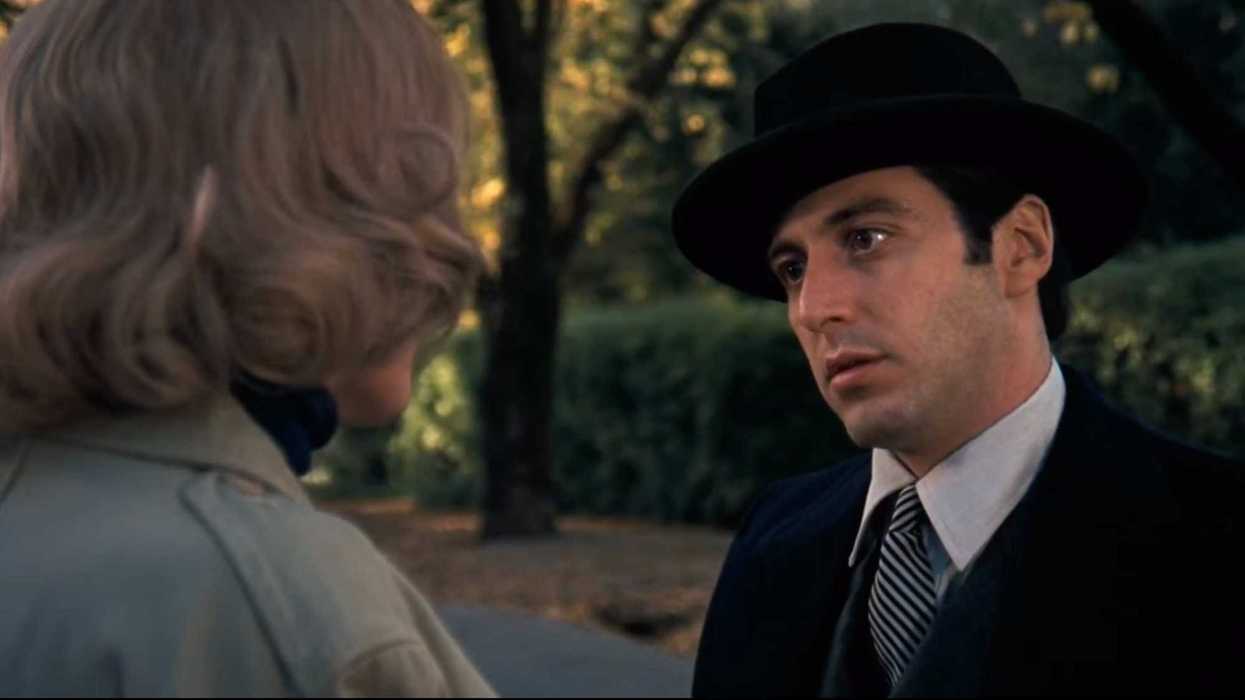
In The Godfather (1972), this moment is one of the few “soft” ones. It doesn’t have the searing edge of “Don't ask me about my business, Kay” and “Don’t ever take sides against the family" or the lethal weight of “I’m gonna make him an offer he can’t refuse.” In fact, this is kind of a sweet moment, actually.
Having ghosted her for over a year, Michael Corleone (Al Pacino) suddenly shows up on a New England leaf-strewn street and surprises Kay Adams (Diane Keaton). But this is not romantic rekindling. He is just showing up; no plans. He doesn’t quite look like a war hero, as Kay remembers. And she learns why when Michael tells her that he has joined his father, Vito Corleone (Marlon Brando), in the family’s crime business.
That’s a silent blow to Kay’s still idealized version of the American Dream, so she tries throwing him a lifeline: “You aren’t like your father.” But Michael isn’t having Kay’s distinction between legitimate and illegitimate. He has spent enough time away to learn that rules are just suggestions for those without enough leverage. He says his father is no different from other men with power.
Kay faults him, calls him “naive,” and says the legitimate, powerful men, the good guys—you know, the “senators” and “presidents,” and such—don’t have people killed.
Michael returns her jibe: “Oh! Now who’s being naive, Kay?” Well, he isn’t mocking her; he loves her. But he is stating his thesis: Titles only legitimize the power; they don’t sanitize it.
With those five soft, loving words, Michael dismantles Kay’s entire reality.
The Great Power Equalizer
Senators, Presidents, and the Family Business
When Kay says that Michael is not like his father, her underlying demeaning insinuation (towards Vito) doesn’t fly past him. He probably wouldn’t have tolerated this patronization from someone else, but it’s Kay, and he is aware of her idealistic worldview. After all, she is the daughter of a Baptist minister. So, he gives her a comparable reasoning: a leader is a leader, someone with power, and in that capacity, his father is no different from a senator or a president. He chooses to compare Vito with the highest offices in the land, which makes sense considering his love and respect for his father.
But the key takeaway here is that, by saying this, he evaporates the halo of prestige and gravitas that surrounds these public offices. He suggests that at the core of any leadership, be it legal or illegal, lies the same ruthlessness, and it is directed at protecting interests and maintaining order.
The Illusion of Legitimate Authority
How Kay reacts to Michael’s comparison of his “criminal” father with the likes of senators and presidents—the “respectable” public offices—is indicative of how common citizens think and what they believe. That comparison is downright ludicrous to her belief system; it shows in her giggle. She is clearly not willing to give his theory any consideration.
It’s interesting, actually, to see how much trust she has in the system. Michael once had it too; perhaps his wasn’t as “clean” as Kay’s, but he did. He fought for his country; it must take some level of trust in your system since you are fighting a war for it. But he is not that Michael now. He has become, or is becoming, someone who stands on the opposite spectrum.
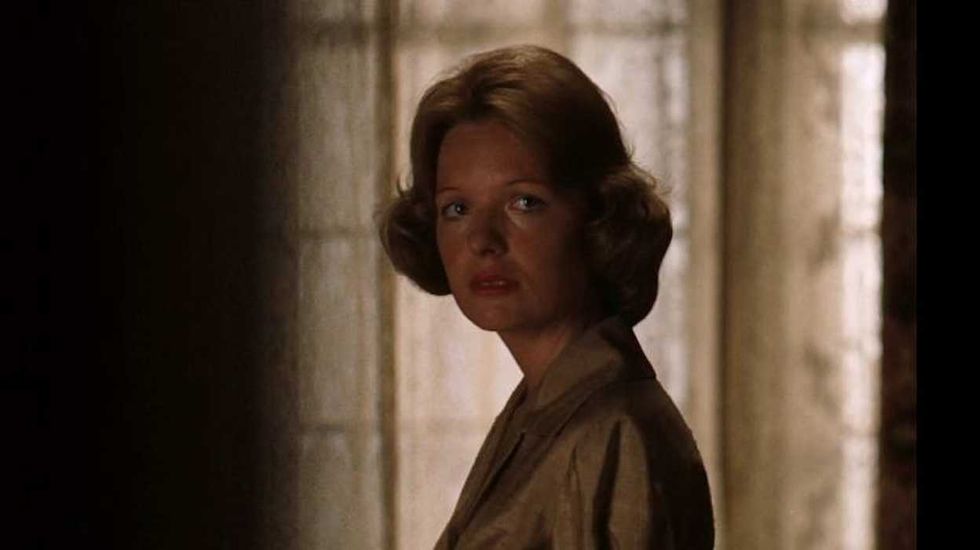 ‘The Godfather’ Credit: Paramount Pictures
A Lesson in Political Realism
“Now Who’s Being Naive, Kay?”
According to Kay, the government operates on morality, and the mafia operates on crime. Hers is a clean, black-and-white, and innocent world, which Michael sees as a fairy tale. According to his (newly forged) cynical, pessimistic worldview, “legitimacy” is nothing but just a coat of paint used to hide the same rotten machinery of violence and influence. So, when he responds, “Oh, now who’s being naive, Kay?” he is not throwing a comeback but giving her an education.
Also, it goes a bit deeper. Back in time, when he was a uniformed soldier, he followed the lead of those who ran the show. He may have been idealistic, but his leaders were not. Now, he has become the showrunner, but he is no longer an idealist. This is a lesson in the inevitable and intrinsically corrupt nature of power.
The Death of Michael’s Idealism
Take this scene as the final exit of the Michael you saw at the start of the movie. He is not the Ivy League boy with ideals in his heart and dreams in his eyes. This Michael stands in stark contrast to the Michael who said, “That’s my family, Kay. That’s not me.”
Here, when he defends his father’s methods as “standard practice” for any leader, he breaks away from his old self and justifies his new present and future. This moment points to the fact that Michael is not falling into this life; he is choosing it. And it makes sense, because he doesn’t believe that there is any other “clean” alternative.
Conclusion
This scene, and this line, aside from its “telling-off” vibe, also shows that Michael isn’t only not going to apologize for his heritage, but he is just not apologetic. He has found a solid belief system to justify what he is doing: Thinking that a political leader is different from a criminal leader is naivety.
And yet, on the other hand, his argument is not far off from reality. Sadly, we don’t live in Kay’s fairy tale; we live in Michael’s reality—the reality in which innocence is not a virtue, it’s just a lack of information.
- Vito and Michael Corleone’s 3 Defining Scenes in The Godfather ›
- Breaking Down Michael’s Kiss of Death in 'The Godfather Part II' ›
- ‘The Godfather: Part III’ and Michael’s Most Famous Line ›
- Michael Corleone’s Wardrobe Was the First Red Flag ›
- ‘The Godfather: Part II’: The Coldest Offer Michael Corleone Ever Makes ›
- ‘The Godfather’: Michael’s Quiet Threat to Fredo ›
- Decoding the “Sicilian Message” of ‘The Godfather’ ›
- How Closing a Door Rewrote Michael’s Fate in ‘The Godfather’ ›