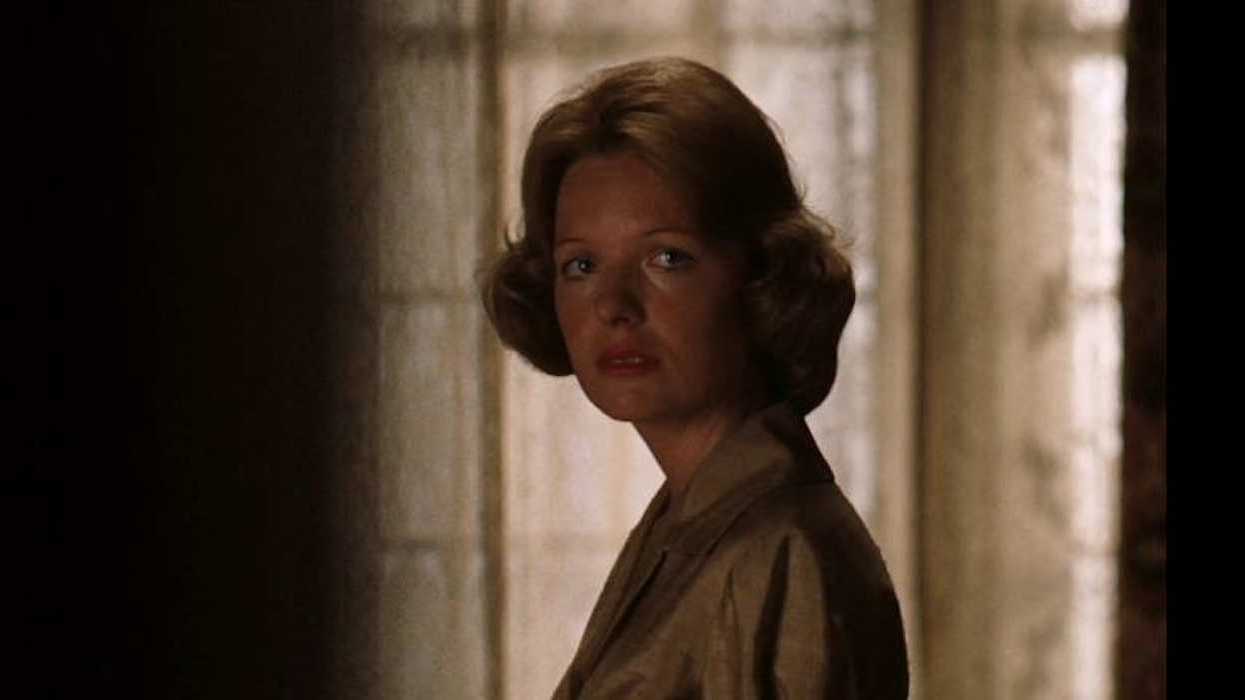
Some visuals carry a sense of permanence with them. In movies, such visuals endure because of the powerful imagery they carry within.
The ending shot of The Godfather (1972) gives us one such visual. With a simple closing of a door, director Francis Ford Coppola says everything that needs to be said about the film’s protagonist. The beauty of this scene is that it’s quiet, deceptively simple, and yet completely shattering.
With this door shut, a lie is exposed that was told just a few seconds ago, trust and hope are broken forever, and a soul is thrown, hurling towards its damnation.
Onscreen, the door shuts on Kay, but it traps Michael inside his new, dark fate.
Michael: The Promising Hero
To understand the gravity of the downfall of Michael Corleone (Al Pacino), we have to start with the hope that he once offered as Captain Michael Corleone—the golden boy, the war hero who stayed away from the world that would eventually consume him.
An Outsider by Choice
We first meet Michael at his sister, Connie’s (Talia Shire) wedding, where he enters with his girlfriend, Kay (Diane Keaton). Michael, a US Marine Captain, is dressed in his military uniform, which distinguishes him from everyone around. As if his antithetical image isn’t screaming that he is an outsider, he spells it out to Kay, saying, “That’s my family, Kay. That’s not me.” When he says it, he believes it, so does Kay, and so do we. He is the Golden Boy personified—the son who broke away from his mafia family.
The Dream of a Different Life
Kay is an ideal girlfriend, an ideal wife; a woman who comes from a respected family. As someone who comes from a dark background, Michael desperately wants to counterbalance his “familial drawbacks” with a promise of a bright future of lawfulness and decency. The fact that Kay continues to date Michael even after learning about his family is indicative of her trust in him. Because of who Michael is at the moment, Kay believes he can create a wall between them and his family’s sinister legacy.
 'The Godfather'Credit: Paramount Pictures
Michael: The Prisoner of Destiny
An attempt on his father, Vito’s (Marlon Brando) life, plunges Michael into a series of events that he never saw coming. As is the case with the crime world, every dark deed leads to another dark deed, and then there is no escape. That’s what happens with Michael.
Avenging Father
In the midst of solving differences between the feuding New York crime families, Vito is subjected to an assassination attempt. He barely survives but is increasingly indisposed to control the family business, let alone tackle the violent rivalry with other crime bosses.
The discussion about exacting retribution proves that Michael, the ultimate novice in the crime world, would be their best bet. Michael, like the loyal son he is, takes up the challenge and follows through with it. His first murder, his first taste of satisfying vengeance, gives him the motivation he needs to start being comfortable with what his family represents.
A Reluctant Heir
Michael’s retribution has put the Corleone family in a tight spot. One crime boss and one corrupt police officer are dead, but all the other crime bosses are not only alive but now aware that there is a new player in the game—Michael.
Vito is an ailing patriarch who can guide but cannot lead. Vito’s two sons, Sonny (James Caan), a hot-head, and Fredo (John Cazale), a weakling, do not have it in them to control the business. Sonny doesn’t survive his flair for impulsive actions, and Fredo, though bitter about it, does what he is told. That leaves Michael, the smart, restrained, and calculating man, to become the new don.
Michael: The Cold Devil
The final events leading up to the ultimate door slam are the defining moments in the making of Don Michael. From here on, everything Michael does is not out of helplessness; it’s out of sheer, cold drive.
The Baptism and Carlo Rizzi
Michael is now becoming an absolutist. He doesn’t like looming threats or even hints of insubordination. To finish what he started—to safeguard his family—he decides to take down the whole crime syndicate of New York City. As we see, in the now iconic baptism scene, Michael eliminates every crime boss one after another to become the only reigning monarch of the NY underworld.
Carlo Rizzi (Gianni Russo), Connie’s husband, is abusive towards her. As we have seen previously, these acts caused Sonny to publicly thrash and humiliate Carlo in one instance, and later plunge towards his own death in the second. But that was Sonny, the hot-head. When Carlo abuses Connie for the third time, he is dealing with Michael, the cold brother. Michael deals with Carlo the same way he deals with anything that may go out of hand. He has him killed.
The Lie
Connie gets wind that Michael might be responsible for her husband’s death, and she hysterically confronts him in front of Kay. After Connie leaves, Kay asks him if this is true. Michael, at first, angrily dismisses her, saying, “Never ask me about my business, Kay.”
This, according to me, is as good as a confession. I don’t need to know anything more. But I am not a desperate, doting wife. I don’t “need” to know Michael is innocent. Kay does. For her, a lot depends on this assurance. She needs it, and she insists on it. And Michael, knowing very well where she is coming from, gives her what she needs with a straight face—a reassuring lie.
Closing of the Door
After Michael says he had nothing to do with Carlo’s murder, Kay doesn’t linger on the subject. All she needed was to hear him say it. That’s enough for her. Visibly relieved, she accepts this fiction as reality and moves on and steps out of the room.
However, when she momentarily looks back, what she sees breaks down every wall of reassurance that was built just a moment ago. She sees Michael’s capos, including Clemenza, entering Michael’s room and paying him their respect. She hears them, who once referred to him simply as Michael, now referring to him as Don Corleone.
As she looks on, aghast, one of the capos closes the door in her disheartened face. With this door slam, the screen fades to black.
What Does the Closing Door Signify?
Shutting Out Humanity
In this scene, the door between Kay and Michael is a symbolic gateway between hope and doom, between love and hatred, between decency and immorality. When the door closes, both have lost something. Kay has lost the love, the bright future she was hanging on to. And Michael has lost the only hope of true happiness he could ever have had. By shutting Kay out of his sinister world, Michael has stepped on the path of no return.
The Prison of Power
By shutting Kay out of his world, Michael has locked himself in. The vicious circle of crime gave him the taste of power, dominance, and the feeling of invincibility, but at the cost of warmth, love, and genuine companionship. Like his father, he is going to be a ruthless leader, but it doesn’t seem like he is going to be the family man that his father was—or receive the love that his father did. He will forever be locked within the cold walls of the prison he built.
Cinematic Brilliance
The Mise-en-Scène
Coppola designed the setting in such a way that every shot, every angle, and every ray of light builds a devastating closure. He used the game of light and shadows to bring out the growing emotional isolation between Michael and Kay—Michael in the shadows and Kay caught up in the light.
The Power of Ambiguity
Coppola refuses to spoon-feed the meaning of the scene. He instead puts all his energy into giving us the powerful visuals and then leaves it up to us to expand on them. The scene, like the rest of the movie, endures because of his trust in the audience's ability to be insightful.
The Blueprint for the Modern Tragic Denouement
The scene has since become the go-to template for establishing the last act of a narrative: a subdued, symbolic image that ends with emotional destruction rather than spectacle. We can see, in several films, from gangster movies to dramas, stories falling into this narrative cast.
The Echo of the Door Closing
The film poses a question: Can a good person navigate the world of crime without being a part of it? This scene is the answer to it—and it’s a definitive and resounding “no.” Michael’s metamorphosis from a hopeful and idealistic outsider to a cold, isolated Don is completed with this simple door shut. This is the moment when Michael seems to have gained absolute power, but all we can see is that he has lost everything.
The scene still captivates us today because its theme is universal and timeless. How can our decisions and actions force us onto a path that we never wanted to undertake?
- The Godfather’s Cat: A Furry Accident That Made Film History ›
- 13 Brilliant Movie Character Arcs Ranked ›
- The Godfather Line That Changed Movie Dialogue Forever ›
- Friends Close, Enemies Closer: The Most Famous Lesson From 'The Godfather' ›
- Vito and Michael Corleone’s 3 Defining Scenes in The Godfather ›
- Breaking Down Michael’s Kiss of Death in 'The Godfather Part II' ›
- Michael Corleone’s Wardrobe Was the First Red Flag ›
- The Chilling Montage That Turned ‘The Godfather’ Into a Masterpiece ›
- Michael Corleone's Arc in 'The Godfather' Films Proves He's the Best ... ›
- How Films Come Full Circle: Endings That Mirror the Beginning ›
- The Power Shift: Analyzing the Michael Corleone vs. Moe Greene Showdown in ‘The Godfather’ ›
- The Calm Before the Storm: Analyzing Don Vito’s Lethal “No” That Ignites ‘The Godfather’ ›
- The Naive Kay Argument: The Moment Michael Corleone Became "Untouchable" ›