9 Movie Moments That Secretly Hinted at the Ending
These hidden foreshadowing moments reveal how filmmakers quietly told us what was coming much before we saw it.
'Get Out'
When we treasure hunt, we follow a trail of clues. Good storytelling is very much like that. It’s scattered with visual cues and pieces of information that lead us to the big finale, or at least something important. Your job as an audience is to locate them. And only those who realize that the real magic isn’t in explosions but in muted whispers can really understand the fun in this treasure hunt.
It’s called “foreshadowing.” It’s the art of concealing signs in obvious places, such as a dialogue, a background prop, or a seemingly inconsequential scene. When we look at these signs in retrospect, we can see the entire film in miniature.
The 9 scenes listed here cleverly and covertly imply a sinister turning point and suggest that the ultimate fate was always imminent in the story.
1. The Cave on Dagobah (The Empire Strikes Back, 1980)
Luke Skywalker (Mark Hamill) has a vision of Darth Vader (David Prowse/James Earl Jones) after entering a dark cave on Dagobah. In the vision, a scuffle ensues between them and ends with Luke decapitating Darth Vader. As Darth Vader’s head drops, it explodes, and Luke sees his own face inside.
This scene foreshadows on two fronts: The vision clearly tells Luke that if he submits to his fears, he will become Darth Vader, which, in a metaphorical way, compels him to face his greatest fear. And, more directly, it’s a clear premonition of the “I am your father” twist.
2. “You Don’t Listen” (The Sixth Sense, 1999)
Dr. Malcolm Crowe (Bruce Willis) and his wife, Anna (Olivia Williams), are going through marital problems. Anna always seems to complain, more like uttering to herself, that they no longer communicate. And yet, when Malcolm tries to communicate, she behaves as if she is not in the mood for it, as if she has broken all ties with him, as if he doesn’t exist.
It’s only towards the end that we come to know; she behaves like this (like he doesn’t exist) because he actually doesn’t exist. This narrative structure works because the twist is rooted in a realistic situation.
3. Tyler’s Appearance (Fight Club, 1999)
Before the movie’s big reveal, or even before the Narrator actually meets Tyler Durden (Brad Pitt) on a plane, Tyler’s image flashes on screen for a single frame in four key moments—at a hospital, a support group meeting, on pavement, and by a copy machine.
This is a clear cue for the Narrator’s psyche that is in free fall in real time. The Narrator is “creating” Tyler. A new, dominant personality is breaking through from the shy and submissive Narrator’s consciousness.
4. “Where is the Brother?” (The Prestige, 2006)
At the beginning of the film, a magician performs a bird-vanishing act. Upon witnessing it, a child in the audience starts crying, thinking the bird was killed in the act. Even when the magician brings back the bird, he remains convinced that the bird is dead. Alfred Borden (Christian Bale) tries to convince him the bird is alive by showing him a bird in the cage. The boy, having correctly guessed the secret of the trick, asks, “But where is the brother?”
This question and the “twin” birds are a straightforward foreshadowing of the grim secret behind Borden’s magic act—shared life with an identical twin, not a sophisticated machine.
5. The Coin Toss (No Country for Old Men, 2007)
When Anton Chigurh (Javier Bardem) plays a coin toss for a gas station owner’s life, his act tells us the central theme/philosophy of the movie: fate is unpredictable and cruel. This coin toss predicts every subsequent death in the movie.
This is an example of foreshadowing used as a clue for the philosophy rather than for a plot point. Using the “coin’s logic,” the randomness is presented as destiny rather than chaos.
6. Briony, the Unreliable Narrator (Atonement, 2007)
The movie starts with young Briony (Saoirse Ronan) finishing her play, titled “The Trials of Arabella,” on her typewriter. This scene presents her as a storyteller; someone who creates and controls the narrative.
This foreshadows her part in misrepresenting the incident between Robbie (James McAvoy) and Cecilia (Keira Knightley), which causes the tragic turn of events that destroy the lives of these two lovers. When old and successful, Briony again misrepresents the lover’s tragic fate as a “happy ending” in her autobiography and establishes herself as an unreliable narrator.
7. The Missing Cigarettes (Shutter Island, 2010)
In the movie, US Marshal Teddy Daniels (Leonardo DiCaprio) is frequently seen borrowing cigarettes and getting them lit by others.
A federal agent who is conducting an investigation is most likely to have his own pack of cigarettes and should be able to light them up whenever he wants. However, a patient in a psychiatric facility will have no such privileges for security reasons. This is how, every time Teddy asks for a cigarette and someone else lights it for him, it foreshadows Teddy’s reality: he is not an investigator; he is a psychiatric patient.
8. The Rehearsal (Black Swan, 2010)
We come across Nina’s (Natalie Portman) psychological crumbling quite early on in the movie. She is shown to obsess over perfection. It mirrors her ongoing mental collapse. Each of her slip-ups during the rehearsals hints at the impending identity fracture.
It must be noted how Aronofsky uses physical choreography to mirror Nina’s mental decay. It is a brilliant example of how performance art can foreshadow mental breakdown.
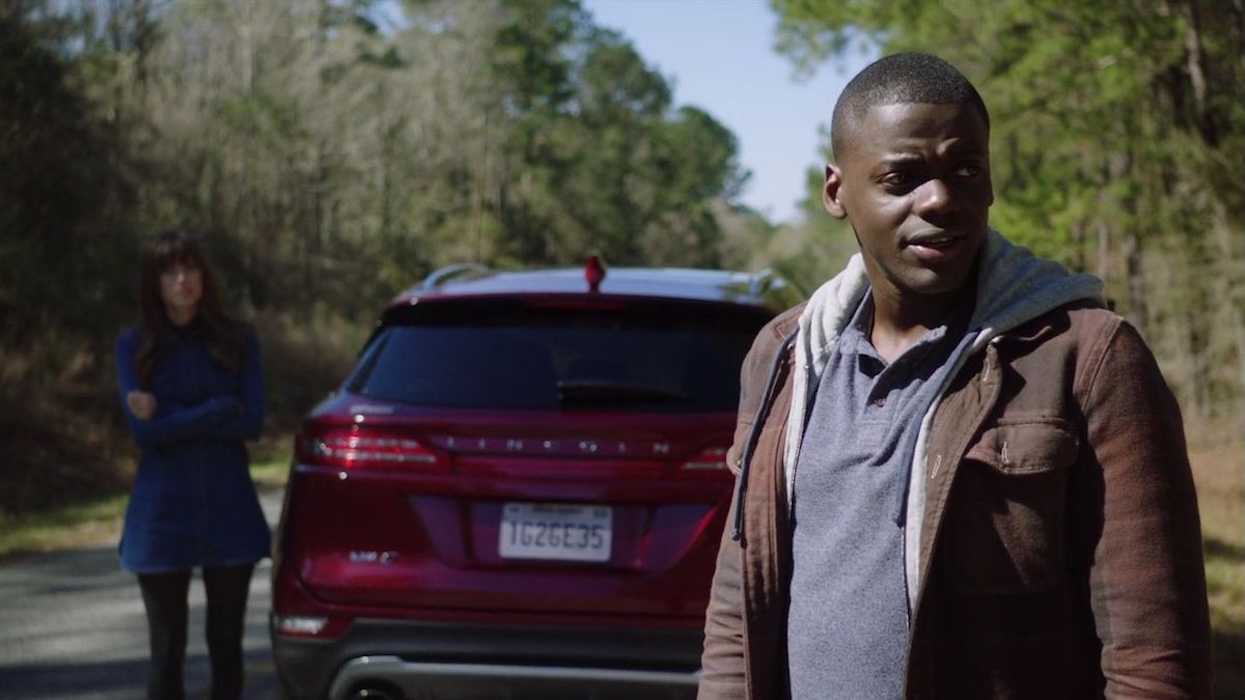
9. The Deer (Get Out, 2017)
Chris (Daniel Kaluuya) and Rose (Allison Williams) are driving to Rose’s parents’ house. En route, they hit a deer. The incident clearly shakes Chris up, but Rose is indifferent. She coldly dismisses it as something to be expected and insists that they should get going.
The scene is a lot more than just a jump scare. The deer symbolizes Daniel as a Black man. In the same way a hunter hangs a deer’s head on a wall, Rose’s family hunts Black people for their bodies. Rose’s indifference to the deer is indicative of her involvement in this nefarious tradition.
This shows how a minor incident can allude to the entire story arc. In one single scene, it shows the film’s central theme (the hunt), Rose’s true nature, and foreshadows the true horror that lies ahead.
- 11 Screenwriting Lessons from M. Night Shyamalan | No Film School ›
- Seeing Red: The Supernatural Signal in 'The Sixth Sense' | No Film ... ›
- Iconic One-Liner: “I See Dead People”: The Sixth Sense | No Film ... ›
- 'The Empire Strikes Back' Almost Had An Entirely Different Ending ... ›
- 'Get Out': Jordan Peele Reveals How to Get from Sketch Comedy to ... ›
- The Real Meaning Behind the Sunken Place in 'Get Out' | No Film ... ›
- Watch: Symbolism, Satire and Social Horror in 'Get Out' | No Film ... ›
- Watch: How 'Get Out' Gives Us a New Perspective on Horror | No ... ›
- Decoding the Chilling Symbolism of 'Get Out' | No Film School ›