Whiplash Ending Explained: Was It a Triumph, a Tragedy or Something In Between?
This article breaks down the film’s electrifying final scene and explores the shifting power dynamic between Andrew and Fletcher.
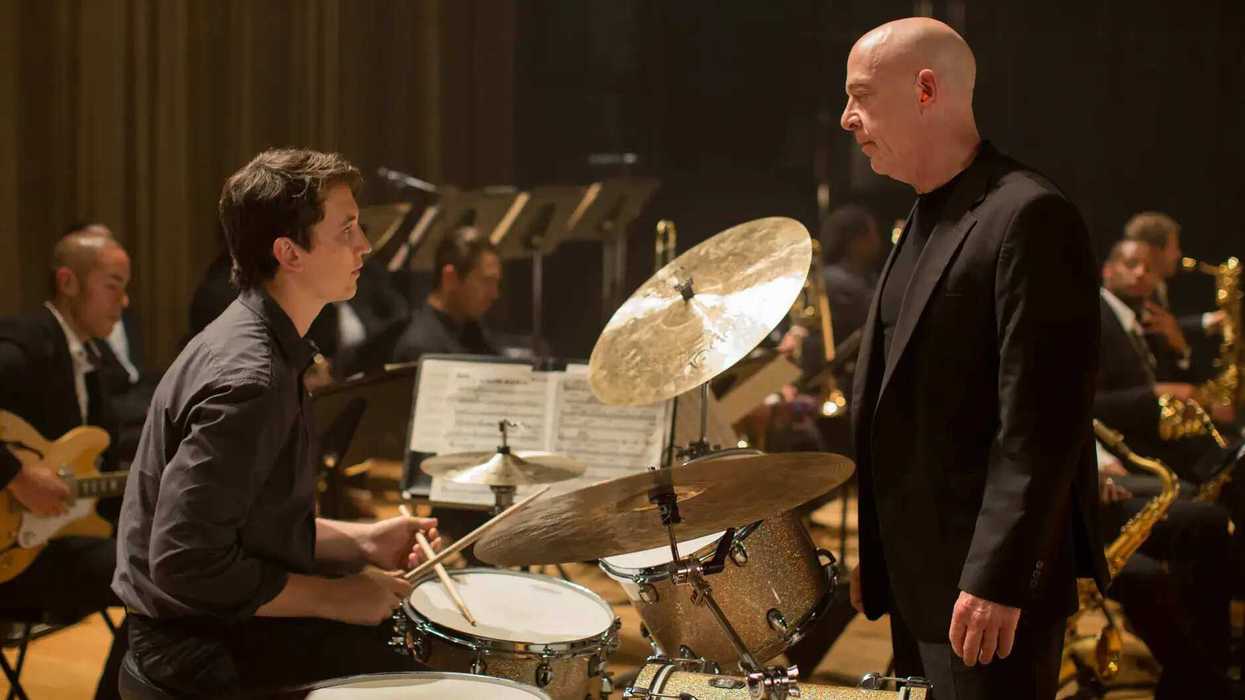
Whiplash (2014)
The climax of Whiplash (2014) is energetic and resounding. And more importantly, it doesn’t play it safe, much like the protagonist himself.
The humiliation that precedes his final performance has stripped Andrew (Miles Teller) of all inhibitions and confinements, and now he has nothing else to do but prove that his rightful place is on the stage. What seems like it could turn into an outburst or a garish act of revenge, unexpectedly becomes something quite hard to label.
The finale also serves as the moment for which the film saves its most potent questions. Of course, not just about the music but about control, ambition, and what people would trade in exchange for singularity.
Andrew’s act of launching into his final solo is an act of open defiance. With this act, the dynamic between them shifts from mentorship to ownership. And that shift is where the ending derives its energy from.
To a common eye, the ending might look like a regular high-powered climax, but it’s much more nuanced than that. And that’s because of the peculiar choices buried inside it.
Fletcher’s Motives Leading into the Finale
The relationship between Fletcher (J.K. Simmons) and Andrew is marked by persistent temperamental volatility. There is a lot of bad blood between them. What Andrew sees as Fletcher’s bullying, Fletcher considers as exacting mentorship necessary for creating true talent.
Fletcher is aware of Andrew’s testimony against him that resulted in Fletcher getting fired from his position at the prestigious Shaffer Conservatory. So when he warmly invites Andrew to play with his band at the JVC concert, he is not burying the hatchet; he is planning Andrew’s humiliation. This implies that beneath the “exacting mentorship” is Fletcher’s hunger for control and dominance.
After his band settles on the stage, Fletcher whispers to Andrew that he knows he testified against him, and promptly opens the concert with a chart Andrew has never seen before. This is a clear indication that Fletcher wants to embarrass Andrew on the stage that he dreams of ruling. His plan works. As the band begins to play, Andrew falls apart.
Andrew’s Decision to Return to the Stage and the Stakes Involved
After running off the stage, Andrew is completely shaken. But still, he leans into his humiliation and decides to come back. Here, his motive is to reclaim what was taken away from him. His dream.
But he has to be very careful. The JVC concert is a precipitous point for Andrew. It’s the highest platform he has ever been on to perform. If he performs well, his career can soar. If he doesn’t, it can nosedive. The atmosphere is grim, and the stakes are very high. Andrew knows this. He is also aware that, among everyone else on stage, he has the least experience. What’s worse, his defiance can easily be seen as a delusion, entitlement, and plain arrogance if he fails to deliver a performance of exceptional quality.
So, when he walks back on stage after the insult, he is bearing the emotional bruises that Fletcher gave him, but also the training he provided. However, what’s truly driving him is his desire to double down on his burning resolve to own the stage.
When it comes to satisfying Fletcher’s expectations, Andrew is still uncertain as he has always been. The only difference is that, right now, he doesn’t give a damn. He is anxious, he is angry, he is determined, but he is also confident that this performance will finally validate his efforts and accomplishments.
He not only starts playing without Fletcher’s permission, but also interrupts his address to the audience while doing so. It’s reckless, but he no longer needs Fletcher’s approval; now he is playing for himself. This small choice shifts the power dynamic between them, and Fletcher is forced to respond.
How the Band Reacts
The bandmates clearly register Andrew’s out-of-line actions, and it’s visible in their nervous, uncertain glances. And yet, they have also noticed the power shift between Andrew and Fletcher. At first, it’s a confusing moment for them, but when Andrew gains momentum, they start following his lead.
Here, it’s important to understand what their response signifies. It proves that the command resides, not in an authority, but in an authoritative performance. Andrew, simply by putting faith in himself, takes away the control from Fletcher.
Andrew’s Final Solo
Andrew’s solo in the end is symbolic of him taking sole control of his narrative. He is now refusing to be dictated by Fletcher’s authority or his petty sabotage. The solo is a bold statement that says Andrew could have walked off defeated, but he chose to come back and say his bit. And he said it in the language that Fletcher (and the audience) understands: music.
In that sense, Andrew’s final act is as much a performance as it is a personal declaration. It starts as an act of defiance, but grows into something steadier and more layered, only because he plays with clarity and passion instead of panic or grievance.
And Fletcher. His initial reaction to Andrew’s insolence is irritation. But when he recognizes the breakthrough Andrew is having, his displeasure turns into quiet support.
The solo’s fast repetitive patterns are also noted for their symbolic significance to the themes of endurance, timing, and precision. The way the band gradually aligns with Andrew’s lead indicates that he has become the driving force of the entire performance.
Conclusion
The finale of Whiplash stands out because it’s not a straightforward climax where drama intensifies, and loose ends fall neatly into place, giving us one single conclusion. Instead, it leaves room for uncertainty and multiple interpretations. It leaves the decision to the audience to understand what Andrew gained and what he lost.
This is as much Andrew’s solo moment as it is the moment of his dynamic with Fletcher. Neither of them fully comes out of this scene—which provides talent, ego, risk, and tension—as a winner.
- Learn the 5 Fundamental Ways of Using Sound in Your Film | No ... ›
- When Music Takes the Lead: 7 Films Where Sound Becomes Story ›
- This is What Good & Bad Editing is According to 3 Oscar-Winning ... ›
- Two Pro Editors Analyze the Editing in 'Whiplash' | No Film School ›
- Are 'Black Swan' & 'Whiplash' the Same Movie? Pretty Much. | No ... ›
- What Can We Learn from the 'Whiplash' and 'Black Swan ... ›
- Watch: How 'Whiplash' the Short Led to 'Whiplash' the Oscar ... ›
- Breaking Down the Oscar-Winning Editing of 'Whiplash' | No Film ... ›
- How ‘The Shawshank Redemption’ Quietly Set Up Its Ending Long Before The Escape ›
- Iconic Villain Moments: Terrence Fletcher - The Moment You Realize How Far He’ll Go | No Film School ›