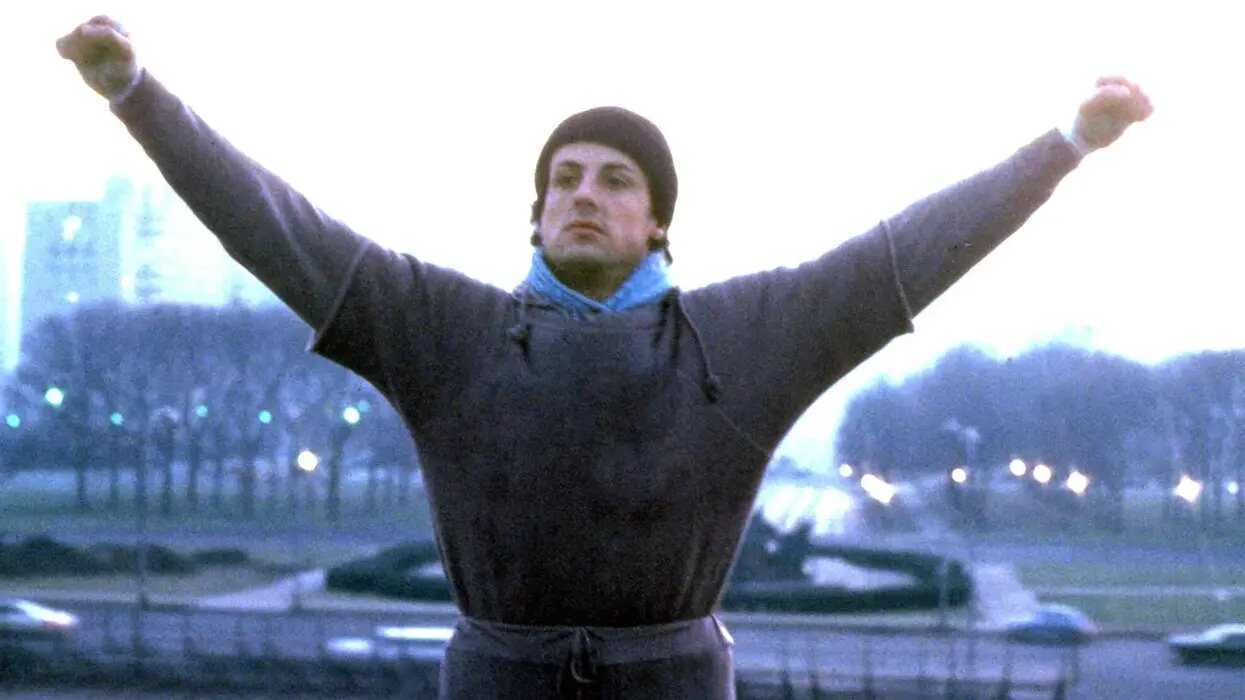
This story starts in 1969. 23-year-old Binky, a.k.a. Mike Stallone, has had a few stage appearances to his credit. Nothing noteworthy, though, for if it were, that act wouldn’t have been followed by weeks of homelessness and then a starring role in a pornographic movie. This $200 worth of stint later, Mike reverts to his original name, Sylvester, and moves to New York. Here, while being looked after by Sasha, his waitress girlfriend (and later wife), and doing menial jobs in places like a zoo and a movie theater, he tries to hone his writing skills.
The next six years pass by doing one-scene cameos and other uncredited roles—16 roles, to be precise. Then one day, he watches the “Muhammad Ali vs. Chuck Wepner” fight on a closed-circuit television in an L.A. theater. It gets him thinking. That night, he starts working on a screenplay. Three days later, the first draft is ready.
Henry Winkler, his co-star in The Lords of Flatbush (1974)—one of the four films in which Stallone had a starring role—takes the script to the executives at ABC. They like the script and purchase it immediately. However, the happiness sours when Stallone learns ABC is planning to hire new writers to redo the script. He implores Winkler to buy back the script. Fortunately, Winkler has recently struck big with ABC’s Happy Days, playing Fonzie, so he has the negotiating power. The script comes back home, but now what?
One important thing Stallone has learned: the script has potential, and this is the time to bet on himself. So, from here on, every time he approaches a producer, he makes it clear that the script comes with him as the lead. They are a package.
Sadly, that turns out to be a deal-breaker.
Filled with hope and enthusiasm, Stallone visits multiple studios in an attempt to sell his script. Everyone agrees that the script has serious potential. Stallone also insists on playing the lead himself.
And that’s where the talks end.
 'Rocky' Credit: Paramount
The High-Stakes Bidding War
The Rising Value of Stallone’s Exit
The situation was basically this: virtually a nobody in possession of a valuable story.
In Hollywood, thousands of writers pitch their stories every day, ultimately to end up in a trash bin. So, you can imagine how unique it is for a “virtual nobody” to find a buyer. Most producers offered Stallone a comparatively small compensation (around $25,000), expecting him to take it without another word.
Stallone didn’t mind the compensation, but his condition was to play the main lead.
The producers saw serious value in the script, so they also saw someone like Burt Reynolds, James Caan, or Robert Redford in the lead. Not a rando. So, they offered more money. And then some more. The price ultimately rose to $360,000, just for him to walk away and leave the script behind.
That’s almost $2.1 million in 2026—for a virtual nobody, who, by the way, was also starving. To put it into perspective, the highest-paid writers in Hollywood today charge $4-5 million for a script. And these are the crème de la crème writers we are talking about.
This should also tell you the kind of conviction a starving nobody must have to refuse that kind of money.
The Legendary “No”
Stallone’s destitute state immediately made his refusal to sell his script a talking point in the circle. He expressed to Sasha (his wife) his feelings about playing the part himself in these words: “I would rather bury the script in the backyard and let the caterpillars play Rocky.”
He couldn’t have said these words, especially in the midst of desperate times, if he didn’t have an intelligent understanding that the value wasn’t only in the writing; it was in the performance, too.
His conviction and patience paid off. By standing his ground, he forced the studio to take a massive risk on an actor with droopy eyes, a funny accent, and a crooked smile.
Production Hurdles and the Final Payoff
A Million Dollar Budget and a Dream
Stallone’s insistence on starring as the lead prompted United Artists to cap the production budget at a mere $1 million. And since necessity is the mother of invention, the cropped budget forced the production team to be creative.
For example, instead of spending money on the more expensive dolly shots, the newly invented and portable Steadicam technique was used for the iconic running scenes.
Since a professional animal trainer wasn’t budgeted, they used Stallone’s own dog, Butkus. In fact, Stallone had earlier sold Butkus when he had no money to feed him. When he got his first paycheck, he bought Butkus back for $40.
The Knockout Success
The gamble, both on Stallone’s and the studio’s part, paid off in ways no one had expected. Rocky became the highest-grossing film of 1976. It made north of $200 million at the box office against the $1 million budget.
It was also a critical success. It earned a whopping nine Oscar nominations, including Best Picture, Best Director, and two nominations for Stallone for Best Actor and Best Original Screenplay. It won three awards that night: Best Picture, Best Director, and Best Editing.
And just like that, a guy who once went hungry, who once slept at the Port Authority Bus Terminal, and who once did a porno movie for survival became a global icon overnight.
It would be very easy to credit all this to “luck,” which indeed plays a significant part in a glam industry like Hollywood, but in truth, there is no doubt that it was the success that came from his indomitable belief in himself and his dogged determination to follow his dream.
What Sylvester Stallone’s story tells us is that owning your work is more valuable than any one-time paycheck.
Conclusion
We often hear pep talks, such as “you alone can decide your own worth,” but how many times do we actually follow through? Most of the time, we don’t because we are too scared. We are too scared because we don’t believe we have it in us.
If you wanna know how it looks when someone has that kind of conviction, look at Stallone. He is simply the man who walked away from a fortune because he knew his worth wasn’t negotiable.
- How Sylvester Stallone Almost Died While Fighting Dolph Lundgren ... ›
- Rocky's Iconic Training Montage That Changed Movies Forever ›
- Rocky Balboa vs. Adonis Creed — Immigrant Dream vs. Inherited ... ›
- Rocky Isn’t a Movie About Boxing: Why It’s Actually Hollywood’s Greatest Character Study ›
- Are You For or Against Stallone Cutting the 'Rocky IV' Robot? ›
- Ranking the 'Rocky' Movies In Order of Greatness | No Film School ›
- Analyzing The Story Map: The Original Rocky Script - No Film School ›
- “If He Dies, He Dies”—The Most Cold-Blooded Line in the ‘Rocky’ Franchise ›
- The ‘Coach Carter’ Speech: Unpacking “Our Deepest Fear” ›
- Why Exactly Wasn’t Stallone’s ‘Over the Top’ a Bigger Hit When It Originally Came Out? ›
- 5 Iconic Roles Sylvester Stallone Turned Down ›