The Meaning Behind “We Don’t Need No Stinking Badges” in The Treasure of the Sierra Madre
An exploration of the “We ain’t got no badges” quote from The Treasure of the Sierra Madre (1948), and what it reveals about power, rebellion, and illusion.
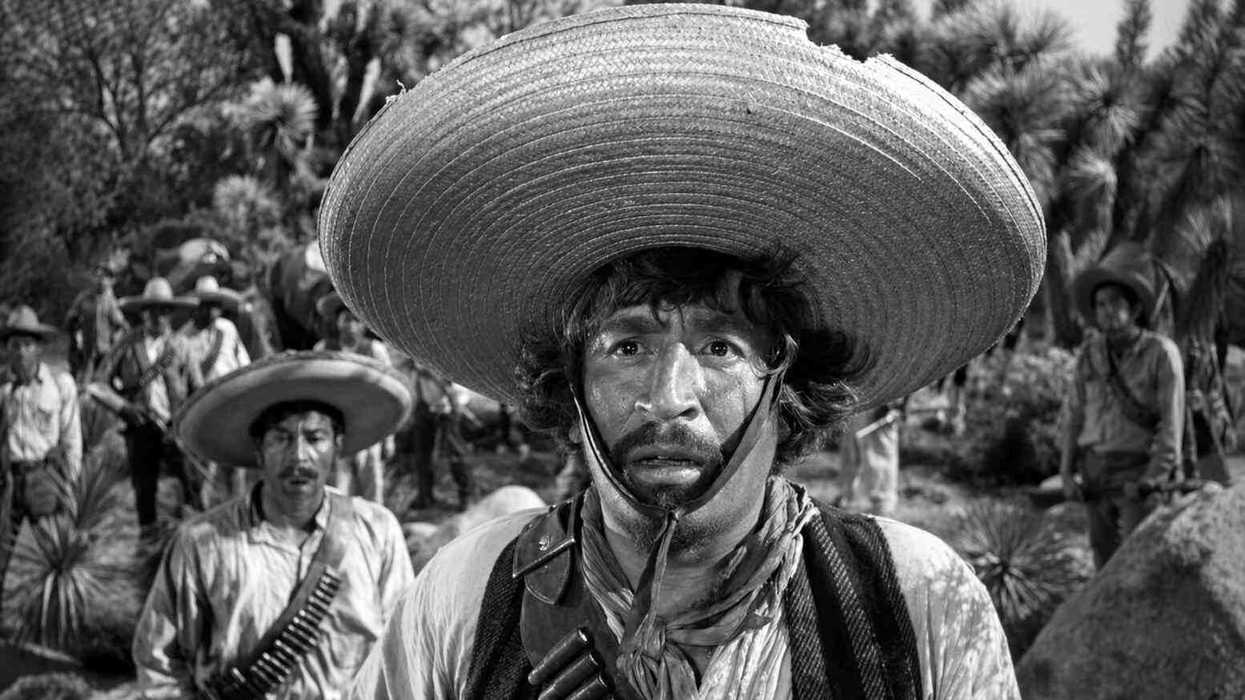
‘The Treasure of the Sierra Madre’ (1948)
In the dusty Mexican wilderness, a man with a wide-brimmed hat, claiming to be a member of the Guardia Rurales, is asked to produce his police badge. He doesn’t. Instead, he gives a dismissive response that literally breaks apart the entire concept of state authority.
This moment from The Treasure of the Sierra Madre (1948) unfolds more like a high-stakes glitch in the social contract than a scripted scene. Usually, we come across villains, especially in Westerns, who want to (and don’t hesitate to) break the law. What’s special about this man is that he doesn’t even acknowledge that the law exists.
There is no beating around the bush, no clever wordplay. His refusal to show his ID is his way of mocking the very idea that a piece of tin can hold any power whatsoever.
But why, after almost 80 years, is this confrontation still being discussed?
That’s because this moment created a vibe that has echoed through time and cinema. It’s messy and cynical (I mean, hello, it’s a Western), but weirdly, it also feels modern. A vibe that today we have gotten pretty used to. It goads us to ask a key question: When the safety net of civilization is replaced by raw survivalism, what exactly is it that makes someone “official”?
There is drama and tension in this moment, a threat of violence, but the heart of this quote is not just about that. It’s about the collapse of the labels we use to feel safe. When the badges—the symbols of legal and constitutional authority—are dismissed as “stinking,” the hierarchy of the world crumbles and rests at zero. Then all you have is desert and desperation.
The Scene
In 1925, Tampico, Mexico, two broke drifters, Fred C. Dobbs (Humphrey Bogart) and Bob Curtin (Tim Holt), having recently been tricked into gratuitous hard labor, come across Howard (Walter Huston), an aging but talkative old-timer who has traveled a significant amount in search of gold. Howard puts the idea of gold prospecting in their heads. Driven by this idea, Dobbs and Curtin collect the bare minimum funding for the expedition by fighting the employer who didn’t pay them and also hitting a small jackpot in a lottery. They use the money to buy supplies and weapons for their prospecting.
At one point during their journey, they are ambushed by dangerous bandits, led by the notorious Gold Hat (Alfonso Bedoya). They intend to barter, essentially steal, the prospectors’ firearms since the gang is poorly armed. At first, Gold Hat introduces the gang as “Federales,” the mounted police. When Dobbs demands to see their badges, Gold Hat is first confused about how to bypass this “technical glitch” in his deception. He says, “Badges? We ain’t got no badges.” Then his instinctive confusion is replaced by a confident lie: “We don’t need no badges.” And finally, spotting the futility in the diplomacy, his true instincts come to the surface, and he impatiently says, “I don’t have to show you any stinkin’ badges!”
The Anatomy of a Confrontation
The Power of the Pivot
The key moment in this confrontation is how Gold Hat transitions from a fake, oily politeness to pure, unmasked aggression. His initial attempt to lower the prospectors’ guards and gain a psychological advantage fails when he is pushed for physical evidence. This “complication” prompts him, as it would any crude delinquent, to snap and show his teeth.
This behavioral pivot underlines the fragility of authority. It shows that power is often just performance. It falls apart if someone calls your bluff.
Performance: Accuracy vs. Impact
Many people misquote the line simply as “We don’t need no stinking badges.” As you can see, the line is a bit more nuanced than that. Instead of one simple statement, it has a tiered emotional escalation. It has a rhythm and desperation.
Alfonso Bedoya’s delivery also plays a crucial role; you can feel his chaotic energy from his facial expressions, body language, and voice modulation. You can see the journey of his mental state: that little eye movement when he says, “Badges? We ain’t got no badges.” It feels almost comedic. A bit innocent even, like a child’s lie. The next sentence shows the aggression building up. And in the final sentence, the transformation—from innocent to unhinged—is complete. His voice completely changes. Now, this is the voice of a rugged, belligerent criminal that he really is.
This raw delivery makes Gold Hat’s absolute rejection of the law feel visceral and dangerous rather than just a catchy, sanitized movie slogan.
The Illusion of Authority
Paper Shields in a Lawless Land
When Dobbs, hiding behind a rock and aiming his gun at Gold Hat, demands to see his “badge,” he is essentially clinging to the ghost of a civilized society. The badge is a symbol of a “state,” and Dobbs thinks it can protect him. But he is forgetting that he is in a wasteland where the state has no eyes. Gold Hat’s and his gang members’ laughter points to that sad hopefulness. This is the place where a metal plate is useful in absorbing a bullet, not injustice.
The Bandit as a Truth Teller
It may sound strange, but Gold Hat, the bandit, is the most honest person in this scene. He tries to deceive at first, but almost immediately gives up the act and stops pretending to follow any legal or moral code. He is a creature of pure utility. When he refers to the badges as “stinking,” he is forcing Dobbs and other “heroes” to face the reality of their situation: survival won't favor those who are carrying the right paperwork, but those who are carrying the guns. Stealing their guns is Gold Hat’s primary objective anyway, and his demeanor cuts all the fluff and highlights that fact.
Conclusion
On the surface, it may sound like a regular confrontation, but the line is actually a reflective mirror that shows us our collective (and misguided) perception of the “official” version of the truth. We usually hold it in high regard but fail to realize that it’s a flimsy agreement that can vanish in a cloud of desert dust when someone chooses not to believe in it. The whole act of “legality” stands on the foundation of an illusion.
Now we (or at least most of us) aren’t outlaws or criminals, but every now and then we find ourselves laughing at a rule that makes no sense in the real world. Gold Hat just happens to be candid enough to say it out loud.
- Story of the Rise, Fall & Wild Comeback of the Western Genre ›
- 15 Western Movie Tropes: The DNA That Defines the Genre ›
- The 13 Best Westerns of the ‘90s: Ranked ›
- The 8 Best Westerns of the ‘80s: Ranked ›
- 10 Best Westerns of the 1970s: Ranked ›
- Beyond the Iconic Line: “Here’s Looking at You, Kid.” – Casablanca ›