10 Coldest “Before I Kill You” Lines in Hollywood Cinema
From cold threats to ironic farewells, these quotes define the most savage, ruthless characters in cinematic history.
'True Lies' (1994)
In most drama-driven action movies, there comes a moment when someone is cornered, held hostage, makes a vengeful return or promises to do so, or is in a situation involving a standoff or deception. People involved are usually driven mad with fury, or they are just mad, period. Sometimes they are not mad; they are a picture of chilling coldness. Either way, violence feels assured.
Now, the thing is, we do like violence. (There is no point believing we are a peace-loving species.) And we like it the way we like our enchiladas—with a burst of chimichanga. In the “violent” context, chimichanga is that line that comes before the main event. Those few words “slay” the manslaughter and make it more savory.
These verbal snapshots are not really plot points but are the symbolic fruition of those. The ultimate flex. They come in different varieties, from witty one-liners to chilling promises of doom.
We poked around a little in our cinema history to find such “chimichanga” lines that exude a “cool” vibe. (Or “crazy,” whatever. Potato, potahto.) So, let’s learn how to make a savage exit.
Cinema’s 10 Chilling Final Threats
1. “No, Mr. Bond, I expect you to die!” (Goldfinger, 1964)
Delivered by: Auric Goldfinger (Gert Fröbe)
Written by: Richard Maibaum, Paul Dehn | Directed by: Guy Hamilton
Auric Goldfinger (Gert Fröbe) is holding James Bond (Sean Connery) captive. He has him strapped to a table with an industrial laser (that can cut through solid metal), slowly creeping towards him. Bond tries to call his bluff and asks, “Do you expect me to talk?” What comes next is one of the rare moments when the villain sounds more “drip” than 007. This line is an ultimate subversion of the typical villainous monologue. No sadistic relishing by explaining the “evil plan," no chest thumping, no BS. Straight dismissal. Iconic!
2. “Do you feel lucky? Well, do you, punk?” (Dirty Harry, 1971)
Delivered by: Harry Callahan (Clint Eastwood)
Written by: Harry Julian Fink, R.M. Fink, Dean Riesner | Directed by: Don Siegel
Inspector Harry Callahan, a.k.a. Dirty Harry (Clint Eastwood), stands over a wounded robber, who’s thinking of making a move by grabbing a gun that’s lying next to him. Harry creates uncertainty regarding how many bullets, if any at all, are left in the gun he is pointing at the robber. Ultimately, he boils the suspense down to “serendipity.” Move, if you are feeling lucky. Simple and powerful. This moment is also a typical example of how Dirty Harry plays mind games with his targets, or prey, prodding them to gamble their own lives.
3. “Say hello to my little friend!” (Scarface, 1983)
Delivered by: Tony Montana (Al Pacino)
Written by: Oliver Stone | Directed by: Brian De Palma
Tony Montana (Al Pacino) is trapped in his mansion as his enemies close in on him. Cornered, he turns into a wounded tiger and unleashes unhinged violence, starting with his “little friend,” a grenade launcher rifle. Packed with pure adrenaline, this line works because it personifies the weapon and presents it as Tony’s partner-in-crime. And it’s Al Pacino; you can always rely on him for a passionate, berserk delivery.
4. “I’ll be back.” (The Terminator, 1984)
Delivered by: The Terminator (Arnold Schwarzenegger)
Written by: James Cameron, Gale Anne Hurd | Directed by: James Cameron
T-800 (Arnold Schwarzenegger) is looking for his target to eliminate, but the police clerk is not helpful enough to let him do his job. T-800 (famously) promises to return, and he does—with a bang. The magic of The Terminator lies entirely in T-800’s mechanical, robotic menace, and that is on full display here. The phrase became so iconic that it soon earned the status of a declaration of persistence. Also, in terms of characterization, it perfectly highlights the evil machine’s lack of emotions and its unstoppable nature. Schwarzenegger’s steely personality doesn’t hurt.
5. “I’m here to kill you, Little Bill.” (Unforgiven, 1992)
Delivered by: William Munny (Clint Eastwood)
Written by: David Webb Peoples | Directed by: Clint Eastwood
William Munny (Clint Eastwood), a retired killer, enters a saloon to avenge the murder of his friend. The corrupt sheriff, Little Bill (Gene Hackman), questions his character and intent. Munny simply states the facts and then does the job. Characteristic of Eastwood’s screen persona, Munny engages neither in bravado nor flourish. Ironically, that minimalism is what makes it so heavy. Like all Eastwood Westerns, this one strips away the romanticism of the Old West and gives cold, impending doom.
6. “I’m your Huckleberry.” (Tombstone, 1993)
Delivered by: Doc Holliday (Val Kilmer)
Written by: Kevin Jarre | Directed by: George P. Cosmatos
In this Western, Johnny Ringo (Michael Biehn) is the new leader of a criminal gang of outlaws. He challenges Wyatt Earp (Kurt Russell), the designated lawman, to a duel and ends the conflict once and for all. Ringo, a great shot, is confident he’ll beat Earp. However, much to his surprise, it’s Doc Holliday (Val Kilmer) who shows up. Holliday is the only man who can beat Ringo, and it shows on Ringo’s face. Holliday, knowing his reaction, formally presents him as his opponent and then shoots him in the head shortly after. In the 19th century, this phrase was used to imply willingness to take on a task or a challenge. In this scene, it works as both a polite greeting and a cold promise. It also perfectly captures Holliday’s daredevil attitude towards his own mortality.
7. “And you will know my name is the law when I lay my vengeance upon thee.” (Pulp Fiction, 1994)
Delivered by: Jules Winnfield (Samuel L. Jackson)
Written by: Quentin Tarantino, Roger Avary | Directed by: Quentin Tarantino
Jules Winnfield (Samuel L. Jackson) recites this fictionalized Biblical passage to a terrified punk before he shoots him dead. This line is pure poetic intimidation. Staying true to his iconic persona, Jules not only justifies but deifies his violence. He presents himself as God, not just some sort of divine mercenary. That speaks volumes about his narcissism and delusions—and flair for theatricality. Jackson’s rhythmic and increasingly booming delivery indeed creates a sense of judgment that no one can escape.
8. “Long live the king!” (The Lion King, 1994)
Delivered by: Scar (Jeremy Irons)
Written by: Irene Mecchi, Jonathan Roberts, Linda Woolverton | Directed by: Roger Allers, Rob Minkoff
In this beloved Disney classic, Scar (Jeremy Irons) orchestrates little Simba’s (Jonathan Taylor Thomas) murder by having him trampled in a massive wildebeest stampede. Mufasa (James Earl Jones) saves Simba, but while trying to escape, Scar pushes him into the stampede while mockingly saying, “Long live the king.” This celebratory phrase suddenly becomes vicious because of who says it and when it is said. It’s a cold and calculated moment of treachery that defines Scar’s character.
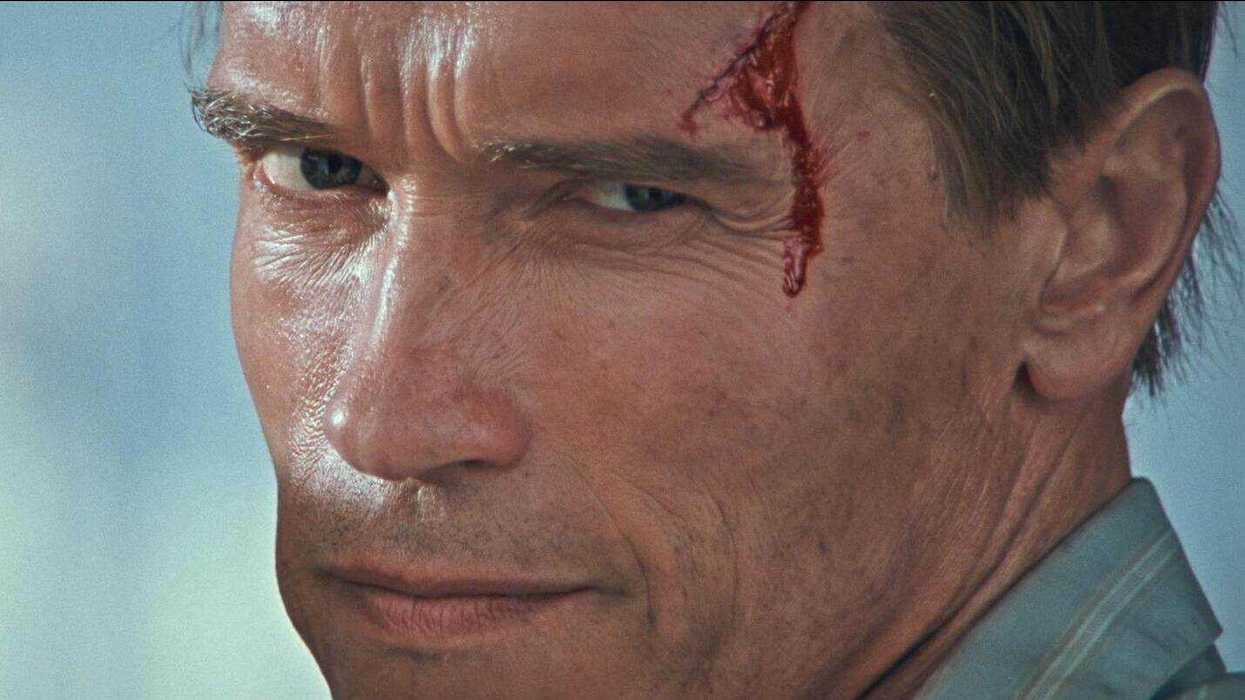
9. “You’re fired!” (True Lies, 1994)
Delivered by: Harry Tasker (Arnold Schwarzenegger)
Written by: James Cameron | Directed by: James Cameron
Secret agent Harry Tasker (Arnold Schwarzenegger) has the main villain, Salim Abu Aziz (Art Malik), caught on a missile attached to the jet he is flying. Salim’s fate is sealed; both know it. That mutual knowledge materializes when Harry says this corporate-themed quip just before pulling the trigger. Filled with the classic ‘90s vibe, the line adds a layer of dark humor to a high-stakes sequence. A hero must be lethal but also witty. Right?
10. “You should have gone for the head.” (Avengers: Infinity War, 2018)
Delivered by: Thanos (Josh Brolin)
Written by: Christopher Markus, Stephen McFeely | Directed by: Anthony Russo, Joe Russo
Thor (Chris Hemsworth) is divinely and “thunderously” quick in driving his enchanted Stormbreaker into Thanos’ (Josh Brolin) chest. Thanos, however, survives long enough to be able to snap his fingers and make half the world go kaput. And he doesn’t miss the chance to mock the God of thunder: “You should have gone for the head.” This highly anticipated climax famously turned a moment of victory into a soul-crushing defeat. Much to the shock of the audience, it took out multiple high-profile characters, including our beloved Spider-Man (Tom Holland). This moment served as a chilling prelude to the most devastating “kill” in modern blockbuster history.
- Story of the Rise, Fall & Wild Comeback of the Western Genre ›
- The Psychological Brilliance Behind Doc Holliday’s Iconic “I Have Two Guns” Response ›
- What Does 'I'm Your Huckleberry' Mean From 'Tombstone'? | No Film School ›
- The Meaning Behind Pulp Fiction’s “Royale with Cheese” ›
- Everyone Misunderstands the Hand-Drawn Joke in 'Pulp Fiction' ›
- The Wolf’s Goodbye in 'Pulp Fiction': One of The Coolest Exits Ever Written ›
- Clocks and Katanas: Breaking Down the Iconic Basement Sequence in 'Pulp Fiction' ›
- The 13 Best Westerns of the ‘90s: Ranked ›