How a “Damaged” Camera Helped ‘McCabe & Mrs. Miller’ Redefine the Western
Vilmos Zsigmond’s unconventional method turned flaws into poetry and redefined how Westerns could look and feel.
'McCabe & Mrs. Miller’ (1971)
For decades, Westerns (i.e., the classic ones) were defined as much by their gritty soul as by their clean, high-contrast surfaces. That polished exterior fed neatly into the black-and-white moral divide between heroes and villains. But something shifted on the eve of the ‘70s.
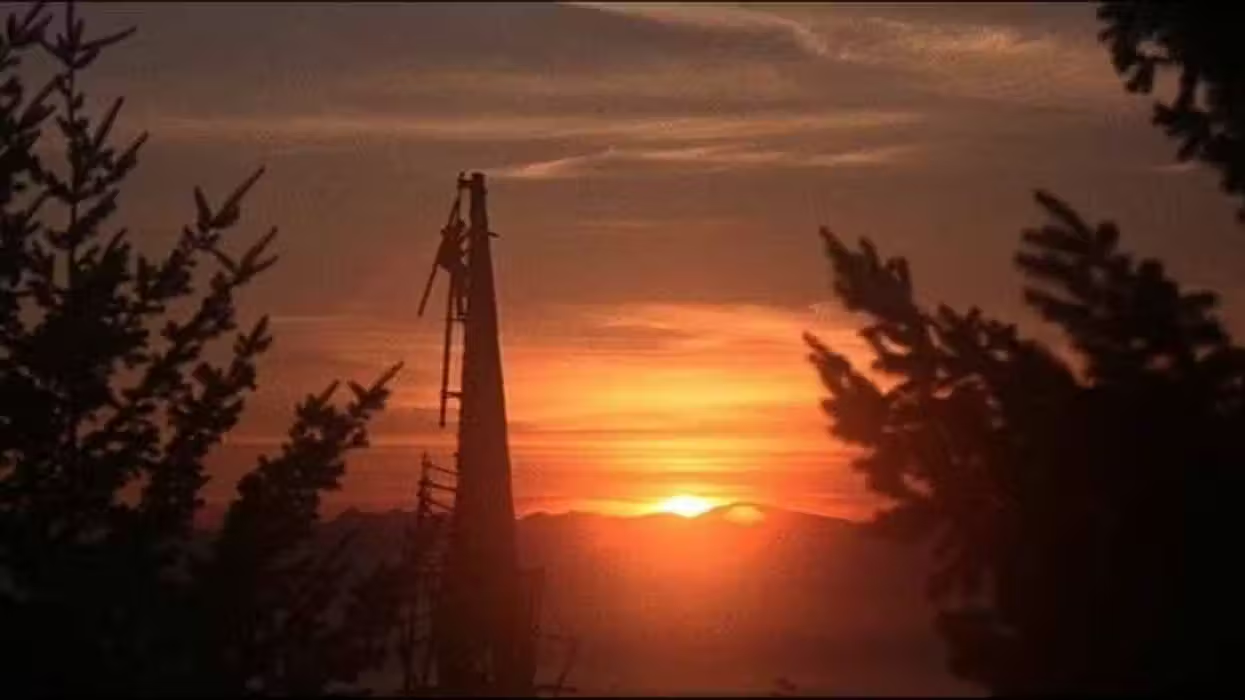
Audiences watching McCabe & Mrs. Miller (1971) felt it immediately. Something was disrupting their subconscious expectations of what a Western should look like. The images were hazy, the colors felt drained, and the frames were incredibly soft. The atmosphere felt so thick you could almost reach out and touch it. It felt more like a faded memory pulled from a dusty attic than a movie. Something was off. Not broken, but unsettled. And in the best way possible.
This was no accident. It was Vilmos Zsigmond’s deliberate artistic vision taking shape. And its philosophy was simple: Chase truth, not technical perfection. To get there, he pushed conventions and even “manhandled” the film stock—something that cinematographers are trained to “handle with care.”
In the end, he not only captured a story but also fogged the lens of history to make the past feel present.
Breaking the Western Image
The Problem With “Clean” Westerns
Traditionally, Westerns had a specific image to uphold: masculine, rugged, and edgy. In terms of camera work, that image translated into visuals that were crisp, high-contrast, and bright. Such visuals definitely created drama, but they also looked controlled. Almost staged. And that really was never a problem, since all of this worked smoothly into mythmaking, and Westerns are all about the myth of the Old West.
However, Robert Altman had a different vision for McCabe & Mrs. Miller. He wanted to step out of the myth and into realism. He was aiming for something that felt like a lived-in experience rather than a fever dream of the frontier. He wanted to blur the lines between elements that usually stood in stark contrast to each other. He wanted to emphasize small details such as dirt, fog, and dim interiors to make the whole experience more intimate rather than intense. So, out went the clean image that would have betrayed this intention.
A Cinematographer to the Rescue
Vilmos Zsigmond, who was until then known for a series of low-budget exploitation and B-movies and somewhat of a breakthrough film, The Picasso Summer (1969), created a specific philosophy to align with Altman’s vision: cinematography as a tool for interpretation rather than documentation. He decided not to preserve clarity for the sake of it. If the story, characters, and situations felt uncertain, what good is clarity? That uncertainty should be reflected in images, too. But how does one go about it?
And it struck him. What if, instead of correcting visual “flaws,” they were made into the focal point?
Flashing: The Art of Breaking the Negative
Flashing Technique: What It Actually Means
Flashing, or pre-fogging, is a technique that is used to reduce contrast and mute colors. It involves exposing the film (negative) to a tiny amount of light before it even goes into the camera. What it ideally does is raise the “black point” of the image.
Black point is the threshold that defines the darkest part of a picture. To better understand, think of a scale from 0 to 100, where 0 is absolute, pitch-black darkness and 100 is pure, blinding white. The 0 is the black point. When cinematographers “raise” the black point, they essentially tell the image that “true black” no longer exists. In other words, darkest shadows, instead of being deep, dark, and void-like (0), enter the dark gray territory, say, a 10 or 15. That’s raising the black point.
When the darkest shadows become milky and grey, the contrast is effectively lowered. As a result, you get a hazy, romantic, dreamlike texture with softened edges. And such texture on rugged mountain scenery looks very intriguing. It’s a different kind of contrast.
The credit for the earliest use of this technique goes to Freddie Young, who’s a three-time Oscar recipient for Best Cinematography—Lawrence of Arabia (1962), Doctor Zhivago (1965), and Ryan’s Daughter (1970). However, it was Vilmos Zsigmond who truly refined and popularized the technique in the early ‘70s, starting with McCabe & Mrs. Miller.
Visual That Look Wrong But Felt Right
The standard practice in cinematography is to maintain and protect the contrast and clarity. Zsigmond went in the opposite direction, toward a muted palette and hazy texture. For example, the snow looked dense, not crisp. Interiors felt smoky when they weren’t. When the executives at Warner Bros. saw the dailies (rushes) of the film, they went into panic mode. For them, the footage was “underexposed,” and thus, “ruined.” They even sent memos regarding this “catastrophe.”
However, Zsigmond stuck to his guns. He knew this “mistake” was actually the message. The film looked like an old, hand-tinted photograph—but that’s exactly what the motive was. Finally, the executives bowed down to Zsigmond’s visual language, and it paid off.
Crafting a Wintry Dreamscape
Painting with Desaturation
Obviously, this visual nostalgia wasn’t the product of flashing alone. The team also used heavy filtration and muted production design to more seamlessly lean into the palette of brown, grays, and deep blues. This absence of vibrant colors made the Pacific Northwest setting feel cold and oppressive. It replaced the natural lighting of a traditional bright yellow sun (typical of Westerns) with one that felt diffused but still organic. It felt like the sun was struggling to break through the constant snowfall.
Impact on Revisionist Cinema
This experiment helped birth the “Revisionist Westerns” era and, consequently, its distinct and highly influential form, the Spaghetti Westerns. These Westerns made their world look weathered and imperfect. They presented a more nuanced and layered (complex) version of the Old West. The cinematography mirrored the story’s gritty, cynical nature.
For years, filmmakers avoided any factors that would make the film “pretty,” but Zsigmond proved that a Western could look beautiful without prettifying it. It also encouraged cinematographers to prioritize mood over clarity. This was the trend that ultimately defined the aesthetic of the “New Hollywood” movement throughout the decade.
Conclusion
Today, when you watch a modern film and notice that it’s leaning more toward texture instead of sharpness, make sure to pay homage to McCabe & Mrs. Miller. Because it’s this film that dared to transform an apparent “technical disaster” into a cornerstone of high-art cinematography.
I am sure you know (and believe) that perfection is overrated. The real beauty lies in the little flaws. That’s why a scar becomes irresistible, wrinkles add dimensions, asymmetry gives personality, and handcrafted pottery fetches a higher price than an assembly-line product.
Sometimes, the beauty is in embracing a well-timed mistake.